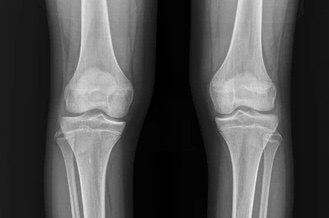
Quick Answer: The only 100% accurate way to know if your growth plates are closed is through a medical X-ray (usually of the hand, wrist, or knee). On an X-ray, open growth plates appear as dark, clear lines, while fully closed plates appear as solid white lines. You can evaluate your growth by checking if your height has remained the same for 1 to 2 years.
Many people start noticing the height when they aren’t growing or have reached the age when height stops increasing. Some people find it natural, while others think it’s a problem with growth plates, so they search for how to know if growth plates are closed. So if you are also curious why you stopped growing, then don’t worry; you aren’t alone. While the internet is filled with myths, it’s crucial to understand your own situation to determine whether your growth has stopped due to factors such as injury, age, or other reasons.
In this comprehensive study, we will understand all the reasons in detail, like the science of skeletal maturity, the exact timelines for bone fusion, and how to accurately determine if your windows for physical growth are still open.
What Is a Growth Plate and What Is Its Role?
Before moving forward on the main question, how do we know if the growth plate is closed? We first need to understand what a growth plate actually is. Well, a growth plate in medical terms is known as an epiphyseal plate, a cartilage plate at the end of each long bone. During the years when a child is growing, these plates prepare the blueprint of skeletal structure. They work like mini departments: the cells in cartilage divide, stack, and mature continuously. Later these cells die and are replaced by hard bone tissues; this process is known as endochondral ossification. This process of creating new bone tissue is what makes a physical adult stature possible.
Growth plates will never be open forever; the main sign of a growth plate that completely stops is the dependence on your endocrine system. As you grow, the main hormones such as estrogen and testosterone experience changes. These hormones carry a biological countdown timer for your skeleton. When we age, the level of estrogen increases, which leads to growth plates slowing down production.
Timeline of Skeletal Maturity & The Sequencing
Growth plates do not remain open indefinitely, and skeletal maturation is not an overnight process. However, it is a highly known process that spans across adolescence and into early adulthood. While every person has a different pattern and biological clock, the timeline for growth plates is completely based on biological sex and specific anatomical locations.
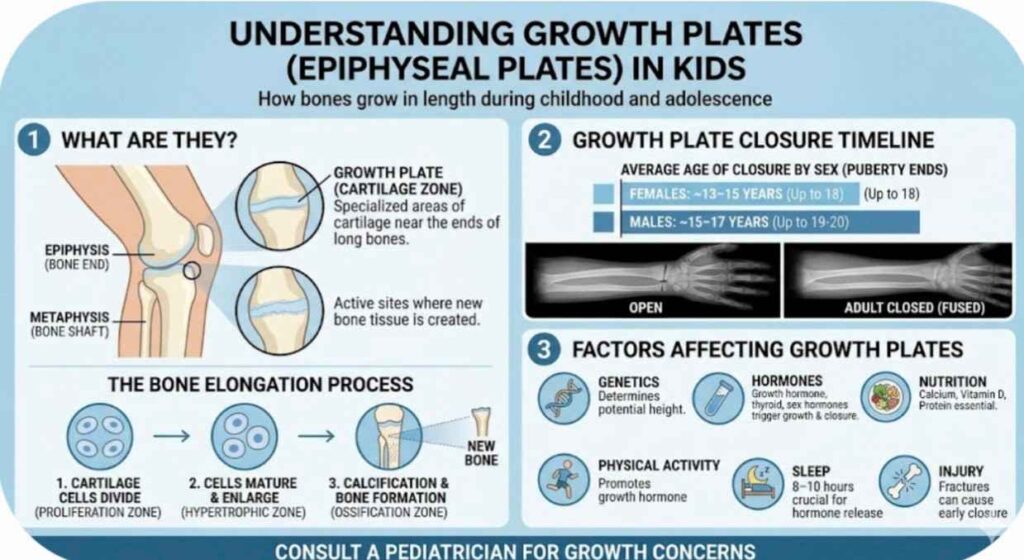
At What Age Do Growth Plates Actually Close?
A normal human skeleton finishes building and completely grows by the end of the teenage years. However, when puberty begins, it is a completely different time for everyone, as chronological age doesn’t always indicate the skeletal age. The change from bone to a completely heavy, long structure is caused and dictated by biological sex, due to the varying timing and hormonal changes.
Growth Window Status Checker
Estimate if growth plates are open based on age & development markers
When Do Growth Plates Actually Close in Females?
In females, the growth plate closes based on the pubertal spike in estrogen. Below is the complete chart so you can understand better:
| Developmental Phase | Approximate Age | Impact on Growth Plates & Height |
|---|---|---|
| 1. Pre-Menarche (Peak Growth) | Ages 10 – 12 | Growth Plates: Wide Open. Height Impact: This is the peak velocity growth spurt. Small bones in the hands and feet begin initial consolidation. |
| 2. Menarche Milestone (The Shift) | Ages 12 – 13 | Growth Plates: Open, but beginning to slow. Height Impact: The onset of the first menstrual period signals a massive surge in estrogen, which starts the countdown timer for bone fusion. |
| 3. Post-Menarche Deceleration | Ages 13 – 14 | Growth Plates: Narrowing rapidly. Height Impact: Vertical growth slows down significantly to minor, incremental millimeters. The joint and elbow plates finish fusing. |
| 4. Final Long Bone Fusion | Ages 14 – 15 | Growth Plates: FULLY CLOSED (Legs & Arms). Height Impact: The primary long bones (femur, tibia, humerus) completely lock. Permanent adult height is achieved. |
| 5. Complete Skeletal Consolidation | Ages 18 – 25 | Growth Plates: Fused, except the clavicle. Height Impact: No vertical height is possible, but the inner clavicle fully ossifies by age 23–25, finalizing chest structure. |
When Do Growth Plates Actually Close in Males?
In males, growth plate fusion is influenced by testosterone and its gradual conversion into estrogen. To gain a better understanding, let’s examine the chart:
| Developmental Phase | Approximate Age | Impact on Growth Plates & Height |
|---|---|---|
| 1. Early Pubertal Acceleration | Ages 11 – 13 | Growth Plates: Wide Open. Height Impact: Initial steady growth. Hand and foot growth plates begin the early stages of consolidation (often causing sudden increases in shoe size). |
| 2. Peak Growth Velocity | Ages 13 – 15 | Growth Plates: Open and highly active. Height Impact: The primary, aggressive “growth spurt” phase. Limbs lengthen rapidly, often making proportions look temporarily uneven. |
| 3. Deceleration Phase | Ages 15 – 17 | Growth Plates: Narrowing gradually. Height Impact: Vertical growth begins to slow down significantly. Intermediate joint plates (like the elbows and ankles) finish fusing. |
| 4. Final Long Bone Fusion | Ages 17 – 19 | Growth Plates: FULLY CLOSED (Legs & Arms). Height Impact: The primary long bones (femur, tibia, humerus) completely lock for the vast majority of males. Permanent adult height is achieved. |
| 5. Late Bloomer Window | Ages 19 – 21 | Growth Plates: Fused for most; rarely open. Height Impact: Only individuals with a severe “constitutional delay of growth” will see minor vertical gains here. |
| 6. Complete Skeletal Consolidation | Ages 21 – 25 | Growth Plates: Fused, except the clavicle. Height Impact: Zero vertical height gains possible. However, the medial clavicle (inner collarbone) fully fuses by age 23–25, causing the physical broadening of the shoulders. |
Which Growth Plates Close First and Which Last?
A common myth everyone thinks about when growing taller is the human skeleton stops developing all at once; however, it’s not real. The skeleton maturity is based on an intricate, staggered sequence. The growth plate closed at different times in individuals. The closing follows a pattern that includes the outer extremities of your body upward and inward toward your torso.
Understanding this pattern is important as it explains why a teenager suddenly stops growing and why an adult torso can continue to broaden even after their height has completely stopped broadening and stopped growing.
Here is the detailed, step-by-step order in which your growth plates close.
Phase 1: The Extremities (First to Close)
According to the research, early puberty takes place at the age of 12 to 14. This is the time when the first growth plate does the job in the farthest points of your limbs, such as hands, feet, and fingers.
The common bones that mature early are found in the hands and feet, leading many young children to notice that their hands and feet appear larger than the rest of their bodies.
The main question you may be thinking about is how to know when the hands and feet are getting larger in teenagers. Well, if a teenager doesn’t need to change shoes after a year, it is clear that phase 1 is completely done. However, the vertical height growth will continue aggressively.
Phase 2: The Intermediate Joints
Mid-puberty takes place at the ages of 14 to 16. Once you are done with the phase where hands and feet reach the needed adult size, the process migrates inward toward the major intermediate structural joints. Now the growth plate focuses on elbows and ankles that are next too close. During this phase, the growth plates located at the lower end of the forearm begin to narrow. Since the wrist growth plates are a complete reflection of skeletal age, the pediatricians always look at the X-rays of the left hand and wrist to understand if the child’s skeleton is getting mature slowly or fast.
Phase 3: The Major Long Bones (The Height Determiners)
Late puberty takes place at the age of 16 to 19, near adulthood. It is considered the most difficult phase to track the height. The overall vertical stature is determined by the long bones of your lower body (your legs) and upper body (your arms).
- The Knees and Hips (Femur and Tibia): The growth plate found at the knees completely depends on the thigh bone (femur) and the top of the shin bone (tibia) for leg length.
- The Shoulders (Humerus): This is the top part of your upper arm bone, and it also completes the fusion in this phase.
- The Height Lock: The main reason for the height lock is that the growth plates around both knees and hips change into solid bones.
Phase 4: The Clavicle (Last to Close)
The last plate closes in the early to mid-twenties at the ages of 23 to 25. The skeletal development continues even after your long bones have fused completely or you stop growing taller.
- The Medial Clavicle: This growth plate is found at the inner end of the collarbone, where it is connected to other things like the breastbone. It is considered the last growth plate in the body that gets fused at last.
- The 25-Year Rule: This last growth plate didn’t finalize its work until you were 10 to 20 years old, and it remained open till the ages of 23 and 25.
- The “Filling Out” Phase: A common thing many teenagers and parents notice is a child suddenly stops growing in the sense of height; however, their shoulders naturally broaden, chest expands, and upper body structure changes well into their mid-twenties. It means the skeleton is complete, finalizing structural broadening.
Quick Summary Table: The Skeletal Fusion Sequence
To see the entire process at a glance, you can trace the journey of skeletal maturity from start to finish here:
| Fusion Order | Body Region | Specific Bones Involved | What It Means For Your Body |
|---|---|---|---|
| 1. First | Hands & Feet | Phalanges, Metacarpals, Metatarsals | Your shoe size stabilizes; hands and feet reach adult size first. |
| 2. Second | Intermediate Joints | Elbows, Ankles, Wrists | Joint structures harden; overall skeletal maturity can now be read via a wrist X-ray. |
| 3. Third | Major Long Bones | Femur (Thigh), Tibia (Shin), Humerus (Arm) | Vertical height growth completely stops. Long bones cannot lengthen further. |
| 4. Last | Torso / Upper Body | Medial Clavicle (Collarbone) | Shoulders and chest continue to broaden and fill out until your mid-twenties. |
What Are the Symptoms of a Closed Growth Plate?
There is a myth among many people, especially in the fitness forums: growth plate closure does not cause any physical symptoms like a sudden pop, localized throbbing, or stiffness. You will not notice any physical symptom when the growth plates are closed. The term “growing pain” is common; according to much research, this pain takes place at night among
Children and young teenagers; however, the cause can be muscle fatigue, daily activity, and stretching tissues, not growth plates. When the epiphyseal plates close, there is no sign they do so silently. You can look for indirect signs to understand when it closed; think of these as biological symptoms of a fully matured skeleton.
The first and most effective indicator is the height. Yes, you hear it right; if you have been tracking your height for many years with the help of a flat wall or doorframe and you notice the height has remained the same for the last 1 or 2 years, then it is a sign the long bones’ plates have completed calcification.
The second way is checking the wardrobe and shoes. When a teenager is growing, their shoes and clothes sizes change constantly, so if your pants and shoes fit even after a year, this means the bones in your extremities and limbs have reached the limit.

How to Know If Your Growth Plates Are Still Open?
If your growth plates are still open, then you can look at the primary signs as follows:
Continuous Height Changes: If you notice the height increase even by a half centimeter in 6 to 12 months, then it means your growth plates are still active.
Outgrowing Wardrobes: You notice the pants are getting shorter from the ankles or your shirt sleeves aren’t reaching the wrists.
Rapid Shoe Size Fluctuations: If the shoe size is increasing continuously, then it is a sign your body is in the earlier or middle age of puberty.
Asymmetric Proportions: When the growth plates are still open, the limbs grow faster than the torso, leading to long legs.
Diagnostic & Assessment Methods
Tracking height at home can be useful; however, it does not provide insight into what is happening beneath the skin, such as the condition of your skeleton. If you seek confirmation on whether your growth plates are still open or closed, consider the following methods.
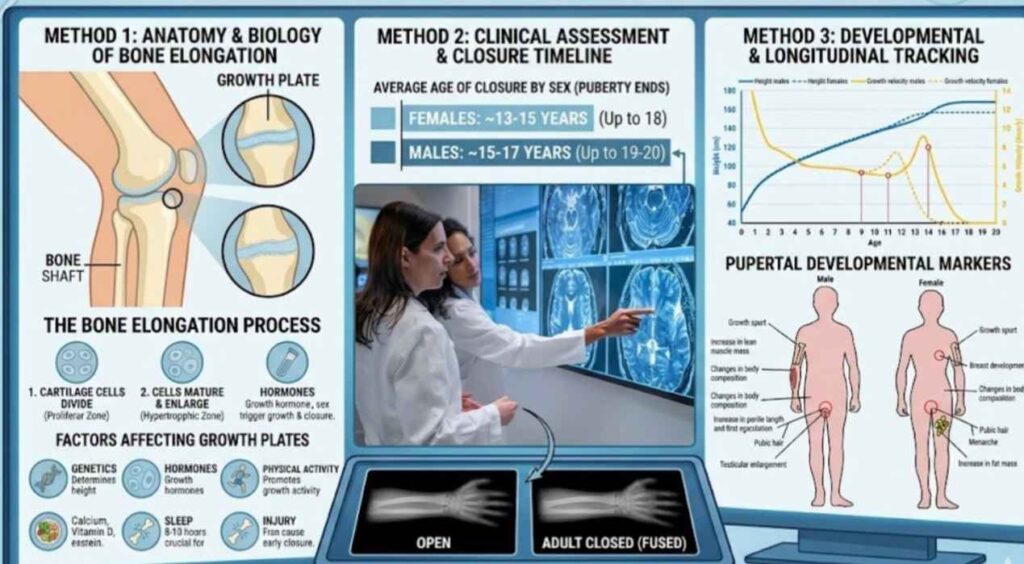
Methods to Check If Growth Plates Are Closed
To measure a person’s remaining growth potential, medical professionals rely on three primary assessment levels:
Growth Velocity Tracking
In this method, the specialist creates a chart to track your height history over the past years. If the end result line on a standard growth curve graph completely flattens out for 12 to 24 months. It is an indicator of skeletal maturity.
Physical Markers of Pubertal Development
A scale of physical development known as the Tanner Scale, which doctors use to understand where you stand.
Since bone fusion takes place at the end stage of pubertal hormones, reaching physical maturity in other parts of the body depends on the growth plate.
Diagnostic Imaging
It is a golden method used to view the growth plates physically and get a definitive 100% accurate answer.
When the long bones close, height stops increasing, but the plates in the torso and collarbone fuse much later, so you may notice the body is still developing; areas like shoulders, chest, and hips will naturally begin to broaden and shape into an adult.
| 6-Month Measurement Audit | Diagnostic Result: What It Proves About Your Growth Plates | Next Action Step |
|---|---|---|
| Reading has increased by 1.0 cm or more since your last check. | Active Growth Zone: Your long bones are actively elongating. The epiphyseal cartilage cells are wide open, dividing, and synthesizing new bone tissue. | Maintain optimal deep sleep (HGH production) and nutrition to support active development. |
| Reading increased by less than 0.5 cm since your last check. | Deceleration Zone: Vertical growth is slowing down significantly. Your growth plates are narrowing rapidly as late-stage pubertal hormones begin the calcification process. | Maximize postural alignment exercises; your primary structural window is beginning to close. |
| Reading is identical (0.0 cm change) for two consecutive 6-month checks. | Potential Closure Zone: Vertical height velocity has officially flatlined. Your long bones have likely completed their genetic timeline, replacing cartilage with solid bone. | Keep tracking for another 6 months to rule out a temporary growth plateau or “lull.” |
| Reading remains identical (0.0 cm change) for 18 to 24 consecutive months. | Confirmed Skeletal Lock: Your long bone growth plates are fully closed. The cartilage is gone, leaving a permanent white epiphyseal line. Vertical height is final. | Stop tracking vertical height. Physical development will now shift entirely to structural broadening (shoulders and chest). |
Can an X-Ray Tell If Growth Plates Are Closed?
Yes, an X-ray can provide you an accurate result on whether the growth plates are closed or not. When you get a bone X-ray done, the image is purely based on tissue density. The X-ray includes hard, mineralized bone blocks, which are shown as white on the sheet. Cartilage is soft and dense in nature, so X-ray radiation can easily pass through it.
An open growth plate has soft cartilage, so it appears as a dark, clear gap separating the main shaft of the bone from its rounded end. A common person may look and think the bone is broken; however, it’s not true. A doctor seeing a dark gap means the growth plate is active.
If the growth plates are closed, the X-ray will show that dark gap narrows until it vanishes completely. You will also see a solid white line that represents solid bone.
Also Read: How to Increase Baby Height: Maximizing Your Child’s Potential
Chronological Age vs. Bone Age: The Left-Wrist Standard
When the doctor wants to understand what the reason behind the closing of growth plates is, they don’t do a full-body X-ray; instead, they go for a highly specific diagnostic scan: an X-ray of your left hand and wrist. This way they can predict whether the reason is chronological age or bone age.
- Chronological Age: It is measured by the time you were born.
- Bone Age (Skeletal Age): It is measured by your skeleton’s actual biological and hormonal maturity.
Due to diet, genetic changes, or underlying health conditions, a person’s bone age isn’t the same as his age, like a boy who is 16 years old might have a bone age of 14; this means he still has years to grow more.
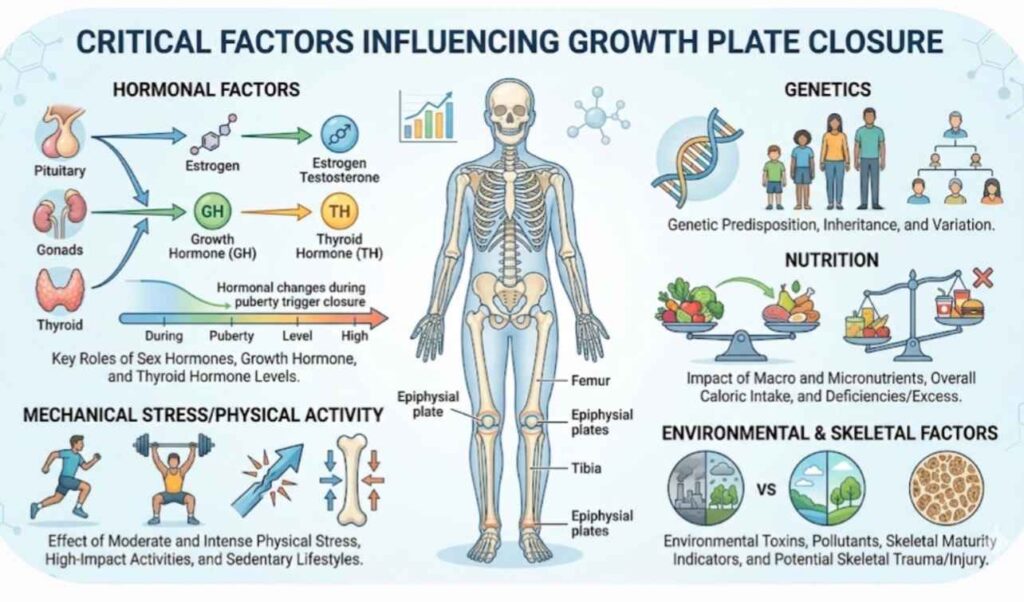
Critical Factors Influencing Growth Plate Closure
The skeletal maturation depends on many factors, so let’s look at each in detail.
Biological & Genetic Factors
- Genetics (The Master Blueprint): The DNA is the most important factor to look at because it determines final adult stature and the age at which growth plates close. The genetic makeup regulates the bone tissue’s sensitivity to growth hormones.
- Estrogen Levels (The Ultimate Fusion Signal): While testosterone is considered an important hormone, especially in male growth, estrogen is responsible for closing growth plates in both males and females. When puberty is near to ending, the high level of estrogen gives a signal to epiphyseal cartilage to stop replicating and undergo final calcification.
Developmental & Medical Conditions
- Precocious Puberty: It occurs when a child’s body starts changing into an adult body. Puberty takes place at the age of 8 in females and 9 in males. The premature sex hormones trigger early closing of the growth plate; that’s why some adult heights are shorter as compared to other siblings’ heights.
- Chronic Illness: If a child is facing health conditions like celiac disease, inflammatory bowel disease (IBD), juvenile arthritis, or severe kidney disorders that have a direct connection with nutrition and hormone production, then it can also stop skeletal development.
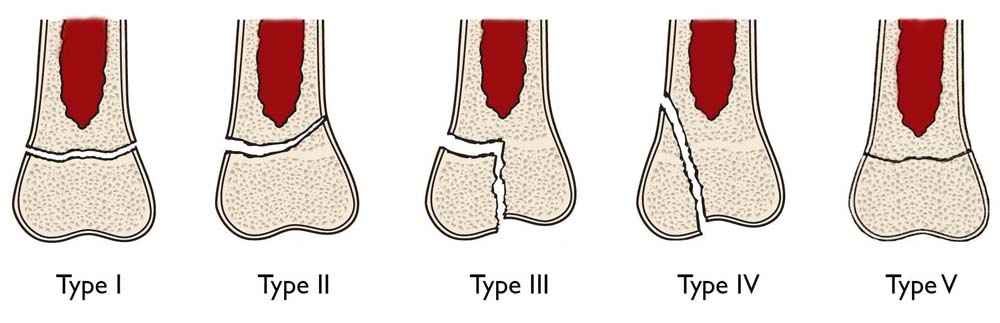
- Growth Plate Injuries (The Salter-Harris Classification): Since growth plates are based on an important factor that is cartilage, they are soft and weak as compared to hard bone and solid ligaments. This makes them vulnerable to fractures during childhood sports or accidents.
According to doctors, these fractures are classified using the Salter-Harris system (types I through V) to determine the risk of early closure:
- Types I & II: A most common type of fracture takes place through or above the plate; however, it doesn’t have any effect on future growth.
- Type III: This type of fracture takes place through the plate and into the joint; it needs urgent surgical help to protect development.
- Types IV & V: This fracture crushes or compresses the growth plate matrix. It can support growth plate leads to permanent limb shortening or asymmetrical bone growth.
Lifestyle & Environmental Factors
- Body Weight / BMI: Excessive weight gain in children alters endocrine profiles. The fat tissue produces and stores hormones, which cause early puberty. In many cases the high BMI-trigger hormone spikes lead to closed growth plates early.
- Diet and Growth Plate Development: The nutritional deficiencies in kids, especially like calcium, vitamin D, magnesium, and zinc, can also cause growth plates to close, as when the body isn’t getting full nutrition, the new bone tissue won’t work properly.
- Sleep (The HGH Window): The growth plates don’t work when you are awake or moving; they work when you are in the sleeping phase. If a child does not get enough sleep or goes to bed very late, it can contribute to the early closure of growth plates.
- The Role of Exercise (Debunking the Weightlifting Myth): Many people think sudden weightlifting can cause growth plates to close; however, it is not true. In fact, age-based weightlifting never damages growth plates.
Medical Disclaimer: This content is for informational purposes only and does not substitute for professional medical advice. Accurately determining if growth plates are closed requires an evaluation, such as an X-ray, by a qualified healthcare provider.
Medical Interventions & Treatments
When the parents are concerned about child growth or skeletal development, they go for medical intervention to understand; however, it can only help when the growth plates are still open.
Are There Medical Interventions for Early Growth Plate Closure?
Pediatric endocrinologists and orthopedic specialists made protocols to manage and treat such conditions that are creating hurdles in growth.
- Hormone Suppression Therapy (GnRH Analogs): To diagnose puberty in children, doctors go for a medication known as gonadotropin-releasing hormone (GnRH) analogs. These medications pause the growth of sex hormones, which freezes the skeletal clock while allowing the growth plates to remain open longer so the child can continue to grow at a normal, age-appropriate pace.
- Human Growth Hormone (HGH) Therapy: If a child is facing growth hormone deficiency, chronic kidney disease, or specific genetic conditions, HGH is recommended by a doctor. This treatment stimulates cartilage cells in an open growth plate to distribute and expand, which leads to reaching a maximum genetic potential before fusion takes place.
- Surgical Growth Plate Regulation (Epiphysiodesis): In some cases where the injury takes place, especially in legs, it stops the growth while the other leg may continue to grow. In this situation, a surgeon goes for a procedure known as epiphysiodesis. In this process they fuse the growth plate of the longer limb to allow the injured limb to catch up so both legs are balanced.
Frequently Ask Questions by People
Is it possible to open a closed growth plate?
No, it is a natural process. You can’t just hope to reopen a closed growth plate; there are no medical therapies, exercises, or dietary supplements capable of opening the closed growth plate.
Can I still grow if my growth plates are closed?
No, you won’t grow if the growth plates are closed because when they close, skeletal height has stopped. However, you can increase a bit if you do strengthening exercises.
Are my growth plates still open at 17?
It depends on the biological sex and also the puberty timeline. In biological females the age is 17 when the growth plates close, whereas in males it can be close to 19.
Can I grow 7 cm after 18?
It is not possible to grow 3 inches suddenly after the age of 18; this can only happen if a person faced injury in the past.
Can growth plates close earlier than normal?
Yes, growth plates closed early due to some reasons like untreated precocious puberty, an abnormally high BMI that accelerates the pubertal timeline, or physical trauma. A severe injury can also be a reason.
Medical References & High-Quality Sources
- The Left-Wrist Standard & Bone Age Assessment: National Institutes of Health (NIH) StatPearls Database.
- The Salter-Harris Fracture Classification: American Academy of Orthopaedic Surgeons (AAOS) OrthoInfo.
- Hormonal Regulation of Growth Plate Fusion: Journal of Clinical Endocrinology and Metabolism (JCEM).
- Adolescent Growth Velocity Charts: Centers for Disease Control and Prevention (CDC) Growth Charts.
