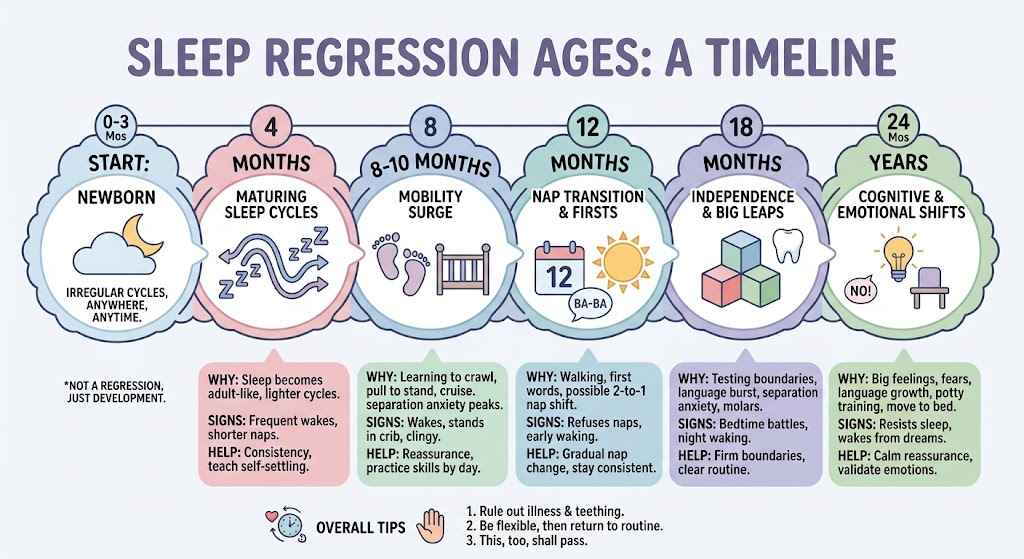
Quick Answer: Sleep regressions typically occur at 4 months, 6 months, 8–10 months, 12 months, 18 months, and 2 years. Lasting anywhere from 2 to 6 weeks, these temporary sleep disruptions are normal biological responses to major developmental leaps, physical milestones (like rolling, crawling, and walking), teething, separation anxiety, or shifting nap schedules. Rather than a permanent loss of sleep habits, a regression simply signals that your child’s brain and body are undergoing rapid growth.
We consider sleep regression as a temporary phase in which a baby who was first sleeping well suddenly starts waking up, naps become short or quick, and they even create trouble in sleeping. In short, we can say sleep regression is an important factor in sleep disturbance.
The phase often takes place when the baby is going through growth spurts and developmental changes. I see many parents, especially the new ones, become very confused or exhausted when a baby’s sleeping pattern becomes a nightmare. However, it is temporary and important for the baby’s growth.
In this article we will look at sleep regression ages in detail and what tips parents can follow to make sleep regression smooth so you will know everything that can help.

7 Major Causes of Sleep Regression in Babies
Before moving forward on the main topic, which is sleep regression ages, let’s first look at the major causes of sleep regression, which every parent should know.
- The most common cause of sleep regression is brain development in which babies start learning skills like rolling, crawling, or walking.
- Increased hunger can cause sleep disturbance.
- Changes in sleeping cycle, especially in the last 4 months
- Teething, as it causes pain in the gums, which leads to night wakings
- Separation anxiety as the baby becomes aware of parents
- Some kind of illness like a cold, ear infection, or acid reflux
- Sudden changes in daily schedule, like travel, daycare, or missed naps
Do All Babies Face Sleep Regression in Growing Age?
Many people search for this question, especially new parents. When I was a new parent, I also searched the same. Well, the answer is every baby experiences different sleep regression because they aren’t the same. Some babies show noticeable signs of sleep regression, while others show mild signs. The most important factors that play an important role in the sleeping cycle of a baby are temperament, environment, sleep routines, and parental responses. Sleep regression is very common, and every baby experiences it; however, the duration and effects may vary from baby to baby.
Common Signs of Sleep Regression
When the sleep regression occurs, many parents notice some common signs as follows:
| Sign # | Common Symptom | What It Looks Like | Primary Cause |
|---|---|---|---|
| 1 | Frequent Night Wakings | Waking up every 45–90 minutes after previously sleeping longer stretches. | Inability to bridge maturing sleep cycles independently. |
| 2 | Short / Fragmented Naps | Naps suddenly capping out at exactly 20–30 minutes (“catnapping”). | Brain struggles to connect light REM sleep to deep NREM sleep. |
| 3 | Bedtime Resistance | Crying, fighting, or arching back as soon as the wind-down routine starts. | Overtiredness spiking cortisol, or increased environmental awareness. |
| 4 | Increased Daytime Fussiness | Frequent crying, clinginess, or low patience during regular wake windows. | Cumulative sleep debt from disrupted night and daytime sleep. |
| 5 | Appetite Changes | Demanding extra feeds at night or acting distracted during daytime feeds. | Growth spurts combined with seeking nursing/bottle for soothing. |
| 6 | Practicing Skills in Crib | Rolling, sitting up, or babbling frantically instead of settling down. | Developmental motor surges firing neural pathways during sleep transitions. |
| 7 | Harder to Soothe | Usual comforting tricks (rocking, swaying, pacifier) take much longer to work. | Heightened fight-or-flight response due to physical or neurological shifts. |
| 8 | Early Morning Awakenings | Waking up fully alert between 4:00 AM and 5:00 AM ready to play. | Weak sleep drive paired with low natural melatonin in early hours. |
| 9 | Clinginess & Separation Anxiety | Crying when set down or demanding to be held constantly by a primary caregiver. | Cognitive growth and developing awareness of object permanence. |
| 10 | Sudden Refusal of Naps | Skipping scheduled naps entirely despite showing clear tiredness signs. | Overstimulation and fighting sleep transitions due to brain development. |
Sleep Regression Based on Baby Age
Sleep regression according to age is widely discussed among pediatric research and other parent-education resources such as the American Academy of Pediatrics (AAP) and Cleveland Clinic. While every child is different, the sleep disruption can occur at different ages. Here is a complete explanation of infant regression ages as follows:
The 3-Month Sleep Regression: Symptoms, Causes, and Solutions
After 3 months babies start shifting from the newborn stage, so it also causes sleep disruption. Many parents notice lighter sleep and frequent awakenings among babies.
What parents commonly experience:
- Baby wakes up with just a little sound
- Baby starts taking more short naps
- Baby doesn’t want to sleep easily at night.
According to many pediatric sleep specialists, all these changes in sleeping occur because babies are still developing stable circadian rhythms.
| Feature / Aspect | What Happens | Why It Happens | Actionable Parent Solution |
|---|---|---|---|
| Primary Cause | Sudden disruption in sleep patterns | Growth spurt, early circadian rhythm maturation, and heightened environmental awareness | Maintain a calm, dark sleep environment to minimize stimulation |
| Nighttime Behavior | Wakes up every 1–2 hours crying | Baby is transitioning out of newborn deep sleep into lighter, adult-like sleep stages | Practice gentle soothing; pause 1–2 minutes before picking baby up |
| Nap Patterns | Short “catnaps” lasting 20–30 minutes | Difficulty connecting daytime sleep cycles without assistance | Focus on 60–90 minute wake windows to avoid overtiredness |
| Feeding / Appetite | Cluster feeding or increased night hunger | Physical growth spurt combined with seeking comfort to fall back asleep | Offer full feeds during awake windows to ensure adequate daytime calories |
| Motor & Cognitive Skills | Hands-to-mouth discovery, increased tracking, bat-at toys | Rapid neurological development and sensory expansion | Provide plenty of daytime floor and tummy time to work off cognitive energy |
| Duration | Lasts roughly 1 to 2 weeks | Temporary milestone-driven bump (unlike the permanent 4-month regression) | Stay consistent with sleep hygiene; avoid introducing unsustainable new sleep associations |
The 4-Month Sleep Regression: Complete Guide & Breakdown
At 4 months, a baby begins transitioning from a newborn sleep pattern to a more mature sleep cycle. Many parents notice a baby start waking up after every 1 to 2 hours at night; the naps become shorter and quicker.
Why it’s important:
According to much research, when a baby’s sleeping cycle changes from newborn to adult-like sleep cycles at this age, the baby starts to learn how to sleep independently, which is very important for long-term sleep health.
Also Read: 4 Month Sleep Regression: Why It Happens & How to Fix It
| Feature / Aspect | What Happens | Biological Cause | Actionable Parent Solution |
|---|---|---|---|
| Primary Driver | Permanent change in sleep structure | Brain shifts from 2-stage newborn sleep to adult-like 4-stage sleep cycles | Focus on developing healthy sleep hygiene rather than waiting it out |
| Nighttime Behavior | Wakes up every 45–90 minutes | Light REM sleep phases increase; baby wakes fully between cycles and doesn’t know how to fall back asleep | Pause 1–2 minutes before responding; practice gentle self-soothing techniques |
| Daytime Naps | Short “catnaps” lasting exactly 30–45 minutes | Difficulty bridging daytime light sleep transitions | Keep wake windows strictly between 1.5 and 2 hours to avoid overtiredness |
| Soothing Needs | Baby demands rocking, nursing, or holding to sleep | Sleep associations (props) used at bedtime are needed again at every micro-waking | Put baby in crib drowsy but awake so they associate the crib with falling asleep |
| Physical Safety | Baby begins attempting to roll over | Motor skill development (rolling back-to-tummy) | Immediately transition out of the swaddle into an arms-free sleep sack |
| Duration | Lasts 2 to 6 weeks | Permanent biological shift in sleep architecture | Stay consistent with bedtime routines; avoid introducing temporary crutches |
5-Month Sleep Regression: Causes, Symptoms, and Solutions
Many parents notice sleep disturbances among children take place when they become more physically active.
Common observations by parents:
- Baby starts rolling during sleep
- Baby moves more at night while sleeping
- Fussiness due to growth spurts
According to the clinical perspective, all these happen because at 5 months, motor development stimulates the brain, which causes sleep changes.
| Feature / Aspect | What Happens | Biological / Developmental Cause | Actionable Parent Solution |
|---|---|---|---|
| Primary Driver | Lingering 4-month sleep cycle shift paired with rapid motor skill surges | Brain mastering rolling, reaching, and prep work for crawling; lingering unmanaged sleep props | Focus on extending wake windows slightly to build sufficient sleep pressure |
| Nighttime Behavior | Waking up every 2–3 hours, rolling into crib sides, or practicing pushing up | Active motor cortex firing mid-sleep; baby gets stuck on belly and panics | Practice rolling back-to-tummy and tummy-to-back during daytime awake hours |
| Daytime Naps | Unpredictable 30–45 minute naps; fighting naptime entirely | Wake windows shifting from 1.5 hours to 2–2.5 hours, causing undertiredness or overtiredness | Adjust wake windows to 2–2.25 hours; keep a solid 3-nap daily schedule |
| Feeding & Appetite | Distracted daytime feeds; asking for extra comfort feeds at night | Heightened curiosity about surroundings leads to partial feeds during the day | Feed in a quiet, dark nursery with minimal distractions before naps |
| Soothing Needs | Strong demand for rocking, nursing, or pacifier replacement | Baby reaches out for familiar sleep crutches to transition between light sleep stages | Practice placing baby in crib wide awake; use gentle physical soothing (pats/shushes) |
| Duration | Typically lasts 1 to 3 weeks | Temporary milestone-driven disruption | Maintain consistent sleep habits; avoid introducing new long-term crutches |
6-Month Sleep Regression: Causes, Symptoms,
At this stage parents link sleep regression with other factors like teething, growth spurts, and dietary changes. Parents may observe that their baby suddenly wakes up at night and may cry intensely at bedtime.
Trusted guidance: Health professionals recommend maintaining routines and offering comfort without overstimulation.
| Feature / Aspect | What Happens | Biological / Developmental Cause | Actionable Parent Solution |
|---|---|---|---|
| Primary Driver | Disrupted sleep paired with major cognitive and physical milestones | Sitting up, crawling prep, starting solid foods, and early separation anxiety | Expand wake windows to 2.5–3 hours to build sufficient sleep pressure |
| Nighttime Behavior | Waking up 2–3 times per night, sitting up in the crib, or babbling loudly | Active motor brain pathways firing; separation anxiety kicking in between sleep cycles | Give baby 3–5 minutes to settle back down independently before offering comfort |
| Daytime Naps | Nap resistance, short 30-minute naps, or fighting the 3rd nap | Transitioning schedule from 3 naps down to 2 solid naps per day | Shift to a 2-nap schedule if wake windows exceed 2.5 hours easily |
| Feeding & Solids | Waking up hungry or acting distracted during milk feeds | Introduction of solid foods changing digestion; growth spurts | Ensure balanced solid feeds during the day, keeping nursing/bottles primary |
| Separation Anxiety | Crying immediately when a parent leaves the nursery or sets baby down | Brain realizing object permanence (knowing parents exist when out of sight) | Use a consistent 15–20 minute wind-down routine to offer emotional security |
| Duration | Typically lasts 2 to 3 weeks | Temporary milestone-driven development phase | Keep sleep rules consistent; avoid creating new long-term sleep crutches |
7–8 Month Sleep Regression: Causes, Symptoms, and Solutions
At 7 to 8 months, separation anxiety peaks, and parents often notice this every night.
What parents often report:
- The baby starts crying when parents leave the room
- Baby doesn’t want to sleep alone
- Baby clinginess increases at night.
All these happen because at this stage, babies develop more awareness about the environment, like the presence of objects, etc. That’s why they respond when the caregiver is gone from the room.
| Feature / Aspect | What Happens | Biological / Developmental Cause | Actionable Parent Solution |
|---|---|---|---|
| Primary Driver | Severe bedtime resistance and middle-of-the-night waking | Crawling, pulling to stand, language explosion, and peak separation anxiety | Maintain strict 3–3.5 hour wake windows to ensure proper sleep pressure |
| Nighttime Behavior | Standing up or crawling around crib at 2:00 AM; crying when left alone | Brain processing major physical milestones; heightened awareness of parent absence | Practice standing-to-sitting transitions during the day; offer gentle, calm reassurance |
| Daytime Naps | Nap refusal, short 30–45 minute naps, or fighting Nap 2 | Final adjustment of the 3-to-2 nap transition; brain fighting sleep to practice skills | Consolidate down to a predictable 2-nap schedule (aiming for 2.5–3 hours total nap time) |
| Separation Anxiety | Intense crying during bedtime routine or when parent walks away from crib | Cognitive milestone: object permanence peaking alongside stranger/separation fear | Use a loving, consistent 15–20 minute wind-down ritual; play daytime peek-a-boo |
| Teething Impact | Swollen gums, drooling, and fussiness interfering with sleep onset | Primary incisors and lower central teeth breaking through | Consult a pediatrician regarding safe pain relief options before bedtime |
| Duration | Typically lasts 2 to 4 weeks | Temporary milestone-driven development phase | Stay consistent with sleep boundaries; avoid creating long-term sleeping dependencies |
9–10 Month Sleep Regression: Causes, Symptoms, and Solutions
At 9 to 10 months, a baby’s sleep disturbance is considered more behavioral than biological.
Common signs parents observe:
- Baby starts standing or crawling in crib
- Bedtime resistance
- Baby starts taking shortened naps
| Feature / Aspect | What Happens | Biological / Developmental Cause | Actionable Parent Solution |
|---|---|---|---|
| Primary Driver | Sudden bedtime resistance and persistent middle-of-the-night waking | Rapid brain development: cruising, standing, speech development, and cognitive processing | Extend wake windows to 3–3.5 hours to build proper sleep pressure |
| Nighttime Behavior | Waking up 1–3 times, standing in the crib, or babbling instead of sleeping | Motor cortex firing as baby masters standing, cruising, and early coordination | Practice standing-to-sitting transitions repeatedly during daytime floor play |
| Daytime Naps | Refusing Nap 2 entirely or taking short 30–45 minute naps | Undertiredness from outdated wake windows or fighting sleep to practice new skills | Do not drop to 1 nap yet. Maintain a 2-nap schedule with 3 to 3.5-hour wake windows |
| Cognitive Shifts | Heightened separation anxiety, emotional clinginess, and intense fear of missing out | Deepening awareness of object permanence and social-emotional growth | Keep wind-down routines calm and predictable; avoid sneaking out of the nursery |
| Teething Impact | Fussiness, drooling, and waking up abruptly from gum discomfort | First molars or upper lateral incisors beginning to emerge | Consult your pediatrician about safe pain relief options before bedtime |
| Duration | Typically lasts 2 to 4 weeks | Temporary milestone-driven development phase | Stay consistent with sleep boundaries; avoid creating long-term sleeping dependencies |
12-Month Sleep Regression: Causes, Symptoms, and Solutions
At this age parents get confused with a nap transition because the baby shows both physical and cognitive growth.
What parents observe:
- Baby refuses to take a nap
- Baby starts waking up at night again
- Baby wakes up early
All these changes happen because of walking, language development, and teething.
| Feature / Aspect | What Happens | Biological / Developmental Cause | Actionable Parent Solution |
|---|---|---|---|
| Primary Driver | Sudden nap refusal and bedtime resistance around the 1-year mark | Walking milestones, first-word language surges, and expanding independence | Extend wake windows to 3.5–4 hours to build sufficient sleep pressure |
| Nighttime Behavior | Waking up 1–2 times, standing/walking in the crib, or crying for comfort | Brain processing walking, balance, and new vocabulary during sleep cycles | Offer brief, low-energy physical reassurance; avoid taking baby out of the dark nursery |
| Nap Struggles | Completely refusing Nap 1 or Nap 2 for days in a row | “False 1-nap transition”—baby tests independence and fights sleep despite needing 2 naps | Do not drop to 1 nap yet. Stick to a 2-nap schedule using “quiet crib time” if they refuse sleep |
| Cognitive Shifts | Testing boundaries, heightened separation anxiety, and strong willpower | Developing self-awareness, testing cause-and-effect, and fear of missing out | Keep bedtime routines predictable; offer small choices during wind-down (e.g., choice of book) |
| Teething Impact | Fussiness, gum irritation, and night awakenings | Eruption of first molars causing deep jaw ache and gum discomfort | Consult your pediatrician regarding safe pain relief options before bedtime |
| Duration | Typically lasts 2 to 4 weeks | Temporary milestone-driven development phase | Hold firm on 2 naps; stay consistent with established sleep boundaries |
16–18 Month Sleep Regression: Causes, Symptoms, and Solutions
At this age, a toddler’s sleep regression can be driven by emotional factors, presenting parents with challenges such as
- Baby doesn’t sleep easily at bedtime
- Suddenly waking at night
These changes happen because of language growth and emotional awareness among toddlers.
| Feature / Aspect | What Happens | Biological / Developmental Cause | Actionable Parent Solution |
|---|---|---|---|
| Primary Driver | Peak toddler independence testing, separation anxiety, and the official 2-to-1 nap transition | Stronger self-will, desire for autonomy, rapid language acquisition, and brain rewiring around sleep schedules | Maintain clear, firm bedtime boundaries while offering simple daily choices to foster autonomy |
| Nighttime Behavior | Waking up screaming for parents, throwing loveys/stuffed animals out of the crib, or standing at crib rails | Peak separation anxiety combined with testing cause-and-effect (“What happens if I scream?”) | Keep night check-ins brief, quiet, and consistent; return dropped items once without turning it into a game |
| Nap Struggles | Refusing the single afternoon nap, taking 2+ hours to fall asleep, or short 45-minute naps | Over-tiredness from dropping to 1 nap too quickly, or under-tiredness from outdated wake windows | Lock in 5–5.5 hours of wakefulness before the nap and before bedtime; enforce “quiet rest time” in crib |
| Behavior & Temperament | Major daytime tantrums, extreme clinginess, and fighting routine transitions (baths, PJs) | Emotional regulation centers developing slower than physical/verbal desires, leading to frustration | Use visual schedules, transition warnings (“5 minutes until naptime”), and stay calm during meltdowns |
| Teething Impact | Waking up crying hysterically, chewing hands/objects, and refusing solid foods | Emergence of first molars or canine teeth (eyeteeth), which cause deep pressure and gum throbbing | Consult your pediatrician regarding safe pain relief options before bedtime |
| Duration | Typically lasts 2 to 6 weeks | Developmental milestone surge & toddler boundary-testing phase | Hold firm on keeping child in their crib; avoid introducing new long-term habits (e.g., co-sleeping) |
2-Year Sleep Regression: Causes, Symptoms, and Solutions
This phase is quickly linked to fear, imagination, and boundary testing.
What parents report:
- Child gets scared of darkness or doesn’t want to sleep alone
- Bedtime routines get changed.
- Child calls parents continuously
All these happen because the child becomes sleep independent, and parents prefer to let them sleep alone to get more independent; however, children who have a habit of sleeping with parents start getting afraid to sleep alone.
| Feature / Aspect | What Happens | Biological / Developmental Cause | Actionable Parent Solution |
|---|---|---|---|
| Primary Driver | Bedtime stalling, crib escaping, night fears, and severe testing of boundaries | Peak autonomy, vivid imagination, night terrors/fears, and 2-year molar eruption | Maintain strict bedtime boundaries; use an OK-to-wake clock if transitioning to a bed |
| Nighttime Behavior | Waking up demanding water/parents, crying out from bad dreams, or climbing out of crib | Developing imagination triggering fears of the dark, coupled with testing parent response | Add a dim, warm nightlight; keep check-ins brief, neutral, and consistent |
| Nap Refusal | Refusing the single afternoon nap entirely, or taking 1+ hours to fall asleep | “False nap transition”—toddler tests independence, but still requires a daily nap | Enforce 60–90 minutes of “quiet rest time” in their room even if they don’t sleep |
| Bedtime Stalling | Asking for “one more book,” extra hugs, glass of water, or bathroom visits | Mastering cause-and-effect and delay tactics to exert control over their schedule | Use a visual bedtime routine chart and limit request concessions to exactly one check |
| Teething & Growth | Deep jaw pain, gum swelling, and waking up crying in distress | Eruption of the 2-year molars (the last set of primary teeth) | Consult your pediatrician regarding safe pain relief options before bedtime |
| Duration | Typically lasts 2 to 6 weeks | Developmental milestone surge & toddler boundary-testing phase | Stay consistent with sleep boundaries; avoid creating long-term sleeping crutches |
What are external sleep regression stages?
Sleep regression ages aren’t the only reason for sleep disturbance. According to many pediatricians, external disruptions are also a major cause of sudden sleep changes in many children who slept well in past days. Some common triggers are as follows.
- Illnesses such as fever, ear infections, or colds
- Teething pain
- Traveling
- Starting daycare or new caregivers
- Missed naps
- Changes in environment
6 Evidence-Backed Tips for Parents to Handle Sleep Regression
Following are some tips that align with pediatric sleep experts, child psychologists, and trusted health organizations’ guidelines.
1. Maintain a Consistent Bedtime Routine
One of the most recommended strategies by many pediatric experts is a constant bedtime routine.
Why it works: When the timing of baby sleep is consistent, it can help in regulating the baby’s body clock. When a baby sleeps at the same time every night, it helps the brain to release melatonin, the sleep hormone.
What parents can do:
- Follow the same routine every night, like fixing a time for feeding and sleeping.
- Keep the routine short for 20–30 minutes.
- Start the routine at the same time each night
According to the American Academy of Pediatrics, a routine is considered a major factor when it comes to improving sleep patterns among infants and toddlers.
Below is a chart to help you track whether your baby is getting the recommended amount of sleep.
| Age Group | Total Daily Naps | Average Wake Window | Total Daytime Sleep | Ideal Bedtime Window |
|---|---|---|---|---|
| Newborn (0–2 Months) | 4–6 naps | 45–90 minutes | 7–9 hours | Variable (8:00 PM – 10:00 PM) |
| 3–4 Months | 4 naps | 1.5–2 hours | 4–5 hours | 7:30 PM – 8:30 PM |
| 5–6 Months | 3 naps | 2–2.5 hours | 3.5–4 hours | 7:00 PM – 8:00 PM |
| 7–8 Months | 2–3 naps | 2.5–3 hours | 3–3.5 hours | 7:00 PM – 8:00 PM |
| 9–12 Months | 2 naps | 3–4 hours | 2.5–3 hours | 7:00 PM – 8:00 PM |
| 13–18 Months | 1–2 naps (transition phase) | 3.5–5 hours | 2–2.5 hours | 7:00 PM – 8:00 PM |
| 19–36 Months (1.5–3 Yrs) | 1 nap | 5–6 hours | 1.5–2.5 hours | 7:30 PM – 8:30 PM |
2. Adjust Wake Windows According to Age
Sleep regression can be worse, especially when a baby is very tired or not tired at all.
Why it matters: When babies start growing, their sleeping needs and waking times change. For example, if a baby stays awake for a long time, it can cause the rise of stress hormones, which leads to sleep disturbance.
What parents can do:
- Write in the journal how long a baby stays awake between naps.
- Try to adjust nap timing over some time instead of a quick fix.
- Notice if the baby is rubbing eyes or zoning out
3. Offer Comfort Without Creating New Sleep Dependencies
During sleep regression, babies need parents around them more, and how parents respond to it matters.
Why balance is important: Providing comfort helps babies feel safe, but introducing new sleep habits like rocking to sleep every waking may cause long-term sleep challenges.
What parents can do:
- Always try to comfort the baby in the crib.
- You can use methods like gentle patting or a soothing voice.
- Avoid introducing any new sleep crutches.
All these habits can help a child to feel more secure without any disturbance in sleep skills.
4. Protect Daytime Naps
Many parents make mistakes; the common one is they reduce daytime naps and think it will improve nighttime sleep in the baby; however, research shows this often backfires.
Why naps matter: If you don’t let the baby take a nap during the day and only consider it at night, it can make the baby overtired, which leads to more night wakings, not fewer.
What parents can do:
- Follow age-based nap pattern or schedule
- Avoid skipping daytime sleep during regression.
- Make sure the baby takes naps in a relaxed and stress-free environment.
All these factors help the baby to sleep more peacefully and longer at night.
5. Create an Optimal Sleep Environment
A baby’s sleeping environment also plays an important role when it comes to sleep quality and duration.
Why the environment matters: Babies are light sleepers, especially in development stages, so even a small disturbance in the surroundings can wake them.
What parents can do:
When the baby tries to sleep, make sure the room is dark and the curtains are properly set.
- Use white noise to block sudden sounds
- Make sure the room temperature is normal.
- Remove all toys from the baby’s crib
All these things help in providing a better sleeping environment, which leads to uninterrupted sleep cycles.
6. Practice Patience and Emotional Reassurance
Sleep regression is a temporary phase when parents feel exhausted and think it won’t go easily. All you need to do as a parent is stay calm, as babies can sense the stress. Calmness makes them feel safe and supported by parents.
What parents can do:
- Be patient and respond calmly, especially when the baby wakes up at night.
- Avoid any quick changes in sleeping pattern.
- Remember this phase is temporary and will pass in some days or months.
According to many pediatricians and child psychologists, these factors can help a baby to feel secure and help in sleep regression.
Medical disclaimer: This information is based on reputable pediatric sleep research and parent-education resources. It is for educational purposes only and does not replace professional medical advice. Parents should consult a pediatrician if sleep issues are persistent or associated with health concerns.
| Tip # | Strategy | Action Step | Why It Helps |
|---|---|---|---|
| 1 | Stick to Wake Windows | Watch age-appropriate awake times (e.g., 1.5–2 hours at 4 months) rather than rigid clock schedules. | Prevents severe overtiredness, which spikes cortisol and makes falling asleep harder. |
| 2 | Darken the Sleep Room | Install blackout curtains to block out all daylight for naps and early mornings. | Stimulates natural melatonin production as biological circadian rhythms mature. |
| 3 | Use Continuous White Noise | Play low, steady white noise (50–60 dB) throughout all naps and night sleep. | Masks household background noise and mimics the comforting sounds of the womb. |
| 4 | Pause Before Responding | Wait 1–2 minutes when baby stirs or grunts before rushing into the room. | Gives baby a chance to bridge sleep cycles independently without unnecessary intervention. |
| 5 | Transition Out of the Swaddle | Move to an arms-free sleep sack as soon as baby shows signs of rolling back-to-tummy. | Crucial for safety and allows baby to use hands for self-soothing (like thumb-sucking). |
| 6 | Keep Night Interventions Calm | Use dim red/warm nightlights, low voices, and minimal eye contact during night feeds/changes. | Teaches baby that nighttime is for rest, preventing full cognitive awakenings. |
| 7 | Maximize Daytime Sunshine | Get outside for natural daylight exposure within 30–60 minutes of morning wake-up. | Sets the internal biological clock, improving daytime/nighttime confusion. |
| 8 | Offer Extra Daytime Comfort | Provide ample cuddle time, physical touch, and full feedings while baby is awake. | Meets emotional and physical needs during the day so baby relies less on night comforting. |
| 9 | Practice Floor Time Skills | Give baby frequent tummy time and rolling practice during active awake windows. | Helps master new physical milestones during the day instead of practicing in the crib at night. |
| 10 | Maintain a Consistent Routine | Keep a predictable 10–15 minute pre-nap and 20–30 minute bedtime ritual. | Cues the brain that sleep is coming, easing the transition into deep rest. |
Frequently Asked Questions About Sleep Regression Ages
1. What are sleep regression ages?
Well, sleep regression ages are considered as specific stages in a baby’s growth when the sleep pattern gets disturbed temporarily. These stages play an important role in a baby’s development, like brain growth, physical skills, or emotional changes.
2. At what age does sleep regression usually start?
Sleep regression starts after 4 months of age and continues to 6, 8, 12, or 18 months, then it happens again at 2 years.
3. How long does sleep regression last?
Many parents notice sleep regression lasts for 2 to 6 weeks. Sometimes it goes quickly when the sleeping routine is consistent. If sleep regression lasts longer, it can be because of other external factors like illness or schedule changes.
4. Is the 4-month sleep regression permanent?
Yes, a 4-month sleep regression is considered a permanent and natural change in a baby’s sleeping cycle. However, frequent waking is temporary. Once a baby overcomes this phase, the sleeping cycle usually improves properly.
5. Do all babies go through sleep regression?
No, every baby is different and responds to sleeping regression differently. Some may show mild changes, while others experience significant sleep disruption signs.
6. Can sleep regression happen more than once?
Yes, many babies and toddlers face sleep regression multiple times at different ages because of ongoing physical and emotional development.
7. What are the most common signs of sleep regression?
The most common signs of sleep regression include sudden waking up at night, short naps, difficulty in sleeping, and early morning wake-ups.
8. Is sleep regression caused by teething?
Yes, teething can contribute to sleep regression, but it’s not the only cause. Other major causes include brain development, growth spurts, and emotional changes.
9. Should I change my baby’s sleep routine during regression?
According to many experts, keeping a constant routine can help in sleep regression. You can do minor adjustments but not sudden changes, as it can confuse the baby and affect sleep.
10. Can sleep regression affect naps only?
Yes. Some babies experience sleep regression by taking short naps or refusing naps, while nighttime sleep remains mostly unchanged.
11. How can I tell the difference between sleep regression and illness?
Sleep regression comes with common signs like sudden waking up at night, short naps, difficulty in sleeping, and early morning wake-ups. However if your baby has a fever, poor feeding, or unusual crying, then illness may be behind it.
12. Can sleep regression happen due to travel or daycare changes?
Yes, according to many experts, changes in environment, like the absence of a parent, and changes in schedule, like traveling or the baby going to daycare recently, can cause external sleep regressions.
13. Will sleep regression harm my baby’s development?
No, sleep regression won’t harm any baby’s development; in fact, it is a very natural and healthy sign of development among babies.
14. When should parents seek medical advice for sleep problems?
Parents should consult a pediatrician if sleeping issues stay the same for more than 6 to 8 days or the baby starts showing signs of illness or pain.
15. Can toddlers have sleep regression too?
Yes. Toddlers commonly experience sleep regression around 18 months and 2 years, possibly because of emotions, fears, and independence.
Conclusion
Sleep regression can be frustrating, exhausting, and overwhelming for many parents; however, it is a very normal and common phase of child development. Every baby goes through this phase but responds differently. Sleep regression goes away on its own with time. Understanding sleep regression ages can help parents to manage the situation calmly. All you need to do is focus on keeping the routine proper, comfort the child, and stay calm instead of stressing out; this will help the baby to sleep more properly.
Trusted Reference Sources
- PubMed – Scientific evidence on infant sleep patterns
https://pubmed.ncbi.nlm.nih.gov/21784676/ PubMed - Cleveland Clinic – What parents need to know about infant sleep regression
https://health.clevelandclinic.org/the-4-month-sleep-regression-what-parents-need-to-know Cleveland Clinic - Sleep Foundation – 4-Month Sleep Regression (causes, signs, tips for coping)
https://www.sleepfoundation.org/baby-sleep/4-month-sleep-regression Sleep Foundation - NHS – Helping your baby to sleep (routine and expectations)
https://www.nhs.uk/baby/caring-for-a-newborn/helping-your-baby-to-sleep/ nhs.uk - UPMC – Sleep Regression in Babies: When and Why It Happens
https://share.upmc.com/2024/06/sleep-regression-in-babies/ UPMC HealthBeat
