
Quick summary: Most common causes include aging, sciatica, and electrolyte imbalances. Red flags include sudden weakness on one side or weakness accompanied by a loss of bladder control. Most weaknesses can be improved at home; however, some need immediate medical attention.
You may feel uncomfortable when there is a sudden heaviness or a lack of strength in your lower body.
Whether you are facing issues in climbing stairs, feeling like your legs are shaking while standing, or noticing weakness in your legs, you need to look at the main causes behind it.
Some people mistake leg weakness as just a sign of aging; however, it is not correct. In many cases it is a sign of a conversion from electrolyte imbalances and overexertion to more serious neurological or circulatory conditions. Since our whole body’s independence depends on legs, finding the cause of weakness is important.
In this detailed guide, we will first look at the 12 common causes of weakness in legs. Examine the red flags checklist to determine when the symptoms require medical attention. Additionally, we will discuss ways to recover from weakness at home. Let’s get started.
At a Glance: Is Your Leg Weakness an Emergency?
Before diving into the causes, use this quick-reference table to determine your level of urgency.
| Symptom Type | Potential Cause | Urgency Level |
|---|---|---|
| Sudden & One-Sided | Stroke or Pinched Nerve | Emergency |
| Heavy/Aching Legs | Venous Insufficiency (Circulation) | Moderate |
| Weakness + Back Pain | Sciatica or Herniated Disc | Moderate |
| Progressive/Bilateral | Neuropathy or Sarcopenia | Long-term Care |
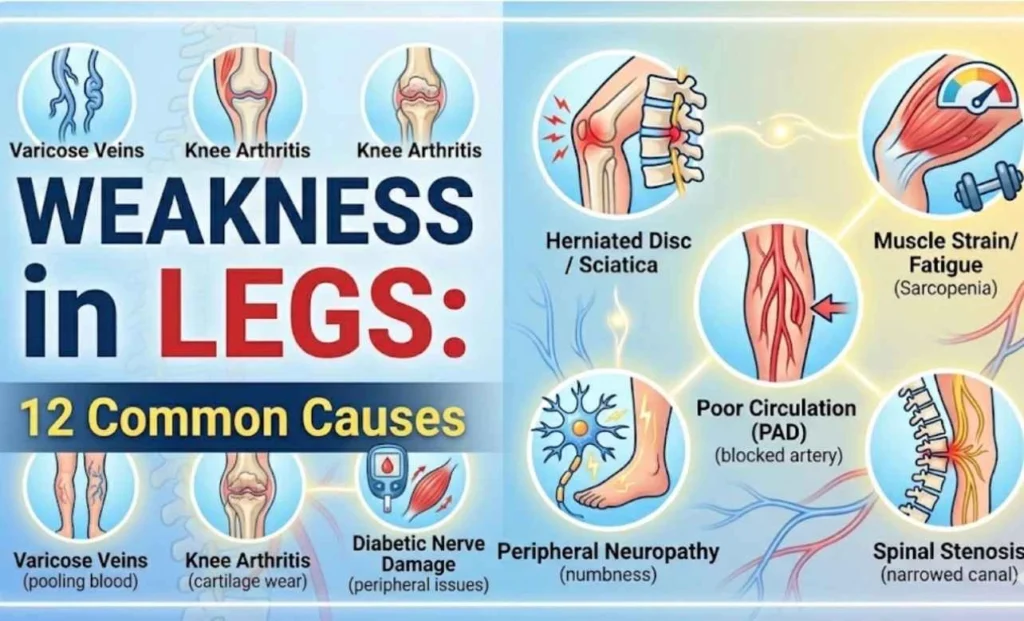
12 Reasons Why Your Legs Feel Weak: Causes & Symptoms
The main and first step is to understand the major cause of weakness in your legs so you can get treatment at your earliest convenience. Here are some major causes and symptoms as follows:
1. Sciatica & Nerve Compression
Sciatica takes place when the longest nerve, called the sciatic nerve, is pinched; this usually happens by a herniated disc or a bone spur. This nerve works as an electrical cord, so when it gets pinched, the power of the leg muscles gets distorted.
Common symptom: You may feel a burning pain on one side from the buttock to the calf.
2. Electrolyte Imbalance
Electrolytes support our muscles as they create electrical impulses. Without it, the muscle fibers are unable to contract or relax properly, resulting in loss of power.
Common symptom: You may face sudden shakiness in your legs, especially after sweating or illness.
3. Sarcopenia
It occurs naturally by gradual loss of skeletal muscle mass and strength, which happens after age 65. Sarcopenia happens when there is a decrease in muscle fiber size and a reduction in motor units that tell the muscle how to move.
Common symptom: It is very slow weakness; you may feel it when you try to push something heavy or open a heavy door.
4. Peripheral Neuropathy
It’s physical damage that happens to the nerve, and the most common reason behind it is diabetes.
Common symptom: It starts with numbness or tingling in the toes and then moves to the legs.
5. Chronic Venous Insufficiency (CVI)
Think of leg veins like a one-way street that goes to the heart. To keep blood moving up, the veins need trap doors called valves. Weakened valves in your leg veins allow blood to flow backward and pool in your lower legs.
Common symptom: Your leg feels heavy when you try to sleep at night; however, it becomes better in the morning.
6. Vitamin B12 Deficiency
Vitamin B12 is an important building block for myelin; it works as insulation around the nerves. When vitamin B12 deficiency occurs and there’s no myelin, the electrical signals won’t work normally, leading to slow or weak muscle responses.
Common symptom: You may feel clumsy and unbalanced and have needle sensations in both feet.
7. Lumbar Herniated Disc
The spinal discs are like jelly donuts lying between backbones. A herniated disc takes place when the jelly in the doughnut leaks because of a crack in the outer crust. This leaked jelly pressed against the spinal nerves. Since these nerves send power to legs, however, pinching them leads to weakness and pain.
Common symptom: You may face sudden weakness, numbness, or pain in your leg; however, it may get worse when you cough, sneeze, or sit for long periods.
8. Peripheral Artery Disease (PAD)
Consider it like clogged pipes for legs. The plaque buildup in arteries restricts blood flow. As we know, the muscle needs oxygen to work, so when the blood gets restricted, it leads to the inability to keep up with the oxygen demand.
Common symptom: When you walk, you may notice cramping and weakness in your legs, and then it completely disappears once you rest.
9. Dehydration & Hypovolemia
When your body is dehydrated, the total blood volume drops. Low blood volume leads to low blood pressure. The most important task for the body is to send blood to your brain and heart, which leads the leg muscles to starve.
Common symptom: You may feel faint when you suddenly stand up. Other symptoms include a racing heart and dark urine.
10. Drug-Induced Myopathy
We may not notice, but some medications can also be toxic to muscle fibers or strip the body of vital nutrients. For example, statins can interfere with CoQ10 production, which is an important enzyme for muscle energy. Whereas diuretics can flush out potassium.
Common symptom: You may feel weakness in both sides or tenderness in the thighs or shoulders.
11. Spinal Stenosis
Think of spinal stenosis as a clogged pipe inside the spine. In old age the arthritis makes the small areas where the nerves live smaller. Because of this, the nerves get squeezed constantly, which blocks the electricity from going to leg muscles, so when you stand up, the space gets even tighter, leading to weakness and heaviness in your legs.
Common symptom: You may feel weakness and pain in your leg when just normally walking; however, the symptom suddenly disappears when you lean over a cart or walker.
12. Overexertion & Overtraining
Both these issues occur when you push the body beyond the ability to recover. Overexertion happens when you do back-to-back things like a long hike, lifting heavy weights, or a sudden sprint. Overtraining is a condition that takes place after a week or even after a month. It happens when you don’t give your body rest during an intense workout. They both lead to leg weakness just at different times.
Common symptoms: You may face muscle soreness, fatigue, moodiness, and poor sleep.
10 Effective Home Remedies for Leg Strength & Recovery
Following are some effective home remedies, you can use when symptoms arent serious.
1. The Legs-Up-The-Wall Elevation
If your legs feel weak or heavy because of poor blood circulation, then consider gravity as your best friend.
- The Method: Lie on your back, then rest your legs vertically against a wall for around 15 minutes.
- Why it works: This remedy helps the pooled blood to flow back to the heart, leading to reduced pressure and swelling in the legs.
2. Targeted Electrolyte Hydration
Electrolytes are important, as water alone can’t stop your leg muscles from behaving shakily and campy.
- The Method: Drink water by adding an electrolyte tablet and a pinch of salt. This mixture provides magnesium and potassium.
- Why it works: These minerals act like the spark plugs for your muscles, which help the electrical signals fire correctly.
3. Controlled Heat & Cold Therapy
For sudden injuries or sharp pain, use ice, as it helps to reduce swelling.
You can also use a warm bath or heat pad for chronic stiffness or overexertion.
4. Compression Therapy
People think compression socks are just for traveling; however, they can also be a beneficial tool for leg weakness.
- The Method: When you stand for a long period of time, like in daywear, Grade 1 compression socks
- Why it works: These socks work like an extra layer of muscle that squeezes the veins to support blood moving upward so your ankles won’t hurt.
5. Nerve-Gliding Exercises
If the leg weakness is caused by a pinched nerve (sciatica), then stretching can make it worse, but you can go for gliding.
- The Method: When you are sitting on a sofa or chair, calmly straighten the leg, then move it in a way that the toes are near the face, and then point it away.
- Why it works: This pulls the nerve through the tight hallway of the spine without overstretching.
6. The Chair-Stand Strength Builder
This is best if you are fighting with age-related muscle loss called sarcopenia.
- The Method: First sit on the chair, then stand up without the help of arms, and again sit back slowly. Repeat the same step 10 times.
- Why it works: It is best if you don’t move that much daily, as it builds the muscle needed for balance and stability.
7. Footwear Audit
The main part of your legs is the feet.
- The Method: To avoid sudden weakness in legs, don’t use flat flip-flops or high heels. Go for shoes with arch support.
- Why it works: Shoes provide proper alignments to reduce the risk of extra work your muscles have to do by wearing heels.
8. Vitamin B12 and D3 Supplementation
Then nerves’ and muscles’ health depend on vitamins B12 and D3.
- The Method: Eat food items like eggs or fortified cereals that are rich in B12, or you can also go for a D3 supplement recommended by a doctor.
- Why it works: Vitamin B12 repairs the insulation on nerves, whereas vitamin D helps muscles to absorb calcium, as it is important for legs.
9. Self-Myofascial Release (Foam Rolling)
Sometimes leg weakness takes place because of extreme muscle tightness.
- The Method: To reduce muscle tightness, you can use a foam roller or a tennis ball and gently roll the calves and thighs.
- Why it works: This rolling can break the trigger points that are stopping muscles from fully activating.
10. The Anti-Inflammatory Diet
Another reason why your legs feel heavy or sluggish is chronic inflammation.
- The Method: Reduce chronic inflammation by increasing use of food items that contain omega-3s, like walnuts, flaxseed, and berries.
- Why it works: Reducing inflammation helps the nerves to send signals more clearly without getting blocked.
If these home remedies don’t work for you in 7 days, it is advisable to go to a professional to understand the structural issues.
Medical Disclaimer: These home remedies are for informational purposes only and do not replace professional medical advice. Always consult a doctor to find the underlying cause of your leg weakness. Seek emergency medical care immediately if you experience sudden weakness, numbness, or loss of balance.
Top Medical Treatments & Interventions for Leg Weakness
If home remedies don’t work for you, the doctor may suggest treatment. The following are some of the most common medical treatments, ranging from non-invasive therapy to advanced procedures:
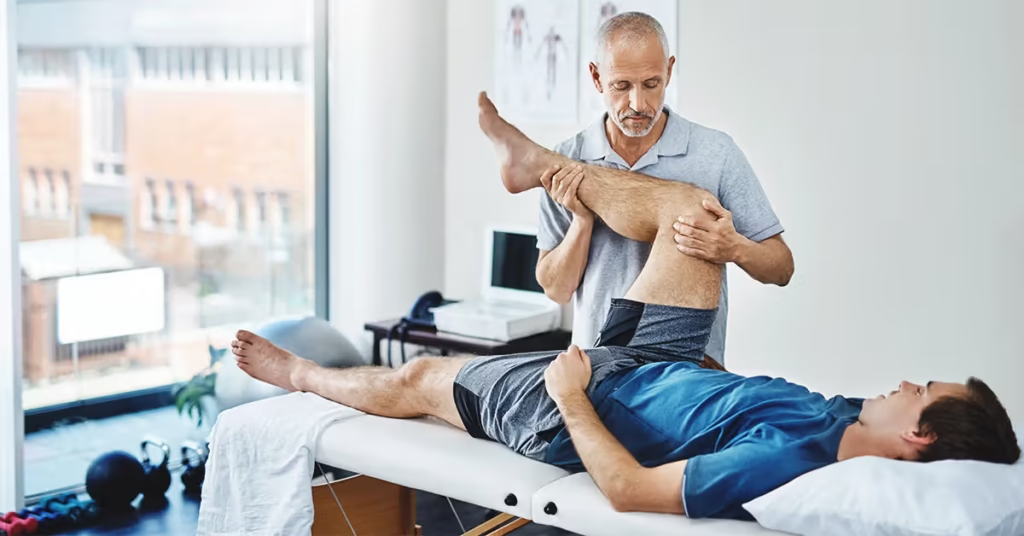
1. Professional Physical Therapy (PT)
This is the first treatment almost every doctor recommends for all types of leg weakness. In the treatment, the therapist uses neuromuscular re-education to make communication between the brain and muscles.
This treatment is best if you have sciatica or sarcopenia or if you are recovering from a surgery or injury.
2. Epidural Steroid Injections (ESI)
If there is an issue with your herniated disc and spinal stenosis, then the doctor may inject epidural steroids into the space around your spinal cord. This injection reduces swelling around the nerve.
It is best for severe nerve pain and weakness.
3. Prescription Medications
Where the doctor doesn’t find a serious issue for leg weakness, they may normally prescribe specific drugs to treat the source. They will give gabapentin or pregabalin to calm misfiring nerves. This medication helps strengthen vein walls, which leads to better circulation.
If you face muscle myopathy while taking medication, then a doctor may change the prescription.
4. Nerve Conduction Studies & EMG
Before giving any medication or treatment, a doctor needs to do a leg test in which small electrical pulses are sent through your nerves to see how fast the signal travels. This test helps to understand the pinpoint of where the nerve exactly gets damaged, for example, in the spine or hip area.
5. Minimally Invasive Vein Procedures
For Chronic Venous Insufficiency (CVI), where blood is pooling, doctors simply close the leaky veins. The treatments for this include endovenous laser ablation or sclerotherapy.
This treatment is best for heavy, swollen legs and painful varicose veins.
6. Revascularization (For PAD)
If the leg weakness is caused by peripheral artery disease, the surgeon does angioplasty. They just insert a tiny balloon to open blood vessels (arteries), often followed by a small mesh tube to keep it open.
This treatment is best for weakness and cramping that take place because of poor blood flow due to blocked arteries.
7. Surgical Decompression
When the nerve area gets too small, it can cause leg weakness too. The surgery is necessary to create space. Laminectomy is a suggested treatment for this; it removes a small piece of bone or the leaking part of a disc.
This treatment is best for those who have advanced spinal stenosis or a severe herniated disc.
8. Therapeutic Bracing (Orthotics)
Sometimes the leg weakness occurs because the muscles are too weak to hold the foot or knee in place. For this doctor’s suggestion, AFO (Ankle-Foot Orthosis), which is a custom-made brace that prevents foot drop.
This treatment is best for nerve damage or stroke recovery.
When to Seek Medical Attention? (Red Flags)
Immediately reach out to the doctor if you feel sudden one-sided weakness, as it can be a sign of stroke.
- When you feel you can’t control your bladder or bowels.
- When your legs are completely null and can’t support any weight.
- When weakness suddenly starts after a back injury.
- When you feel one leg looks thinner or smaller than the other.
- When you feel numbness that doesn’t go away easily.
- When you face severe pain in your legs while sleeping.
- Feeling heavy in the legs while also running a fever.
Elderly Leg Weakness Symptom Assessment
Evaluate onset patterns, mobility changes, and critical care priorities
Immediate Fall-Prevention Checklist:
How to Prevent Leg Weakness naturally?
Prevention is the best strategy to ensure your legs stay strong and reliable as you age. Follow the steps.
- 1. Prioritize Resistance Training
- 2. Maintain a Nerve-Friendly Diet
- 3. Practice Proper Posture & Ergonomics
- 4. Manage Chronic Conditions like Diabetes and Hypertension
- 5. Stay Hydrated and Electrolyte-Balanced
- 6. Choose Supportive Footwear
- 7. Don’t Ignore the Small Pains
- 8.Walk daily for 20 minutes
- 9.Stretch your hip flexors

What is Home Strength Test?
Some people think the leg weakness isn’t about any underlying disease but is just a simple tiredness. However, you can do different tests at home.
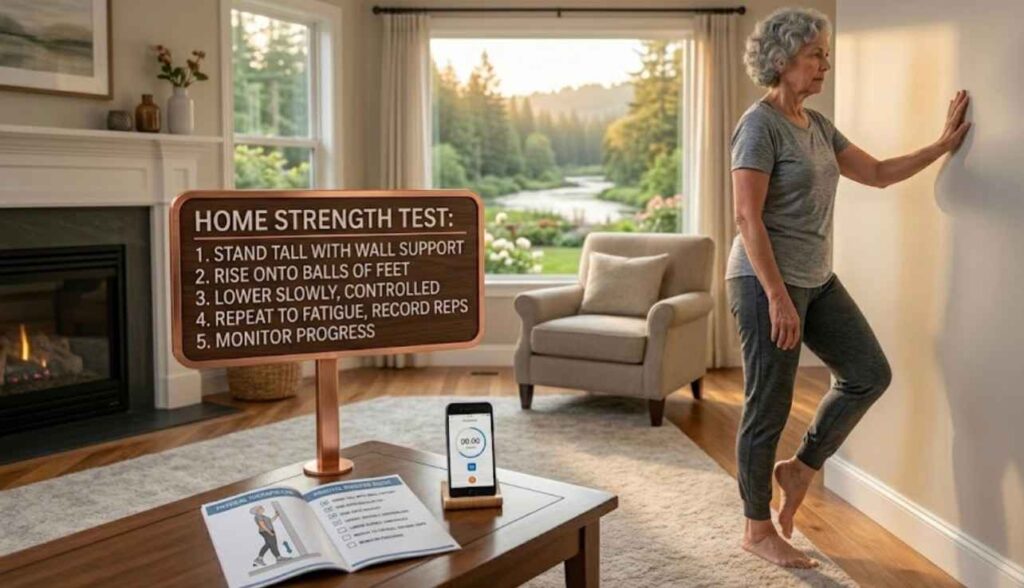
The first one is the Home Strength Test; it is a simple way to measure your lower body power without any need for professional equipment. This test helps you to understand if the leg weakness is because of tiredness or there is something else that needs a doctor’s attention.
The most accurate, scientifically backed version is the 30-Second Chair Stand Test.
How to Do the 30-Second Chair Stand Test?
Many physical therapists use this test to check functional strength.
To do it at home you just need a normal chair with a flat seat. A stopwatch or phone timer.
The Steps: First, place the chair against a wall, then sit in the middle of the seat by keeping your feet flat on the floor, shoulder-width apart. Now cross both arms over the chest so each hand touches the opposite shoulder. Remember not to use your arms to stand up.
Count how many times you can come to a full standing position in 30 seconds.
What Your Score Means (The Goal)
To see if your legs are strong for your age, aim for these numbers:
| Age Group | Men (Goal) | Women (Goal) |
|---|---|---|
| Below 60 | 17+ reps | 15+ reps |
| 60–64 | 14–19 reps | 12–17 reps |
| 65–69 | 12–18 reps | 11–16 reps |
| 70–74 | 12–17 reps | 10–15 reps |
| 75–79 | 11–17 reps | 10–15 reps |
If you are below the goal: You may have severe muscle weakness or sarcopenia related to aging.
If you cannot perform a single repetition without relying on your arms, this is a significant concern. It is crucial to seek the assistance of a physical therapist immediately.
The Single-Leg Balance Test
This test helps to understand the nerve communication and stability.
How to do it: Stand next to a counter, then lift one foot off the ground slowly and see how long you can balance on the other leg without touching the counter.
The Goal:
- Under 60: 30+ seconds.
- Over 60: 10–15 seconds.
If you notice you can’t hold a leg even for even 5 seconds, the risk of falling is higher.
“Perform these tests with a family member nearby or a sturdy piece of furniture to grab onto if you feel dizzy or shaky.”
Comparison Table: Is it a Muscle or Nerve Problem?
| Feature | Muscle Weakness (The Engine) | Nerve Weakness (The Wiring) |
|---|---|---|
| How it Feels | “Heavy,” “fatigue,” or a burning sensation like you’ve worked out too hard. | “Electric shocks,” “pins and needles,” or a “dead” numb feeling. |
| Pain Type | Dull, achy, or localized to a specific muscle (like the thigh). | Sharp, shooting, or “radiating” down the whole leg. |
| Sensation | You can feel your skin and touch normally. | You may have “dead spots” or areas where the skin feels like it’s wearing a thick glove. |
| When it Happens | Usually after movement or effort (gets worse with use). | Can happen while sitting still or even while sleeping. |
| The “Give Out” | Your legs feel shaky and slowly tire out. | Your leg might “buckle” or “drop” suddenly without warning. |
| Recovery | Usually improves with rest and protein/nutrition. | Requires releasing pressure on the spine or nerve path. |
| Common Causes | Overtraining, aging, or low potassium/magnesium. | Herniated disc, Sciatica, or Spinal Stenosis. |
Conclusion: Taking the First Step Toward Stronger Legs
Weakness in legs is a serious issue, not just a minor inconvenience; it is a sign your body is communicating about an issue. Whether the cause is simple, age-related, or a complex nerve issue like spinal stenosis, it is always better to take early treatment.
By understanding the causes and how you can tackle it at home or, if you can’t, what medical treatment you have, you have all the information to overcome this issue. You can also do a quick test at home and compare your symptoms against our Muscle vs. Nerve chart.
Frequently Asked Questions (FAQs)
1. Why do my legs feel weak, but I still have normal strength?
Consider it a perceived weakness often caused by fatigue, anxiety, or poor circulation, not caused by muscle failure. If you perform the leg test at home and your legs feel heavy, then this may be because of dehydration, low electrolytes, or a side effect of medication.
2. Can vitamin D deficiency cause leg weakness?
Yes due to the lack of vitamin D can also lead to weakness, as vitamin D is essential for muscle fiber function and calcium absorption. Lack of vitamin D can lead to osteomalacia, which has the symptoms of dull, aching weakness in the thighs and hips.
3. Is leg weakness a normal part of aging?
While muscle loss is common in old age, a sudden functional weakness isn’t normal. If you do test at home and find yourself tripping or needing to use your arms to push off a chair, then you need to do resistance training or go for a medical checkup.
4. How can I tell if my leg weakness is coming from my back?
If you experience shooting pain, tingling, or numbness that takes place from the buttock to the foot, then the main reason behind it is the lumbar spine.
5. What is the best exercise for weak legs in seniors?
Chair squats are the best exercise for seniors with weak legs, as it is an important movement for independence. You can walk regularly for better blood circulation.
6. When should I be worried about leg weakness?
You should be concerned when you notice one leg is weaker than the other. If it gets worse in a week or you face severe pain or numbness while standing or moving the leg, then see a doctor immediately.
Clinical References & Further Reading
- Spinal Stenosis (Mayo Clinic): A comprehensive look at how narrowing of the spinal canal impacts leg strength and mobility. https://www.mayoclinic.org/diseases-conditions/spinal-stenosis/symptoms-causes/syc-20352961
- Sarcopenia and Aging (NIH): Detailed research on age-related muscle loss and strategies for prevention through nutrition and exercise. https://www.ncbi.nlm.nih.gov/pmc/articles/PMC4066918/
- Balance and Strength Training (Harvard Health): Expert advice on specific exercises to improve lower body stability and prevent falls. https://www.health.harvard.edu/staying-healthy/better-balance-anytime-anywhere
- Peripheral Artery Disease (Cleveland Clinic): Understanding how circulation issues like PAD can cause legs to feel heavy or weak. https://my.clevelandclinic.org/health/diseases/17357-peripheral-artery-disease-pad
