
For many adults the sound of a mobile phone, like a call or a message, doesn’t bring a sense of connection or peace; it brings anxiety, terror, and fear. If you find yourself holding your breath before opening a text message from your mother or fabricating weekend plans to dodge conflict and avoid a lecture, then you are likely dealing with controlling parents.
In childhood, parental control is often considered protection; however, if they still control you in your 20s, 30s, and 40s, then it changes from protection to control, which leads to suffocation.
In this article we will talk in detail about the 30 major signs of controlling parents in adulthood and how to deal with controlling parents without losing your mind or your identity.
30 Signs of Controlling Parents in Adulthood
The following are 30 detailed signs broken into categories so you can understand easily:
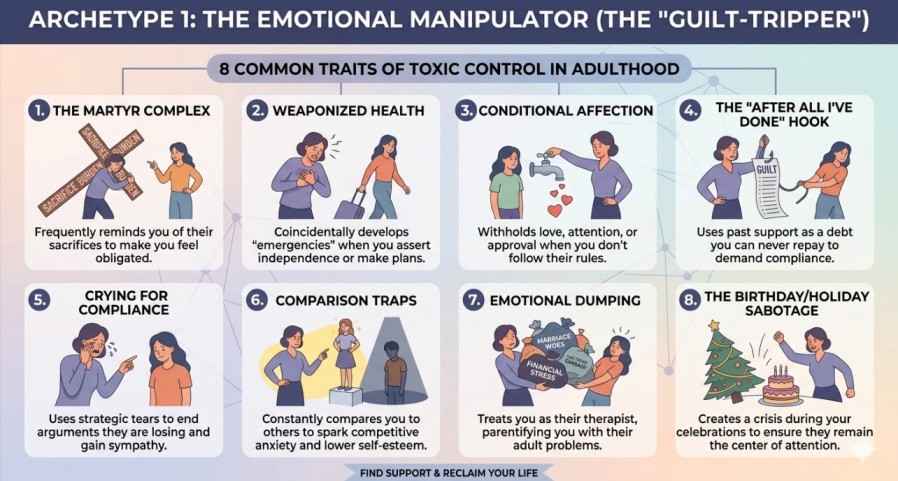
The Emotional Manipulator Parent
This category of parent doesn’t force you directly; instead, they use your own conscience against you. For example, you may hear someone complaining, “My parents are saying I’m a bad child” or “I’m not as good as the other kid.”
- The Martyr Complex: They frequently remind you of the physical or financial toll raising you took on them.
- Weaponized Health: They suddenly behave sick; they are having “chest pains” or “dizzy spells” just the moment you are out on vacation.
- Conditional Affection: They give you silent treatment after an argument.
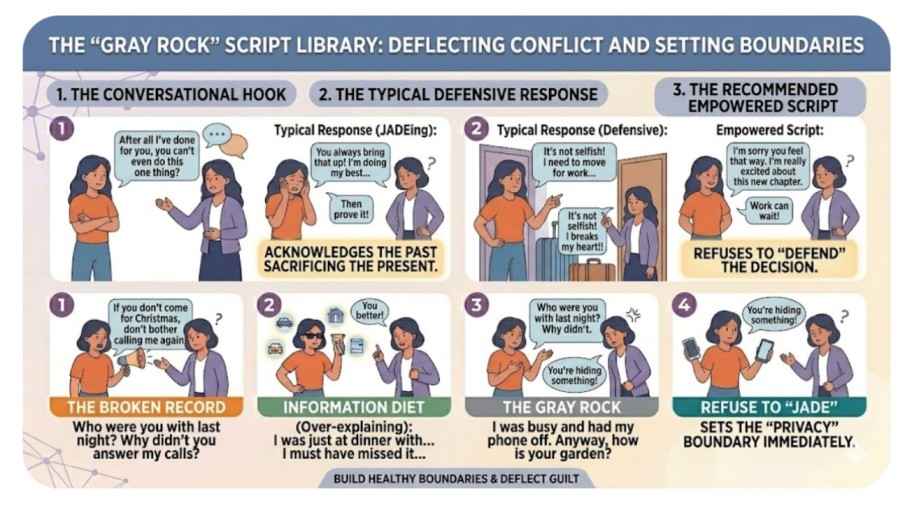
- The “After All I’ve Done” Hook: They connect disagreement with the whole list of their past sacrifices.
- Crying for Compliance: Tears are just used to calm the situation or to win an argument.
- Comparison Traps: You are always compared with your cousin or sibling.
- Emotional Dumping: They treat you like a free primary therapist, sharing unnecessary details about their failed marriage or finances.
- The Birthday and Holiday Sabotage: When they don’t get enough attention during a celebration, they create a crisis to regain center stage.
The Micromanager Parent
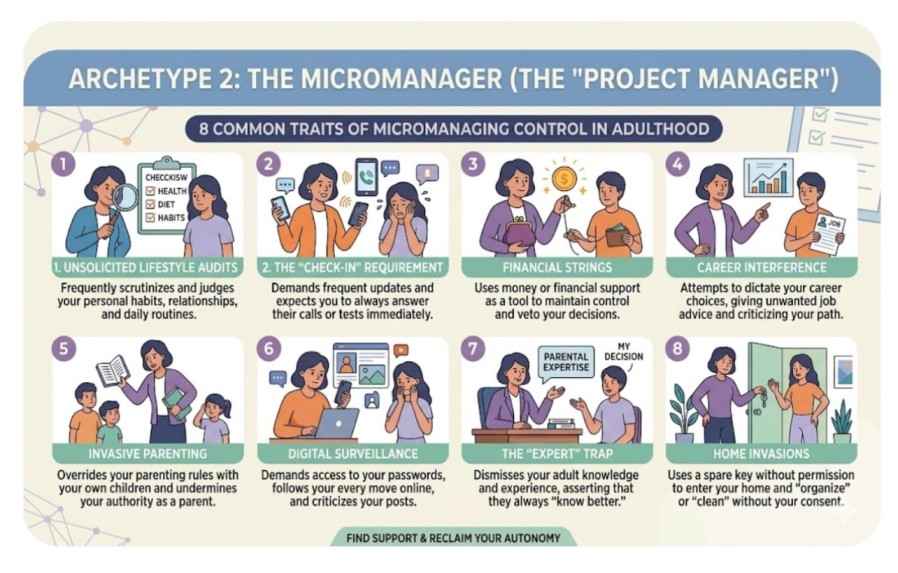
This type of parent thinks they can manage an adult like a project. They don’t believe you are capable of doing anything and can easily survive without them.
- Unsolicited Lifestyle Audits: They hurt you by commenting on your weight, skin color, hair, and sense of dressing.
- The “Check-In” Requirement: They expect you to update them daily about what you did the whole day.
- Financial Strings: They give you gifts and loans with several conditions.
- Career Interference: They even try to involve themselves in your professional life, like your job; they talk to your boss and employees to discuss your career.
- Invasive Parenting: They override your rules with grandchildren, like if you say no to sugar for your child, your father or mother would insist on giving it to them.
- Digital Surveillance: They want your social media passwords and even track your live location.
- The “Expert” Trap: They act like your education and life experience are nothing as compared to theirs.
- Home Invasions: They have a key to your house and access to your room. They go into your private stuff, like drawers, without asking.
The Enmeshed Parent
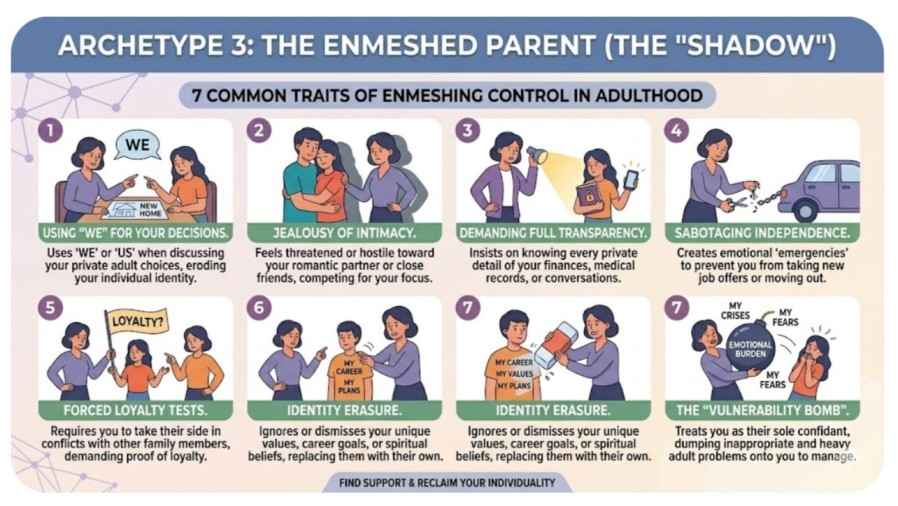
Enmeshment is a lack of emotional boundaries where the parent cannot distinguish their feelings from yours.
- Using “We” for Your Decisions: We are looking for a house, but in reality you are looking for a house.
- Jealousy of Intimacy: They behave jealous when you give someone else importance, like a spouse, partner, or best friend.
- Demanding Full Transparency: Even if you get sick or have a private therapy session, they want to know every single word.
- Sabotaging Independence: They never motivate you to go for another job in another city because family lives together.
- Forced Loyalty Tests: They force you to choose a side in a heated argument with another family member.
- Identity Erasure: They get angry when you express your opinion on a political, religious, or social view that is different from them.
- The “Vulnerability Bomb”: They share your private secrets with other family members to maintain a “gatekeeper” status.
The Gatekeeper Parent
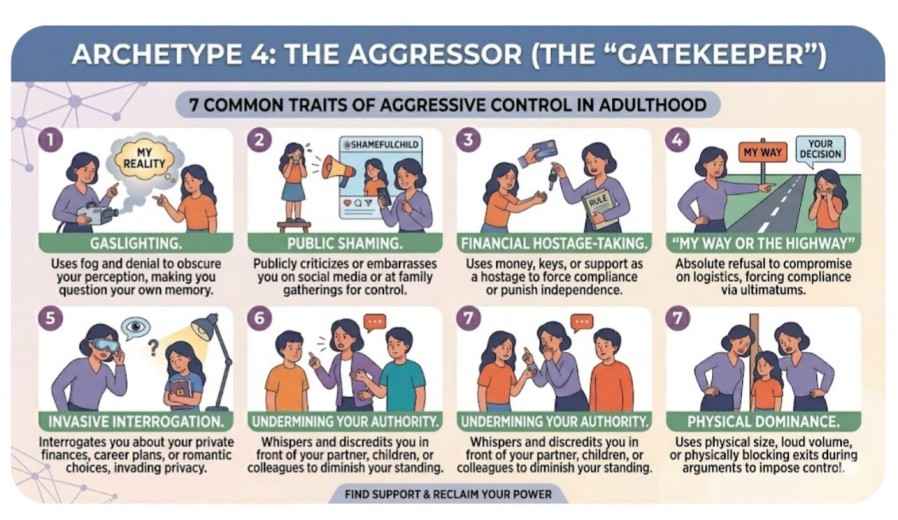
This is the most overt form of control, often bordering on or crossing into emotional abuse.
- Gaslighting: They deny every bad thing they said to you in any argument and pretend you hear wrong or take it in a negative way.
- Public Shaming: They embarrass you at family dinners and among neighbors to feel secure.
- Financial Hostage-Taking: In a heated argument they threatened to cut you out of the will or stop paying for a share to build pressure.
- “My Way or the Highway”: They refuse to attend your big events like weddings or graduations unless they are fully involved in all preparations.
- Invasive interrogation: They ask very personal questions like your finances, sex life, or medical history.
- Undermining Your Authority: They tell your friends or partner embarrassing stories just to make you small.
- Physical Dominance: They use loud volume in fights or block exits to prevent you from leaving a forceful conversation.
How It Affects a Child Raised by Controlling Parents
When a child is raised by controlling parents, it not only affects them emotionally but also affects their brain physiologically. When a child is not allowed to do anything according to their own will, the part of the brain that is responsible for decision-making becomes frozen or just shuts down, as it needs to build confidence, which never takes place in controlling parenting.
The Biological Toll: The Body Keeps the Score
When parents control their adult children, it can lead to the following issues:
Cortisol Spikes
Controlling built-up stress, which can lead to chronic fatigue and digestive issues. IVS is highly common among adults who can’t even breathe without parents’ decisions.
The “Startle” Response
Children who are in extreme control of parents find themselves very uncomfortable when their phone vibrates.
The Psychological Scars
Decision Paralysis: When a child is extremely controlled by parents, they become incapable of even making decisions on small choices like what to order at the restaurant or what to wear for a meet-up.
The “Fawn” Response
Most people fight back when they get into a fight, but children who are controlled by parents’ domain fight back; in fact, they try to please the upset person. They neglect their self-worth.
Internalized Criticism
The parent’s voice becomes your inner voice too. You don’t need them to criticize you anymore because you do it to yourself 24/7.
How to Deal with Controlling Parents Calmly?
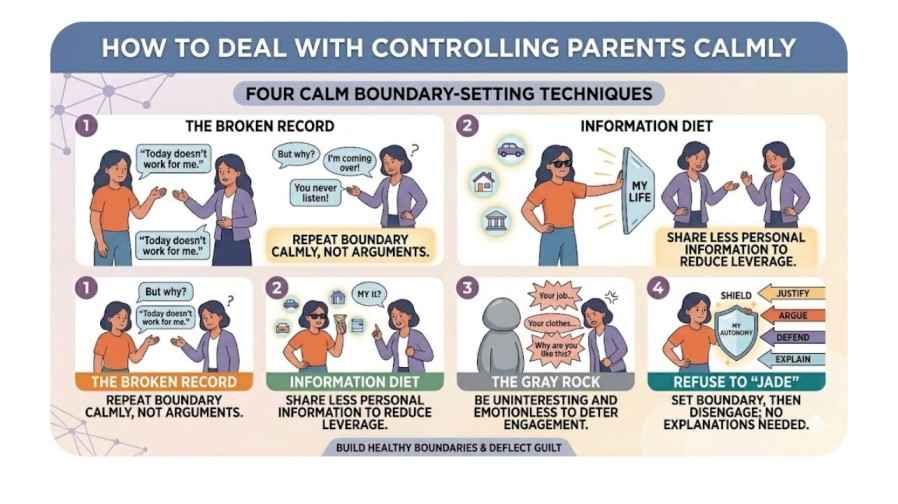
You can’t use logic with an overcontrolling parent. Control is an emotional need for them, often taking place long ago. Therefore, your strategy must be behavioral, not verbal.
Technique 1: The Gray Rock Method
The Gray Rock method is used by many adult children nowadays; it is the art of being uninterested and behaving like a rock. Controlling parents always win when the child is emotional, like if you give them reactions such as crying, yelling, or defending; they can easily win.
To behave like a gray rock gives them short and boring answers during daily talks and arguments.
Example: Your parent says, “I can’t believe you bought a car without my consent.” Then you just say, “Okay, do you want a cup of coffee?” That’s it.
Technique 2: The Information Diet
Controlling parents use information to control you, so the best thing you can do is avoid giving me any information about your life. If they use your job stress and ask you to change the job, stop telling them about your job tension.
The Rule: If a topic always leads to a fight, that topic is now “off-limits.”
Technique 3: The “Broken Record”
When they push a boundary, do not explain why the boundary exists. They will see explanations are as negotiations.
For example, Parent: “I’m coming over at 4 PM.”
You: “Today doesn’t work for me.” Parent: “Why? What are you doing? I’m your mother!”
You: “Today doesn’t work for me. We can try for next Tuesday.”
High-Stakes Logistics: Weddings, Moving, and Money
The 3 most common areas where controlling parents put a lot of pressure are weddings, moving, and money. Here is how to handle them as an empowered adult.
1. Controlling Parents and Wedding Planning
A controlling parent sees a wedding as a golden opportunity to control adults so they can show off to relatives and friends how much they have power over you.
The Financial Trap: If they are paying for your entire wedding, then they demand full grip on the decision-making table. If you want to avoid such pressure, it is better to bear the expense of your wedding instead of asking parents for it.
The Guest List: Set a “Hard Cap.” Tell your parents to provide a list of guests so there is no issue with seat arrangement on the event day. If they argue about flowers that I don’t like, etc., tell them I like them and I’m not discussing it further.
2. How to Tell Controlling Parents You’re Moving Out
When you talk about moving out with controlling parents, they become offended, as this is why they lost control over you.
The “Stealth” Move: If you’re planning to move out, the first thing you need to do is hide your passport, birth certificate, and social security card and place them in a safe location before talking about moving out.
The Announcement: Don’t just say I’m thinking of moving out. Let your controlling parents know once you sign the lease of the new house.
Managing the Fallout: They will use the emotional guilt strategy on you, like how can you leave me alone like this. Just respond, “I’m not leaving you; I only want to start my life alone as an adult.”
3. Financial Abuse in Adulthood
The biggest weapon of a controlling parent is financial abuse. They bear your expenses to keep you tethered.
The Bank Account Tactic: Many parents insist on having a joint account with children. If you have one, then close it today and move your money to a different branch.
The “Debt” Guilt: If they claim you owe them for all the expenses they did for you when you were a child, then remember child-caring is a gift, not a loan. You did not sign a contract to be born.
When to Seek Professional Support
In many cases self-help isn’t enough. If your parent has Narcissistic Personality Disorder (NPD) or Borderline Personality Disorder (BPD), your safety might be at risk. Here are some signs you need therapy:
- You always feel paralyzed by guilt even when you are doing everything right.
- You are lying to your partner to cover up for your parents’ behavior.
- You are facing nightmares or panic attacks before family meet-ups.
- You have suicidal thoughts in mind just to escape the controlling environment.
Choosing the Right Therapist
Don’t just go for any therapist. First get all the information and look at who specializes in family systems, enmeshment, or CPTSD. Keep in mind A therapist who focuses too much on “reconciliation” can harm you if your parents are extremely abusive. You need someone who validates and understands what you are going through.
The “Gray Rock” Script Library
FAQ for Adult Children of Controlling Parents
1. Is it okay to go “no contact”?
Yes, if the relationship gets very toxic and conversations always turn into fights, then it is better to go for no contact for some time.
2. How do I stop feeling so guilty?
Understand that guilt was used to control you. It is a false alarm. If you always feel guilty, you can’t move on and take any decision.
3. What if my parents are elderly?
You can take care of parents without giving them control of your life. You can take care of what they ate or if they are safe. Control is not a requirement for compassion.
Conclusion: Reclaiming the Narrative
Navigating controlling parents isn’t just about fixing but more about how you react. Remember, you can’t change a person who doesn’t even care that they are doing something wrong. However, you can change the style of living your life. Being an adult means you no longer need someone else to make decisions for you; that means you are the CEO of your own existence. You can keep your parents as consultants; they can offer advice, but they no longer have power over your life.
Also Read: Early Orthodontic Treatment: The Definitive Guide for Parents (2026)
Medical Disclaimer: This content is for informational purposes only and does not replace professional or health advice. Always consult a qualified expert if you have specific concerns.
References & Further Reading
- American Psychological Association (APA): Parenting Styles and Adolescent Development. apa.org
- Barber, B. K. (1996): Parental Psychological Control: Revisiting a Neglected Construct. Child Development, 67(6). Wiley Online Library
- Harvard Health Publishing: Understanding the Response to Stress. health.harvard.edu
- Journal of Child and Family Studies: The Impact of Over-parenting on Young Adult Self-Efficacy and Anxiety.Springer Link
- Mayo Clinic: Chronic Stress Puts Your Health at Risk. mayoclinic.org
- National Domestic Violence Hotline: Identifying Emotional and Financial Abuse. thehotline.org
- Pete Walker, M.A., MFT: The Fawn Response in Complex PTSD. pete-walker.com
- Psychology Today: Setting Boundaries with Controlling Parents. psychologytoday.com
