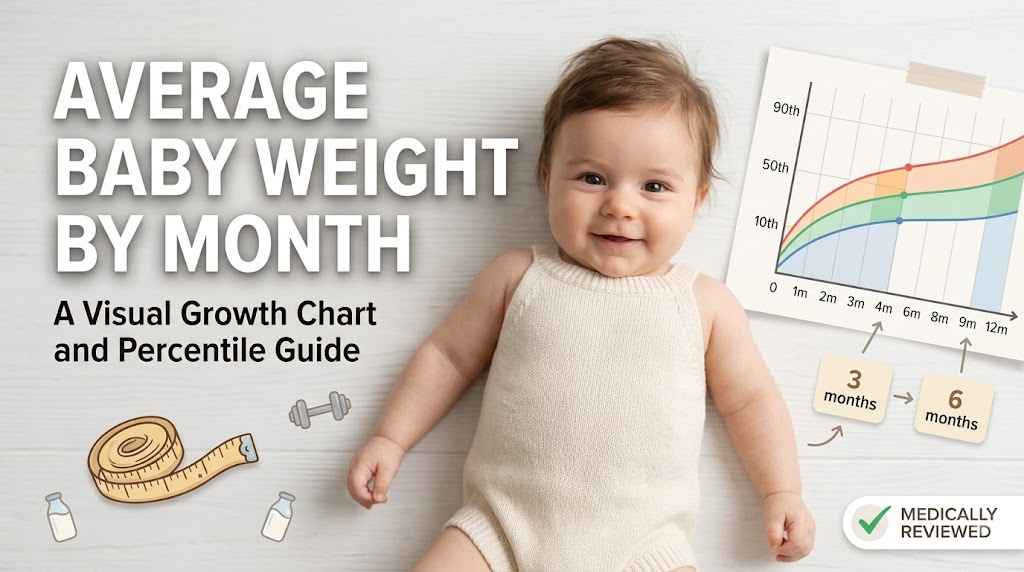
Quick Answer: The average baby weight by month typically doubles by 5 months and triples by a child’s first birthday according to WHO growth standards. At birth, full-term newborns average 7 to 7.5 pounds (3.2–3.4 kg). By 6 months, the average weight increases to around 16.2 pounds for girls and 17.7 pounds for boys, reaching approximately 19.8 pounds (girls) and 21.3 pounds (boys) at 12 months. Pediatricians use visual growth charts to ensure a baby gains weight consistently along their personal percentile curve (10th to 90th percentile spectrum) rather than focusing solely on median numbers.
Tracking a child’s developmental milestone is an exciting and joyful part of parenting, but checking a scale at pediatrician visits comes with many questions. After the visit, parents search for many questions, including the standard average baby weight by month, to find out if their child is growing normally or not. Pediatricians evaluate these numbers using growth percentiles.
A percentile ranking compares the child’s height (or length) and weight with the population of other healthy kids of the same age and gender. For example, if a 6-month-old girl falls in the 60th percentile for weight, it means she has more weight as compared to 60 out of 100 typical 6-month-old girls and less than 40 of them.
Why Growth Curves Matter More Than Single Numbers
It is very normal and healthy for children to fall in between the 3rd and 97th percentiles. A child in the 10th percentile isn’t underweight, and a child in the 90th percentile is not big. The main factor pediatricians monitor is consistency over time because they look for smooth progression with a child’s unique growth curve. A child who tracks with the 15th percentile throughout their first year is considered healthy and has normal development; the concern only takes place if a child faces sudden, dramatic shift drops from the 75th percentile down to the 15th percentile or if the growth curves flatten in months.
WHO Standards vs. CDC Standards: Why the Chart Changes at Age 2
The World Health Organization data comes from various studies based on healthy, breastfed infants raised in many countries around the world, as breastfed infants’ weight gain rate is little different from that of infants who are formula-fed. The WHO chart provides the international gold standard for normal infant physiology.
The Centers for Disease Control and Prevention charts track height instead of weight with how young children are measured once they can stand unsupported.
Infant Growth Charts: Birth to 12 Months (WHO Standards)
In the first year after the baby is born, they go through rapid growth changes in life. Most healthy newborns drop 7% to 10% of their birth weight in the first few days after birth and regain it in 10 to 14 days again. This means an infant’s weight can be doubled in 5 months and triple when they turn 1 year old.
Boys’ Weight & Length (0–12 Months)
| Age | Weight (10th %) | Weight Avg (50th %) | Weight (90th %) | Length (10th %) | Length Avg (50th %) | Length (90th %) |
|---|---|---|---|---|---|---|
| Birth | 6 lb 2 oz (2.8 kg) | 7 lb 8 oz (3.4 kg) | 9 lb 4 oz (4.2 kg) | 18.8 in (47.8 cm) | 19.7 in (49.9 cm) | 20.7 in (52.6 cm) |
| 1 Mo | 8 lb 3 oz (3.7 kg) | 9 lb 15 oz (4.5 kg) | 11 lb 14 oz (5.4 kg) | 20.6 in (52.3 cm) | 21.5 in (54.7 cm) | 22.5 in (57.2 cm) |
| 2 Mo | 10 lb 6 oz (4.7 kg) | 12 lb 6 oz (5.6 kg) | 14 lb 8 oz (6.6 kg) | 22.0 in (55.9 cm) | 23.0 in (58.4 cm) | 24.0 in (61.0 cm) |
| 3 Mo | 12 lb 2 oz (5.5 kg) | 14 lb 2 oz (6.4 kg) | 16 lb 8 oz (7.5 kg) | 23.2 in (58.9 cm) | 24.2 in (61.4 cm) | 25.2 in (64.0 cm) |
| 4 Mo | 13 lb 7 oz (6.1 kg) | 15 lb 7 oz (7.0 kg) | 18 lb 1 oz (8.2 kg) | 24.1 in (61.2 cm) | 25.2 in (63.9 cm) | 26.2 in (66.5 cm) |
| 5 Mo | 14 lb 8 oz (6.6 kg) | 16 lb 9 oz (7.5 kg) | 19 lb 6 oz (8.8 kg) | 25.0 in (63.5 cm) | 26.0 in (65.9 cm) | 27.1 in (68.8 cm) |
| 6 Mo | 15 lb 7 oz (7.0 kg) | 17 lb 7 oz (7.9 kg) | 20 lb 8 oz (9.3 kg) | 25.7 in (65.3 cm) | 26.6 in (67.6 cm) | 27.8 in (70.6 cm) |
| 7 Mo | 16 lb 5 oz (7.4 kg) | 18 lb 5 oz (8.3 kg) | 21 lb 8 oz (9.8 kg) | 26.3 in (66.8 cm) | 27.2 in (69.2 cm) | 28.4 in (72.1 cm) |
| 8 Mo | 17 lb 2 oz (7.8 kg) | 18 lb 15 oz (8.6 kg) | 22 lb 7 oz (10.2 kg) | 26.9 in (68.3 cm) | 27.8 in (70.6 cm) | 29.0 in (73.7 cm) |
| 9 Mo | 17 lb 14 oz (8.1 kg) | 19 lb 10 oz (8.9 kg) | 23 lb 4 oz (10.5 kg) | 27.4 in (69.6 cm) | 28.4 in (72.0 cm) | 29.6 in (75.2 cm) |
| 10 Mo | 18 lb 8 oz (8.4 kg) | 20 lb 5 oz (9.2 kg) | 24 lb 2 oz (10.9 kg) | 28.0 in (71.1 cm) | 28.9 in (73.3 cm) | 30.1 in (76.5 cm) |
| 11 Mo | 19 lb 2 oz (8.7 kg) | 20 lb 12 oz (9.4 kg) | 24 lb 14 oz (11.3 kg) | 28.4 in (72.1 cm) | 29.3 in (74.5 cm) | 30.6 in (77.7 cm) |
| 12 Mo | 19 lb 10 oz (8.9 kg) | 21 lb 6 oz (9.7 kg) | 25 lb 9 oz (11.6 kg) | 28.9 in (73.4 cm) | 29.8 in (75.8 cm) | 31.1 in (79.0 cm) |
Girls’ Weight & Length (0–12 Months)
| Age | Weight (10th %) | Weight Avg (50th %) | Weight (90th %) | Length (10th %) | Length Avg (50th %) | Length (90th %) |
|---|---|---|---|---|---|---|
| Birth | 5 lb 12 oz (2.6 kg) | 7 lb 1 oz (3.2 kg) | 8 lb 11 oz (3.9 kg) | 18.3 in (46.5 cm) | 19.4 in (49.2 cm) | 20.3 in (51.6 cm) |
| 1 Mo | 7 lb 8 oz (3.4 kg) | 9 lb 4 oz (4.2 kg) | 11 lb 0 oz (5.0 kg) | 20.0 in (50.8 cm) | 21.1 in (53.7 cm) | 22.0 in (55.9 cm) |
| 2 Mo | 9 lb 8 oz (4.3 kg) | 11 lb 4 oz (5.1 kg) | 13 lb 4 oz (6.0 kg) | 21.4 in (54.4 cm) | 22.5 in (57.1 cm) | 23.5 in (59.7 cm) |
| 3 Mo | 11 lb 0 oz (5.0 kg) | 13 lb 0 oz (5.9 kg) | 15 lb 4 oz (6.9 kg) | 22.5 in (57.2 cm) | 23.5 in (59.8 cm) | 24.6 in (62.5 cm) |
| 4 Mo | 12 lb 2 oz (5.5 kg) | 14 lb 2 oz (6.4 kg) | 16 lb 12 oz (7.6 kg) | 23.4 in (59.4 cm) | 24.5 in (62.1 cm) | 25.6 in (65.0 cm) |
| 5 Mo | 13 lb 2 oz (6.0 kg) | 15 lb 3 oz (6.9 kg) | 18 lb 0 oz (8.2 kg) | 24.2 in (61.5 cm) | 25.2 in (64.0 cm) | 26.5 in (67.3 cm) |
| 6 Mo | 14 lb 1 oz (6.4 kg) | 16 lb 2 oz (7.3 kg) | 19 lb 2 oz (8.7 kg) | 24.9 in (63.2 cm) | 25.9 in (65.7 cm) | 27.2 in (69.1 cm) |
| 7 Mo | 14 lb 12 oz (6.7 kg) | 16 lb 12 oz (7.6 kg) | 19 lb 14 oz (9.0 kg) | 25.5 in (64.8 cm) | 26.5 in (67.3 cm) | 27.9 in (70.9 cm) |
| 8 Mo | 15 lb 7 oz (7.0 kg) | 17 lb 10 oz (8.0 kg) | 20 lb 12 oz (9.4 kg) | 26.1 in (66.3 cm) | 27.1 in (68.8 cm) | 28.5 in (72.4 cm) |
| 9 Mo | 16 lb 1 oz (7.3 kg) | 18 lb 1 oz (8.2 kg) | 21 lb 8 oz (9.8 kg) | 26.6 in (67.6 cm) | 27.6 in (70.1 cm) | 29.1 in (73.9 cm) |
| 10 Mo | 16 lb 10 oz (7.5 kg) | 18 lb 12 oz (8.5 kg) | 22 lb 4 oz (10.1 kg) | 27.1 in (68.8 cm) | 28.2 in (71.5 cm) | 29.7 in (75.4 cm) |
| 11 Mo | 17 lb 3 oz (7.8 kg) | 19 lb 3 oz (8.7 kg) | 22 lb 14 oz (10.4 kg) | 27.6 in (70.1 cm) | 28.7 in (72.8 cm) | 30.2 in (76.7 cm) |
| 12 Mo | 17 lb 10 oz (8.0 kg) | 19 lb 14 oz (9.0 kg) | 23 lb 8 oz (10.7 kg) | 28.1 in (71.4 cm) | 29.1 in (74.0 cm) | 30.7 in (78.0 cm) |
Toddler Growth Charts: 13 to 24 Months (WHO Standards)
When children turn 1 or 2, their growth slows down as compared to early days when they were born. The toddler starts walking, so the body fat changes into lean muscle mass. When comparing the average baby weight by month during infancy to toddlerhood, all parents notice change where there’s a steady monthly increase and the curve is slow.
Boys Weight & Length (13–24 Months)
| Age | Weight (10th %) | Weight Avg (50th %) | Weight (90th %) | Length (10th %) | Length Avg (50th %) | Length (90th %) |
|---|---|---|---|---|---|---|
| 13 Mo | 20 lb 1 oz (9.1 kg) | 21 lb 13 oz (9.9 kg) | 26 lb 2 oz (11.8 kg) | 29.3 in (74.4 cm) | 30.3 in (76.9 cm) | 31.6 in (80.3 cm) |
| 14 Mo | 20 lb 8 oz (9.3 kg) | 22 lb 4 oz (10.1 kg) | 26 lb 11 oz (12.1 kg) | 29.8 in (75.7 cm) | 30.8 in (78.1 cm) | 32.1 in (81.5 cm) |
| 15 Mo | 20 lb 15 oz (9.5 kg) | 22 lb 11 oz (10.3 kg) | 27 lb 3 oz (12.3 kg) | 30.2 in (76.7 cm) | 31.2 in (79.2 cm) | 32.6 in (82.8 cm) |
| 16 Mo | 21 lb 6 oz (9.7 kg) | 23 lb 2 oz (10.5 kg) | 27 lb 12 oz (12.6 kg) | 30.6 in (77.7 cm) | 31.6 in (80.2 cm) | 33.0 in (83.8 cm) |
| 17 Mo | 21 lb 13 oz (9.9 kg) | 23 lb 9 oz (10.7 kg) | 28 lb 4 oz (12.8 kg) | 31.0 in (78.7 cm) | 32.0 in (81.3 cm) | 33.5 in (85.1 cm) |
| 18 Mo | 22 lb 4 oz (10.1 kg) | 24 lb 1 oz (10.9 kg) | 28 lb 14 oz (13.1 kg) | 31.4 in (79.8 cm) | 32.4 in (82.3 cm) | 33.9 in (86.1 cm) |
| 19 Mo | 22 lb 11 oz (10.3 kg) | 24 lb 8 oz (11.1 kg) | 29 lb 5 oz (13.3 kg) | 31.8 in (80.8 cm) | 32.8 in (83.2 cm) | 34.3 in (87.1 cm) |
| 20 Mo | 23 lb 2 oz (10.5 kg) | 25 lb 2 oz (11.4 kg) | 30 lb 0 oz (13.6 kg) | 32.1 in (81.5 cm) | 33.2 in (84.2 cm) | 34.7 in (88.1 cm) |
| 21 Mo | 23 lb 9 oz (10.7 kg) | 25 lb 9 oz (11.6 kg) | 30 lb 8 oz (13.8 kg) | 32.5 in (82.6 cm) | 33.5 in (85.1 cm) | 35.1 in (89.2 cm) |
| 22 Mo | 24 lb 1 oz (10.9 kg) | 26 lb 0 oz (11.8 kg) | 31 lb 1 oz (14.1 kg) | 32.9 in (83.6 cm) | 33.9 in (86.1 cm) | 35.5 in (90.2 cm) |
| 23 Mo | 24 lb 8 oz (11.1 kg) | 26 lb 7 oz (12.0 kg) | 31 lb 10 oz (14.3 kg) | 33.2 in (84.3 cm) | 34.2 in (86.9 cm) | 35.9 in (91.2 cm) |
| 24 Mo | 24 lb 15 oz (11.3 kg) | 26 lb 15 oz (12.2 kg) | 32 lb 3 oz (14.6 kg) | 33.5 in (85.1 cm) | 34.6 in (87.8 cm) | 36.3 in (92.2 cm) |
Girls’ Weight & Length (13–24 Months)
| Age | Weight (10th %) | Weight Avg (50th %) | Weight (90th %) | Length (10th %) | Length Avg (50th %) | Length (90th %) |
|---|---|---|---|---|---|---|
| 13 Mo | 18 lb 3 oz (8.2 kg) | 20 lb 5 oz (9.2 kg) | 24 lb 2 oz (10.9 kg) | 28.5 in (72.4 cm) | 29.6 in (75.2 cm) | 31.0 in (78.7 cm) |
| 14 Mo | 18 lb 10 oz (8.4 kg) | 20 lb 12 oz (9.4 kg) | 24 lb 11 oz (11.2 kg) | 29.0 in (73.7 cm) | 30.1 in (76.4 cm) | 31.5 in (80.0 cm) |
| 15 Mo | 19 lb 1 oz (8.6 kg) | 21 lb 3 oz (9.6 kg) | 25 lb 4 oz (11.4 kg) | 29.4 in (74.7 cm) | 30.5 in (77.5 cm) | 32.0 in (81.3 cm) |
| 16 Mo | 19 lb 8 oz (8.8 kg) | 21 lb 10 oz (9.8 kg) | 25 lb 13 oz (11.7 kg) | 29.8 in (75.7 cm) | 31.0 in (78.6 cm) | 32.4 in (82.3 cm) |
| 17 Mo | 20 lb 0 oz (9.1 kg) | 22 lb 1 oz (10.0 kg) | 26 lb 5 oz (11.9 kg) | 30.2 in (76.7 cm) | 31.4 in (79.7 cm) | 32.9 in (83.6 cm) |
| 18 Mo | 20 lb 6 oz (9.2 kg) | 22 lb 8 oz (10.2 kg) | 26 lb 14 oz (12.2 kg) | 30.6 in (77.7 cm) | 31.8 in (80.7 cm) | 33.3 in (84.6 cm) |
| 19 Mo | 20 lb 13 oz (9.4 kg) | 22 lb 15 oz (10.4 kg) | 27 lb 6 oz (12.4 kg) | 31.0 in (78.7 cm) | 32.2 in (81.7 cm) | 33.7 in (85.6 cm) |
| 20 Mo | 21 lb 4 oz (9.6 kg) | 23 lb 9 oz (10.7 kg) | 28 lb 0 oz (12.7 kg) | 31.4 in (79.8 cm) | 32.6 in (82.7 cm) | 34.1 in (86.6 cm) |
| 21 Mo | 21 lb 11 oz (9.8 kg) | 24 lb 1 oz (10.9 kg) | 28 lb 8 oz (12.9 kg) | 31.8 in (80.8 cm) | 33.0 in (83.7 cm) | 34.5 in (87.6 cm) |
| 22 Mo | 22 lb 2 oz (10.0 kg) | 24 lb 8 oz (11.1 kg) | 29 lb 1 oz (13.2 kg) | 32.1 in (81.5 cm) | 33.3 in (84.6 cm) | 34.9 in (88.6 cm) |
| 23 Mo | 22 lb 9 oz (10.2 kg) | 24 lb 15 oz (11.3 kg) | 29 lb 9 oz (13.4 kg) | 32.5 in (82.6 cm) | 33.7 in (85.5 cm) | 35.3 in (89.7 cm) |
| 24 Mo | 23 lb 2 oz (10.5 kg) | 25 lb 8 oz (11.5 kg) | 30 lb 3 oz (13.7 kg) | 32.8 in (83.3 cm) | 34.1 in (86.5 cm) | 35.7 in (90.7 cm) |
Preschool & Young Child Growth Charts: 2 to 8 Years (CDC Standards)
When toddlers turn 2, the pediatricians use the CDC growth charts. At this age parents want to know the average weight of a 2-year-old to understand the development. The average weight of 2-year-old boys is around 28 lbs (12.7 kg), whereas the average weight of 2-year-old girls is around 26.75 lbs (12.1 kg).
Boys’ Weight & Height (Ages 2 to 8 Years)
| Age | Weight (10th %) | Weight Avg (50th %) | Weight (90th %) | Height (10th %) | Height Avg (50th %) | Height (90th %) |
|---|---|---|---|---|---|---|
| 2 Years | 24 lb 8 oz (11.1 kg) | 28 lb 0 oz (12.7 kg) | 32 lb 8 oz (14.7 kg) | 33.2 in (84.3 cm) | 34.2 in (86.9 cm) | 36.1 in (91.7 cm) |
| 2.5 Years | 26 lb 12 oz (12.1 kg) | 30 lb 0 oz (13.6 kg) | 35 lb 4 oz (16.0 kg) | 34.8 in (88.4 cm) | 36.0 in (91.4 cm) | 37.8 in (96.0 cm) |
| 3 Years | 28 lb 8 oz (12.9 kg) | 31 lb 12 oz (14.4 kg) | 37 lb 8 oz (17.0 kg) | 36.2 in (91.9 cm) | 37.5 in (95.3 cm) | 39.4 in (100.1 cm) |
| 3.5 Years | 30 lb 4 oz (13.7 kg) | 33 lb 12 oz (15.3 kg) | 40 lb 2 oz (18.2 kg) | 37.5 in (95.3 cm) | 39.0 in (99.1 cm) | 41.0 in (104.1 cm) |
| 4 Years | 32 lb 0 oz (14.5 kg) | 36 lb 0 oz (16.3 kg) | 43 lb 0 oz (19.5 kg) | 38.8 in (98.6 cm) | 40.3 in (102.4 cm) | 42.5 in (108.0 cm) |
| 5 Years | 35 lb 8 oz (16.1 kg) | 40 lb 12 oz (18.5 kg) | 49 lb 8 oz (22.5 kg) | 41.2 in (104.6 cm) | 43.0 in (109.2 cm) | 45.2 in (114.8 cm) |
| 6 Years | 39 lb 4 oz (17.8 kg) | 45 lb 12 oz (20.8 kg) | 56 lb 4 oz (25.5 kg) | 43.5 in (110.5 cm) | 45.5 in (115.6 cm) | 48.0 in (121.9 cm) |
| 7 Years | 43 lb 8 oz (19.7 kg) | 51 lb 4 oz (23.2 kg) | 64 lb 0 oz (29.0 kg) | 45.8 in (116.3 cm) | 48.0 in (121.9 cm) | 50.8 in (129.0 cm) |
| 8 Years | 48 lb 4 oz (21.9 kg) | 57 lb 0 oz (25.8 kg) | 73 lb 0 oz (33.1 kg) | 48.0 in (121.9 cm) | 50.5 in (128.3 cm) | 53.5 in (135.9 cm) |
Girls’ Weight & Height (Ages 2 to 8 Years)
| Age | Weight (10th %) | Weight Avg (50th %) | Weight (90th %) | Height (10th %) | Height Avg (50th %) | Height (90th %) |
|---|---|---|---|---|---|---|
| 2 Years | 23 lb 8 oz (10.7 kg) | 26 lb 12 oz (12.1 kg) | 31 lb 4 oz (14.2 kg) | 32.8 in (83.3 cm) | 33.8 in (85.9 cm) | 35.8 in (90.9 cm) |
| 2.5 Years | 25 lb 8 oz (11.6 kg) | 28 lb 12 oz (13.0 kg) | 34 lb 0 oz (15.4 kg) | 34.4 in (87.4 cm) | 35.6 in (90.4 cm) | 37.5 in (95.3 cm) |
| 3 Years | 27 lb 4 oz (12.4 kg) | 30 lb 12 oz (13.9 kg) | 36 lb 8 oz (16.6 kg) | 35.8 in (90.9 cm) | 37.1 in (94.2 cm) | 39.0 in (99.1 cm) |
| 3.5 Years | 29 lb 4 oz (13.3 kg) | 33 lb 0 oz (15.0 kg) | 39 lb 4 oz (17.8 kg) | 37.1 in (94.2 cm) | 38.6 in (98.0 cm) | 40.6 in (103.1 cm) |
| 4 Years | 31 lb 2 oz (14.1 kg) | 35 lb 0 oz (15.9 kg) | 42 lb 4 oz (19.2 kg) | 38.4 in (97.5 cm) | 39.8 in (101.1 cm) | 42.1 in (106.9 cm) |
| 5 Years | 34 lb 12 oz (15.8 kg) | 39 lb 12 oz (18.0 kg) | 49 lb 0 oz (22.2 kg) | 40.8 in (103.6 cm) | 42.5 in (108.0 cm) | 44.8 in (113.8 cm) |
| 6 Years | 38 lb 8 oz (17.5 kg) | 44 lb 12 oz (20.3 kg) | 56 lb 0 oz (25.4 kg) | 43.1 in (109.5 cm) | 45.0 in (114.3 cm) | 47.6 in (120.9 cm) |
| 7 Years | 42 lb 12 oz (19.4 kg) | 50 lb 8 oz (22.9 kg) | 64 lb 8 oz (29.3 kg) | 45.4 in (115.3 cm) | 47.8 in (121.4 cm) | 50.5 in (128.3 cm) |
| 8 Years | 47 lb 8 oz (21.5 kg) | 56 lb 14 oz (25.8 kg) | 73 lb 8 oz (33.3 kg) | 47.6 in (120.9 cm) | 50.3 in (127.8 cm) | 53.2 in (135.1 cm) |
5 Biological & Environmental Factors Influencing Growth
Genetics: The DNA of parents is a primary template for a child’s eventual adult stature and physical structure.
Preterm Birth & Adjusted Age: For babies who are born earlier than 37 weeks, pediatricians use the adjusted age when they check the growth charts of toddlers who are under 2 years old.
Nutrition & Feeding Method: Babies who are breastfed gain more weight in 2 to 3 months as compared to formula-fed infants in 3 to 12 months, but both have similar weight averages by age 2.
Sleep Patterns: The growth hormone is secreted during a deep non-REM sleep. When an infant has growth spurts, it leads to increased night sleep and daytime naps.
How to Get Accurate Growth Measurements at Home
The growth measurement takes place during a visit to the pediatrician, which is a golden standard; however, as a curious parent, you can also track it at home by following the methods.
- For Infants (Under 2 Years): Measure the length instead of height. For this, you need the baby to lie flat on a smooth surface, let their legs open completely, and mark the top of their head and bottom of their heel with the help of a pencil on a sheet of paper underneath them. Use a digital baby scale on a naked baby.
- For Toddlers & Kids (2 Years and Older): Measure the standing height without any shoes on. Let the kid stand with the heels, back, and head flush against a flat wall. Place a flat book on top of the head and press against the wall, then mark the spot.
Frequently Asked Questions on Average Baby Weight by Month
What does my child’s growth percentile actually mean?
A percentile is a comparison of your child with the other 100 children of the same age and gender. If your 6-month-old girl is in the 75th percentile for weight, it means she has more weight as compared to 75 girls out of 100.
Is being in a lower percentile (e.g., 10th or 25th) dangerous?
No two healthy children have different shapes and sizes. A child that is tracked on the 10th percentile curve every time is considered healthy, like a child in the 90th percentile curve.
What if my child isn’t at the average weight of 2-year-old toddlers or typical infant weight?
If your toddler’s weight is above or below the average 2-year-old weight, it is not a concern when the toddler is growing along their individual percentile curve and hitting developmental milestones.
When should I consult our pediatrician about growth?
Go to the doctor if you notice signs like the child dropping down or jumping across the percentile lines. Weight gain or height is over consecutive well-child checks, and lastly, if the child falls below the 3rd percentile or above the 97th percentile.
Medical Disclaimer: The information in this article is for educational purposes only and is not a substitute for professional medical advice, diagnosis, or treatment. Every child grows at their own unique pace, and variations from median growth charts are completely normal.
Sources for Further Reading
- WHO Child Growth Standards (0–24 Months)
- CDC Growth Charts (2 Years and Older)
- American Academy of Pediatrics: Growth Charts Explained
