Quick Answer: Most babies start to sit up with support between 4 and 6 months old and learn to sit independently without support between 6 and 8 months. By 9 months, most babies can pull themselves into a sitting position and sit confidently while playing.
Sitting up is one of the most exciting and transformative milestones in a baby’s first year because a baby marks a fundamental shift from observation to active engagement with the crowd around them. Once a baby transitions from lying flat to sitting up, their visual perspective opens completely, their upper body strength stabilizes, and their hands begin to reach for objects, all of which help build a precise anatomical foundation essential for starting solid foods, crawling, talking, and walking.
If you are a new parent looking for information on when do babies start to sit up? How to identify physical cues, or how to support your baby safely, you are not alone; we are all in the same situation at this stage of life. In this guide we will cover everything you need to know, so let’s start.
At-a-Glance: The Sitting Up Developmental Timeline
Every baby is different because they have their pace; gross motor development follows a predictable sequence known as cephalocaudal development in medical. Here is a complete physical timeline, including early neck control and full independent mobility.
| Age Range | Sitting Stage | Visible Physical Behaviors | Key Anatomical Milestones |
|---|---|---|---|
| 0 to 2 Months | Newborn Reflexes & Neck Lag | Head flops back when pulled to sit; turns head side-to-side on back | Cervical spine flexors developing; initial neck muscle tone |
| 3 to 4 Months | Head Control & Forearm Support | Lifts head 90° in tummy time; holds head steady when upright on lap | Cervical extensors and upper trap strength; reduced neck lag |
| 4 to 5 Months | Supported Sitting | Sits with parent lap support or pillow backing; torso slumps if unassisted | Thoracic spine stability forming; initial core engagement |
| 5 to 6 Months | Tripod Sitting | Leans forward resting both hands on the floor between spread legs | Lower back (lumbar) activation; shoulder girdle weight-bearing |
| 6 to 8 Months | Independent Sitting | Sits upright unassisted; turns head and reaches for toys without tipping | Full trunk control; lateral protective reactions (balance saved by arms) |
| 8 to 9 Months | Dynamic Sitting & Pivoting | Reaches across body; twists torso; shifts weight onto belly or hands and knees | Hip rotator mobility; abdominal oblique coordination |
| 9 to 10+ Months | Self-Transitioning | Moves independently from lying flat or crawling into a seated position | Complete core rotation, hip flexor strength, and motor planning |
The Physical Mechanics: How a Baby Learns to Sit
As adults we find sitting upright is a simple thing; however, if we talk about infants, it is not because sitting needs complex coordination of sensory systems, muscle groups, and postural reflexes. When parents ask when a baby can sit up, they need to understand what is actually happening inside the baby’s body to make the balance possible.
1. Muscle Groups Involved
Cervical extensors and flexors are muscles that stabilize the head over the shoulders; without head control, a baby cannot sit. Thoracic and lumbar extensors run along the spine. In early infancy the baby spine forms a single C shape. Once the back muscles get straight, the spine creates the inward curve (lordosis), which is required for upright balance.
The abdominal wall works as the front guy who keeps the body safe from falling backward. Lastly, hip flexors and glutes ground the pelvis on the floor, giving a wide and stable base of support.
2. The Role of the Vestibular and Proprioceptive Systems
To sit upright, the baby brain requires two major sensory inputs, which are the vestibular system and proprioception.
The Vestibular System (Inner Ear): These detect the motion, gravity, and spatial orientation and let the baby know when the body is tilted from the center.
Proprioception (Joint and Muscle Sensors): These inform the brain at which place the limbs are in space, so babies don’t need to look at them.
3. Balance Reflexes (Protective Reactions)
Before a baby can sit properly without falling, their body creates the automated protective reactions like frontal protection, lateral protection, and backward protection.
Frontal Protection (5–6 months): Once tipping forward, the baby shoots the arms out in front to catch themselves automatically.
Lateral Protection (7–8 months): When a baby is pushed sideways, they open the arms to the side to save themselves from falling.
Backward Protection (9–10 months): When a baby falls backwards, they open the arms behind them to save themselves from falling.
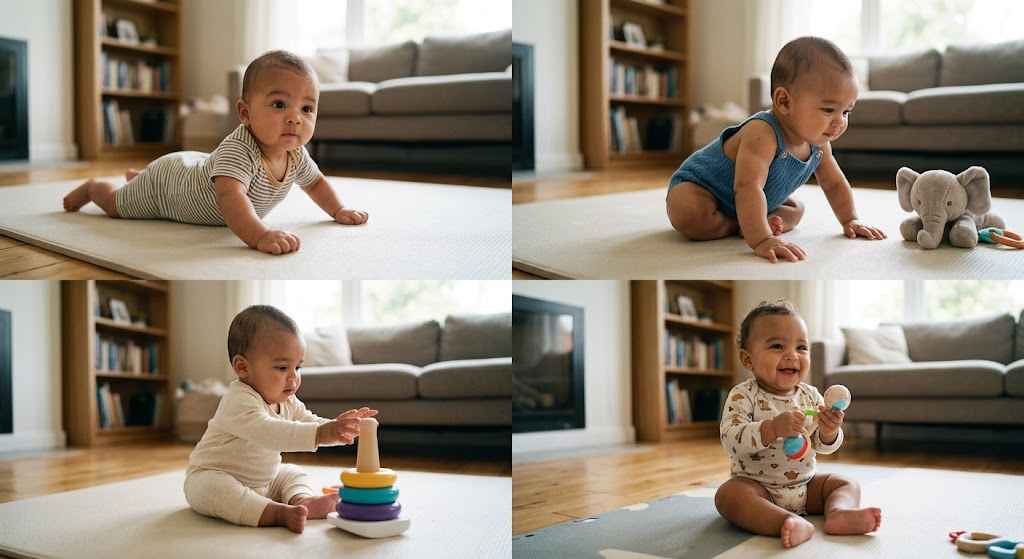
Step-by-Step: The 3 Primary Stages of Sitting
To understand the steps fully, here is a detailed guide as follows:
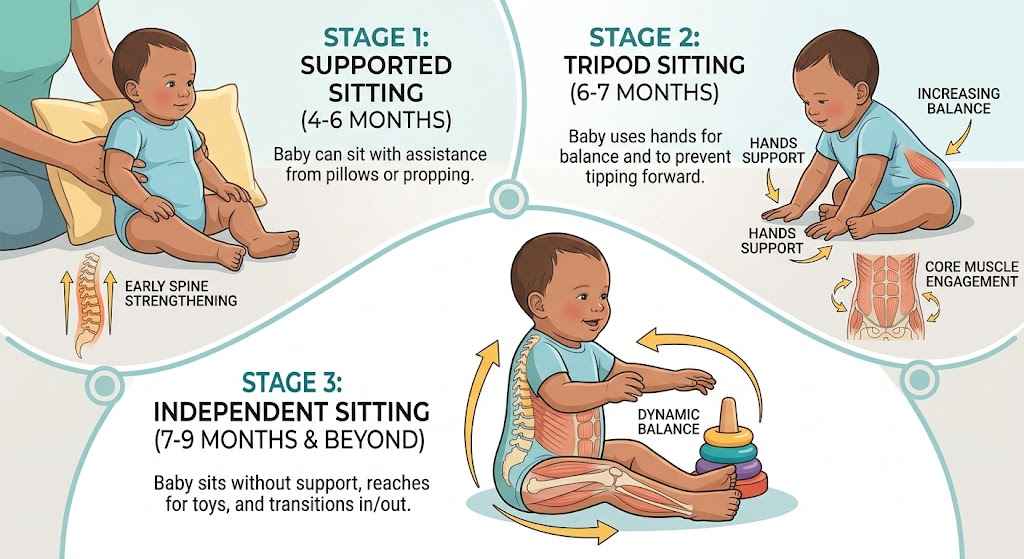
Stage 1: Supported Sitting (4 to 5 Months)
When a baby turns 4 months of age, they start to develop sufficient upper cervical strength in order to control the head reliably. In this phase when you put the baby on your lap or support it with a pillow, the baby can maintain an upright spine for short bursts.
You will observe during this phase the baby can’t hold the balance if you don’t support it. Head control is steady, but if they look at a pet or anything else suddenly, it can lead the whole upper body to sway. The baby uses the eyes to track the activity in the room; however, they depend on external physical support to be safe from falling.
Stage 2: Tripod Sitting (5 to 6 Months)
When a baby turns 5 to 6 months of age, they develop a mid-back and abdominal tone so the torso is stabilized. However, their lateral abdominal muscles and balance reactions are still not fully matured; they use the upper limbs as the structural kickstands.
Characteristics of the tripod position: In order to widen the base, you may see the baby is sitting with the legs positioned wide apart in a V shape. They hinge at the hips and keep both hands flat on the floor that is in front of them between their thighs. The bottom and hands form a three-point support system.
Even in this tripod position, the baby is still restricted because both hands are involved to keep the body upright, so they cannot play with toys while seated.
Stage 3: Independent Sitting (6 to 8 Months)
I have seen many parents talk about this in moms’ gatherings or even on the internet: When do babies sit independently? Well, according to the records, the majority of babies can sit full, unassisted, and hands-free when they turn 6 to 8 months of age.
Hands-Free Operation: The baby is not restricted; they can complete taking both hands off the floor to play with toys or to pick something because they sit with an erect spine.
Trunk Rotation: The baby can easily turn the head or upper chest to the left and right without the risk of balance losing or collapsing sideways.
Righting Reactions: If the baby sways to one side, the core muscles contract on the opposite side to pull them back to center.
Clarifying the Difference: Sitting When Placed vs. Sitting Independently
A confusing stage occurs in parents’ lives while tracking the milestone to understand the difference between a baby who can sit when placed and a baby who can sit up on their own.
Sitting When Placed
A parent physically lifts the baby and lets their bottom sit on the play mat; they even arrange the baby’s legs. The baby only keeps the posture maintained without falling.
At What Age Do Babies Sit Up On Their Own?
This one happens without parental support naturally as the baby, having been lying on their belly or back, pushes themselves up into a seated position independently.
The following chart outlines the major distinctions between these two developmental milestones.
| Feature | Stage 1: Sitting When Placed (With Support) | Stage 2: Independent Sitting (Unsupported) |
|---|---|---|
| Typical Age | 4 to 6 Months | 6 to 9 Months (varies widely) |
| What It Looks Like | Baby is propped up by pillows, a ‘Boppy,’ or held by a caregiver. They lean heavily on hands in a ‘tripod’ pose if left alone for a few seconds. | Baby sits tall with a straight spine, without hands for balance. They can turn their head and reach for toys. |
| Required Muscle Groups | Neck Control: Crucial for holding the head up. Core Stability: Developing, but not yet strong enough to support the whole upper body. |
Strong Core (Abs, Back, Obliques): The absolute foundation of stability. Back Extension: Needed to straighten the spine. |
| Balance & Coordination | Minimal: Requires constant physical support or propping to prevent tipping. | Mastering Dynamic Balance: Baby can shift their weight, recover balance, and reach. ‘Protective Extension’ (putting hands out to break a fall) is developing. |
| Role of the Arms | Structural Support: Arms are strictly for bearing weight on the ground. Hands are not free. | Exploration: Hands and arms are free to reach, grab, play, and explore their environment. |
| Precursor To: | Supported Sitting: Develops the basic posture, vision, and core strength for independent work. | Crawling: Once balance is stable, baby will lean forward, put weight on their knees, and prepare to move. |
| Key Parent Action | Supervision: Never leave a baby propped up alone. Practice: Encourage supervised ‘tummy time’ and short, supervised sitting practice with support. |
Supervised Play: Place toys slightly out of reach to encourage turning and reaching. Ensure the area is soft for falls. |
Early Physical Indicators: Signs Your Baby Is Ready to Sit Up
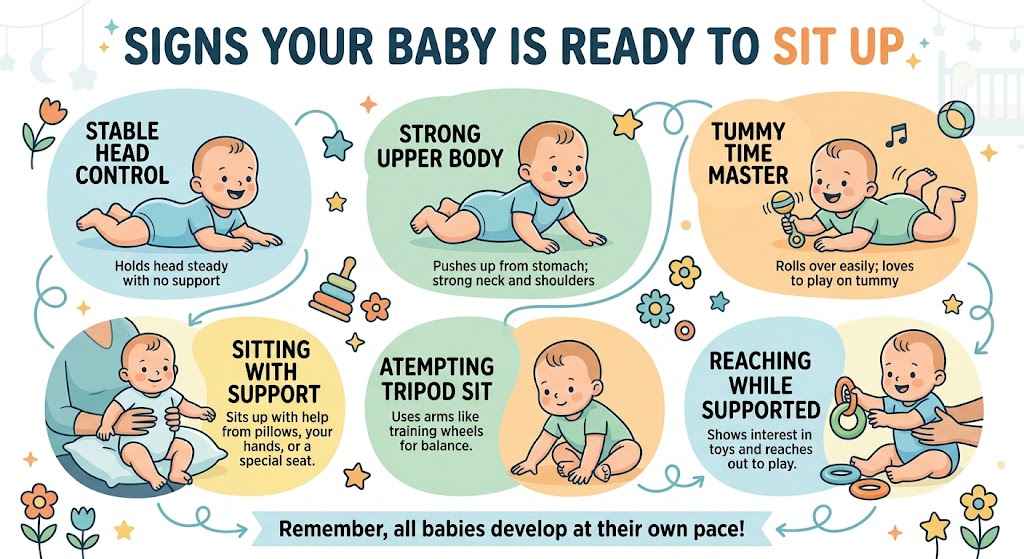
Before a baby tries to do tripod or supported sitting as a parent, you need to look at the following developmental prerequisites:
Flawless Head & Neck Control: When you hold the baby upright or move them, the head is stable and stays on center over the shoulders; it is not wobbling or lagging back anymore.
High Push-Ups During Tummy Time: When tummy time occurs, the baby pushes up by fully extending the arms and lifting the head, chest, and upper abdomen off the play mat.
Active Rolling (Back-to-Tummy and Tummy-to-Back): Rolling needs oblique strength, which is related to core strength important for upright balance.
Toe-Grabbing and Foot-Finding: When a baby is lying on their back, they pull the knees toward the chest, grab the feet, and bring the toes to the mouth. This action helps in building control over the lower abdomen and hip flexors.
Propping Intent: When you let the baby sit on your lap, you will notice the baby pushes the hands against your legs or independently tries to push their chest upright.
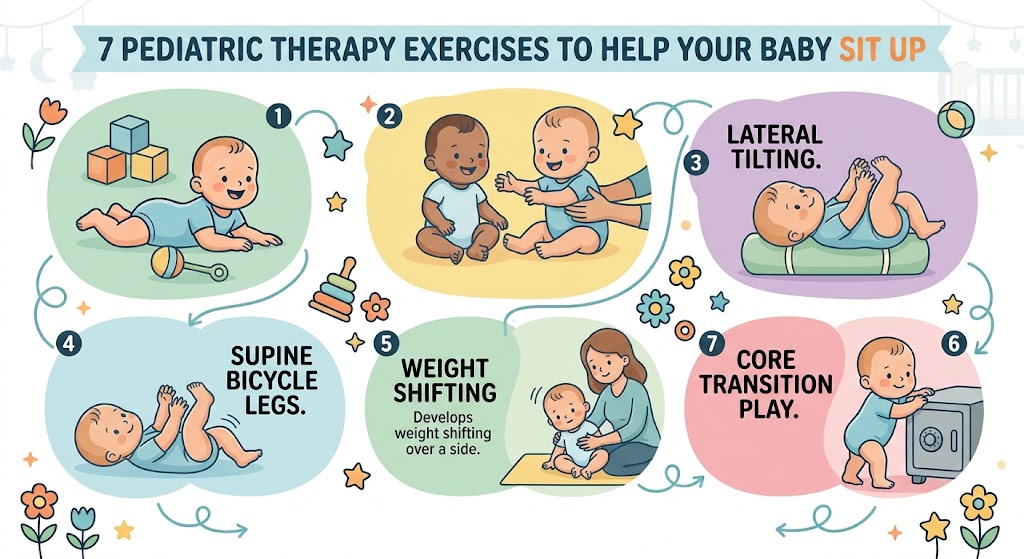
7 Pediatric Therapy Exercises to Help Your Baby Sit Up
While babies are their own natural timeline, when we talk about milestones, the structured movement play helps to strengthen the specific muscle groups needed for balance. Following are seven evidence-based activities you can do with your baby at home.
1. Purposeful Tummy Time Variations
Tummy time helps in building the whole poster on areas like the neck, back, glutes, and shoulders. A chest-to-chest tummy time is reclining on a couch at a 45-degree angle and placing the baby on your chest. This helps in building neck extension while keeping eye contact.
Another one is elevated tummy time; place a small rolled towel under the armpits of the baby to make lifting the head easy and support forearm weight-bearing.
2. Lower-Torso Lap Sitting
First sit on the floor with your back against a couch, then place the baby between the legs of yours, facing away from you. Instead of supporting the baby under their armpits or chest, place your hands low near the hips and upper thighs of the baby. This will work because the lower support you give will force the baby’s upper back, abdominals, and neck muscles to do full active work in order to make the torso upright.
3. The “Pull-to-Sit” Engagement Exercise
In this exercise you need to place the baby on their back on a cushioned play mat. You need to hold baby hands firmly and then guide them upward in a seated position. Make sure you don’t pull the passive baby up. Pause in the middle and let the baby give a reaction, like flexing their elbows, chin-tucking, and actively pulling their torso on you with the help of their abdominals.
4. Create a Protected “Pillow Ring” Environment
Once the baby is done with the tripod sitting, you can make a protective ring with the help of a crescent nursing pillow or couch cushions, which are placed in a horseshoe shape near the baby’s back and sides. You can add their favorite toys between the feet. If a baby loses balance and falls backward or sideways, then add a cushion near them for safety. This will train the brain to balance feedback without causing fright or injury.
5. Reach-and-Grasp Core Play
When a baby gets a full experience in the tripod position on the floor, you can take a toy and hold it above their eyes level. To touch that toy, the baby will lift one hand from the floor, which will transfer all the weight to another hand that is on the floor. This weight shift will open the internal and external obliques and lead to better body stability.
6. Mirror Play Engagement
When the baby is sitting in a tripod position, you can place a mirror in front of the baby. Infants love to see their own faces like reflections in the mirror. When they look in the mirror, they need to extend the neck, lift their chest, and maintain an upright gaze, which leads to natural straightening.
7. Gentle Side-Tipping (Righting Reflex Training)
When a baby is sitting on your lap or on a cushion, you can place your hands on their waist and gently sway their hips a few inches on both the left and right ones by one. When the hips tilt, look at the baby’s head and neck to curve back toward the center to let the eyes stay in the horizon. This will lead to trunk stability buildup.
The Container Warning: Why Floor Play Beats Baby Gear
Modern parents have access to all kinds of infant gear, including molded plastic floor seats, bouncing saucers, jumperoos, and inclined rockers. According to pediatric physical therapists, these products are referred to as containers.
| NATURAL FLOOR PLAY | PLASTIC FLOOR SEATS |
|---|---|
| Free weight shifting | Restricts pelvis movement |
| Full core & back activation | Forces artificial upright posture |
| Builds natural protective falls | Bypasses balance reflex development |
| Promotes hip joint health | Puts unnatural pressure on spine |
Why Overusing Containers Hinders Sitting?
The first issue is the artificial posture, as molded plastic floor seats force the baby spine to stay in an upright position even before their postural muscles are prepared to hold all the weight.
The second issue is the restriction of pelvic alignment; the rigid seats tilt the baby’s pelvis backward in a slouch, which prevents active engagement of both deep core and hip flexors.
The third issue is the reduction of motor exploration because a baby strapped into a seat is unable to practice falling over, prop hands, shifting weight, or reaching to the floor; all these teach balance.
The Golden Rule: Limit using a baby container to short periods like 10–15 minutes while making a meal and make more time on the floor for play on a firm mat.
The Medical Connection: Sitting Up and Starting Solid Foods
According to medical organizations like the American Academy of Pediatrics (AAP), the World Health Organization (WHO), and the CDC, you can start introducing solid foods to babies like purees or baby-led weaning when they turn 6 months of age. Here is a chart below to understand the safety needed when introducing solids while sitting as follows:
| Category | Impact on Solid Feeding | Key Benefits |
|---|---|---|
| Safe Airway Alignment | Prevents chin-to-chest slouching | Keeps airway fully open |
| Swallowing Mechanics | Allows tongue to move food back | Minimizes choking risk |
Why Does Sitting Stability Prevent Choking?
Airway Alignment: When a baby slumps into a high chair because of poor core strength, their chin drops on the chest, which narrows the trachea and leads to a choking risk.
Tongue Thrust and Swallowing: Safe swallowing needs a stable support of both jaw and neck. If the neck is wobbling, then a food bolus controlling in the mouth is dangerous.
Extrusion Control: When a baby is seated with good head control, they can easily turn the head to the side, lean away, or push the spoon to show the sign they are full.
High Chair Tip: When you place a 6-month-old baby into a high chair, make sure the feet are supported by a footrest. If the seat is too wide, then add a small kitchen towel on either side of the baby’s hips to provide lateral support.
Medical Disclaimer: The information provided in this article is for educational and informational purposes only and is not intended as medical advice. Always consult with a qualified healthcare provider or pediatrician regarding your child’s health, development, or any specific medical conditions.
Developmental Red Flags: When to Consult Your Pediatrician
Every infant has a unique schedule when it comes to milestones. A premature baby can achieve gross motor milestones according to their corrected gestational age (calculated from their original due date rather than their birth date). However, a delay or abnormal muscle can be a sign of underlying motor concerns. Always go to the pediatrician or a pediatric physical therapist if you observe the following signs.
| Age / Category | Red Flags to Watch For |
|---|---|
| By 4 Months |
• Severe neck lag when pulled to sit (head flops back completely) • Inability to lift head during tummy time |
| By 6 Months |
• Noticeably stiff (hypertonic) or flopping/limp (hypotonic) body tone when supported • Inability to hold head steady when upright • Fists kept tightly clenched at all times; does not reach for objects |
| By 8 Months |
• Inability to sit with support or maintain a tripod position on the floor • Does not bring hands together at midline or reach out to prop themselves |
| By 9 to 10 Months |
• Completely unable to sit independently without support • Unstable balance; constantly tipping over without extending arms to catch themselves |
| Asymmetrical Movement (Any Age) |
• Consistently tilts heavily to one side only • Props using only one arm while keeping the other arm pulled inward or unused |
Frequently Asked Questions by Parents
Can babies sit up at 4 months?
Yes, some babies can sit at the age of 4 months with the help of parent support; however, they cannot sit independently at 4 months. At this time period most infants work on neck control and build upper back strength through tummy time.
Is it safe to let my baby practise sitting on a bed?
It is considered a best practice to let the baby sit on a firm floor mat instead of a soft mattress or plush sofa because soft surfaces can sink under the baby’s weight, which makes it harder to balance. A firm play mat gives proper feedback to joint receptors and also removes the risk of falling.
What developmental milestones come immediately after sitting?
Once the baby master is sitting independently, they progress through the motor sequence, like twisting or turning 360 degrees on the bottom, shifting on all fours, moving forward on hands or knees, and lastly trying to stand in position with the help of furniture, crib rails, or parent legs.
What should I do if my baby hates tummy time?
If your baby hates the tummy time and cries hard, then you can modify steps like placing the baby chest-to-chest on your reclined body. Lay on the floor and make eye contact with the baby. Place a rolled towel under their chest.
Summary: Key Takeaways for Parents
Support sitting takes place at the age of 4 to 5 months, tripod positioning occurs at 5 to 6 months, and true independent sitting takes place in 6 to 8 months. Babies get up on their own between 8 and 10 months. Independent sitting is important for solid foods at the age of 6 months. Go for more floor play than containers.
