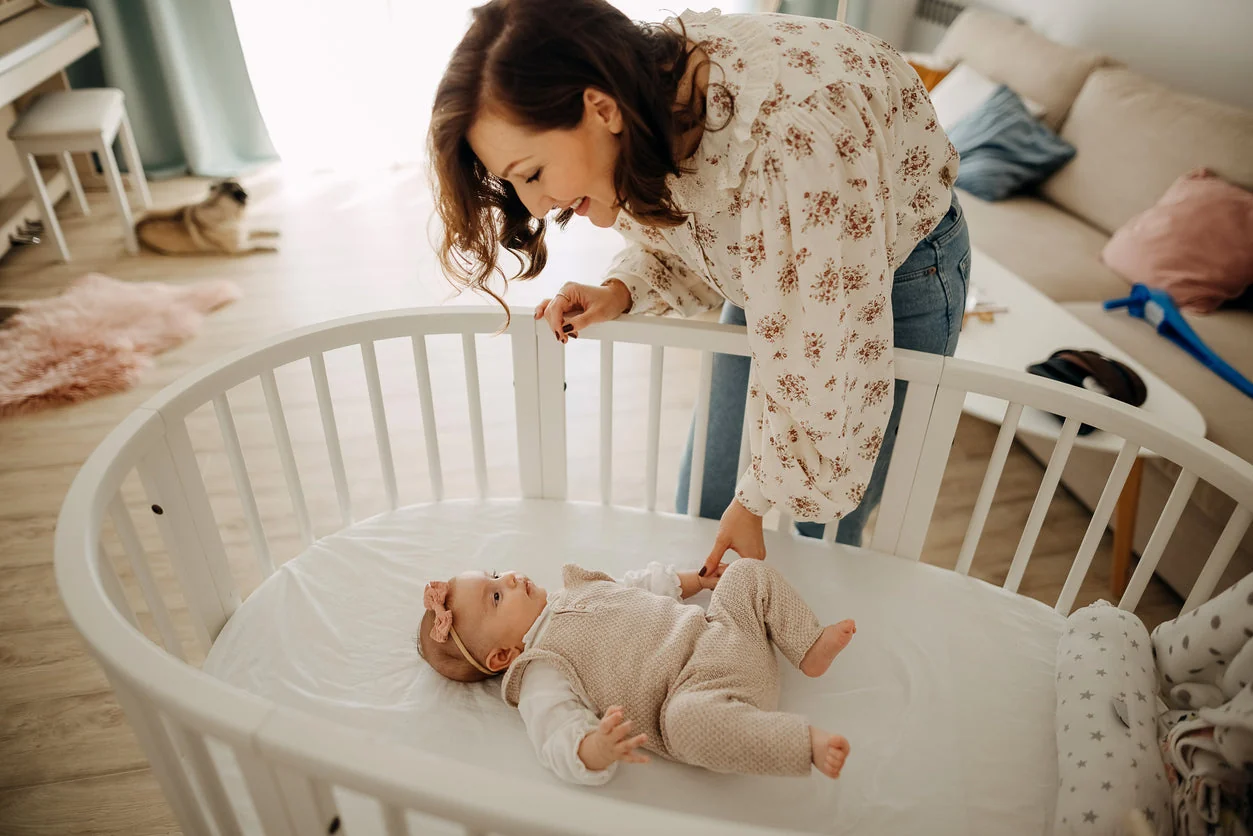
The hallway thermostat says 72. At two in the morning you put a hand on your baby’s back, and she’s damp with sweat. Both of those things are true at the same time, and the thermostat isn’t broken. If your nursery runs hot no matter what number you set, the problem usually isn’t the number. It’s where that number gets measured, how air actually moves into and out of that one room, and how much moisture is riding along with it.
Here’s what’s really going on and which piece of the standard advice you can safely ignore.
Your thermostat measures one spot, and it is not the crib
A thermostat reads air temperature at exactly one point in your home. Usually that’s a hallway wall, about five feet off the floor, often near a return vent where air is being pulled back into the system. It’s a decent average for the house. It tells you almost nothing about a closed room at the end of a hallway with a west-facing window.
Parents often find a real gap, sometimes several degrees, between the hallway reading and the actual air over the crib. That gap isn’t a malfunction. It’s the predictable result of how the room is built and how it’s used.
Four reasons the nursery drifts warmer than the rest of the house
The door is closed all night. This is the big one, and almost nobody hears about it. Your system pushes conditioned air into the room through the supply vent, but that air has to get back out to return to the unit. In most homes the return path is the hallway. Close the door and you pressurize the room, airflow slows, and the air in there starts drifting toward whatever the room wants to be. Rooms with a closed door and no dedicated return run measurably warmer.
It’s at the end of the duct run. Air loses energy over distance. The room farthest from the air handler gets the least of everything: less volume, less velocity, and less cooling. Nurseries are often a back bedroom, which is often the end of the line.
The sun loaded the room hours ago. A west-facing nursery absorbs heat all afternoon into the drywall, the floor, and the furniture. That mass keeps releasing it long after sunset. By bedtime the air might read fine while the surfaces around the crib are still giving heat back.
Everything in the room makes heat. A humidifier, a video monitor, a sound machine, a nightlight, and a plug-in warmer all run continuously in a small closed space. Individually they’re trivial. Together, in a room with restricted airflow, they’re not nothing.
The humidity is half too hot
Temperature alone is a bad description of comfort. A room at 76 degrees and 45 percent humidity feels fine. The same room at 76 degrees and 65 percent humidity feels swampy, because sweat can’t evaporate efficiently and the body loses its main way of shedding heat. When parents say the nursery is stuffy rather than hot, they’re usually describing a moisture problem.
The EPA’s guidance on indoor moisture says to keep indoor humidity below 60 percent, and ideally between 30 and 50 percent. Above that, you’re not just uncomfortable; you’re in the range where dust mites and mold do well.
There’s a counterintuitive version of this worth knowing. An air conditioner that’s oversized for the house cools the air fast, hits the setpoint, and shuts off before it has run long enough to pull much moisture out. The result is a room that’s technically cool and still feels clammy. Short, frequent cycles are the tell.
What the guidance actually says about nursery temperature
You’ll see 68 to 72 degrees repeated everywhere as the correct nursery temperature, usually credited to the American Academy of Pediatrics. That attribution isn’t accurate. The AAP’s safe sleep guidance warns against overheating and over-bundling, but it doesn’t publish a temperature range.
What it does say is more practical. Dress your baby in no more than one additional layer than an adult would wear to be comfortable in the same room, and watch the baby rather than the thermometer. The AAP’s safe sleep guidance says to check your baby for signs of overheating, such as sweating, a hot chest, or flushed skin.
That’s a better target than a number, because 70 degrees in a dry room and 70 degrees in a humid one are different experiences for a sleeping infant.
How to check your room in about five minutes
- Put a cheap combination thermometer and hygrometer at crib height, not on the dresser and not on the windowsill. You want the air the baby is actually breathing.
- Leave it overnight with the door closed, the way the room really sleeps. Check it in the morning against what the hallway thermostat was set to.
- Hold a single square of tissue to the supply vent. It should be pulled or pushed firmly, not fluttering weakly. Weak airflow at one vent while other rooms are fine points at a duct problem, not a thermostat problem.
- Run the same test with the door propped open. If the room reads two or more degrees cooler, you’ve found your answer, and it’s a return air problem.
What you can fix yourself this week
Start with the door, since it’s free. If you can sleep with it cracked and your monitor covers you, do it. If you can’t, an undercut door with three quarters of an inch of clearance at the bottom gives air somewhere to go. A transfer grille or a jumper duct, which is a short connector that lets air pass between two rooms over the closed door, solves it properly and is a small job for a contractor.
Close blinds or curtains in early afternoon rather than at bedtime. You’re trying to stop heat from entering the room in the first place, not trap it once it’s already in the drywall. Move the humidifier away from the crib and off the same wall as the thermostat sensor if you have a remote one. Run a ceiling fan on low for air movement, keeping it well clear of the crib and any cords.
Then reassess with the hygrometer. Most nurseries improve noticeably from the door fix alone.
When it stops being a room problem
A few patterns mean the room isn’t the issue, and no amount of curtain management will help.
- The gap between the nursery and the rest of the house stays above three degrees after you’ve fixed the airflow path.
- Humidity in the room sits above 60 percent even when the system is running normally.
- The system runs almost constantly in the evening and still can’t hold the setpoint.
- The house feels cool and damp at the same time, which usually means short cycling.
Those are system-sizing, ductwork, and moisture-removal questions, and they get solved at the equipment rather than in the nursery. Dedicated dehumidification, better filtration, and properly balanced returns are the tools for it, and indoor air quality equipment is usually what an AC repair contractor in Port St. Lucie will be evaluating when a single room won’t hold a comfortable, dry temperature.
The bottom line
A nursery that runs hot is almost never a thermostat that needs a lower number. It’s a closed door with nowhere for air to go, a room at the end of the duct run, an afternoon of accumulated solar heat, or humidity that the system isn’t removing. Check the air at crib height, fix the return path first, and use your baby’s condition rather than a number you read online as the real measure of whether the room is right.
