
Quick answer: The healthy head circumference normal range for a full-term newborn baby is typically 32 to 37 cm (12.5 to 14.5 inches), with a universal average baseline of 35 cm (13.8 inches). Because boys naturally track slightly larger than girls, pediatricians look for a steady growth curve matching the World Health Organization (WHO) milestones rather than a single perfect measurement.
When my first baby was born, I’m not going to lie, I learned many things and spent all the time to understand this tiny miracle.
I also panicked about everything because I wasn’t an experienced parent. The main thing that drew my attention and made me curious was the head circumference of newborn babies. His head looks big as compared to his small torso, and like any new mom, I want to know everything about it to make sure my baby is completely normal and fine, so if you are also at the same stage in life as I was, then don’t worry; it is a learning and exploring phase of parenting.
In this comprehensive guide, we will examine the normal range of head circumference month by month, the proper method for measuring a baby’s head size, and the warning signs that indicate when a visit to the doctor is necessary.
What is the head circumference normal range?
When you take the child to the pediatrician’s office and watch the doctor using a yellow paper tape around the child’s head, they are just checking a vital sign called the fronto-occipital circumference. As new parents, when we hear numbers like “35 centimeters” or “the 60th percentile,” we immediately get confused and curious to know if the kid is okay, if this number is normal, or if I need to worry. To understand these numbers, we need to look at head circumference normal range and what it means.
The Spectrum, Not a Single Number
The first thing you need to know is that “normal” in pediatrics means a wide, welcoming spectrum, not one target line. According to the World Health Organization, the healthy head circumference normal range lies between the 3rd and 97th percentiles.
According to Dr. Preeti Parikh, MD, Pediatrician: What really matters isn’t a baby’s specific percentile; it’s that they stay within the same percentile range from checkup to checkup.
To understand this easier way, suppose a room has 100 healthy kids; a kid in the 3rd percentile has a small head as compared to a kid in the 97th percentile. A kid who is in the 90th percentile has a larger head than others. All these kids are completely normal and healthy.
A normal baby head circumference means the baby brain is growing according to the genetic blueprint. Just like adults buy small hats, some buy large ones; babies also come in different shapes and sizes. Parents often panic when their kids have big head sizes; however, pediatricians know the head circumference of newborn babies and infants is heavily related to genetics.
A baby’s head can be large if the parents also have the same head; this is called benign familial macrocephaly, so if your spouse buys adjustable hats or struggles with sunglasses, then don’t be shocked when the baby’s chart tracks changes from the 90th or 95th percentile.
Tracking the Shift: From Newborn to Toddler
The baby skull is like an incredible piece of engineering. When a child is born, the skull is made of separate plates connected by soft and flexible spaces called fontanelles, which allow the head to safely mold at the time of delivery and let the brain develop fully for the whole first year. This is the main reason parents notice head circumference normal range changes month by month.
- The Starting Line: The standard range of normal head circumference of newborns lies between 32 and 37 cm.
- The First 6 Months: In this phase parents explore so much about head changes because baby head circumference expands by roughly 2 cm per month in the first 3 months after birth and 1 cm per month during 3 to 6 months.
- The Toddler Slowdown: When the kid became 1 year old, the rapid expansion turned off. Between the ages of 1 and 3, the head only grows a total of 2 to 3 cm.
The Golden Rule: It’s All About the Curve
As a mom I was curious about my kids’ head sizes as well, but what I noticed is that one single measurement won’t tell anything. The trend line tells you everything. When the pediatrician plots the baby’s head circumference baseline and follows it for 6 to 24 months, they are actually looking for a steady curve.
If a baby starts from the 15th percentile at birth and stays at the same point for 1 year, this is perfect; they are growing as they are meant to. The main reason doctors track the range is to notice sudden deviations like a line that spikes from the 20th percentile up to the 95th or drops from the 80th down to the 10th. The goal is to see a consistent and predictable growth pattern.
How to Measure Baby Head Circumference Accurately at Home?
When you try to measure a baby’s head at home by using tape for measurement, it feels like you are measuring a moving target. When you get a different number every time at measurement, don’t feel stress, as it is very common and takes a couple of tries to get it right.
To get a correct and doctor-level measurement at home so you can compare baby head circumference on a chart, all you need is a specific medical protocol. Here is a step-by-step, mom-tested guide as follows to measure head size accurately.
According to Dr. Michael M. Segal, MD, PhD, Pediatrician and Neurologist: Measuring a baby’s head circumference at home can be a great way for parents to stay informed, but it requires a very specific technique to be accurate.
Gather the Right Tools
Before you start to measure, make sure you are using the correct equipment. Use a flexible and non-stretchable plastic or cloth measuring tape.
Never use any metal-based tape measure because it is sharp and not safe for a baby because a baby moves constantly. Avoid standard string or yarn because wool stretches and gives you the wrong measurement.
The Step-by-Step Measurement Protocol
To get a perfect measurement, you need to measure the widest part of the baby’s head instead of placing the tape near the neck or too high near the crown so you won’t get false numbers.
1. Position your baby comfortably: it is the easiest to do this when the baby is calm. Lay them flat on their back on the bed and hold tight. If the baby is in a wiggling mood, give them a toy so they stay distracted and you have some minutes to do the measurement work.
2. Locate the physical landmarks: The next step is to identify 3 anatomical landmarks where the tape needs to sit. One is above the eyes; don’t let the tape slip down on eyes or hairline. Second, over the flat part of the skull, and third, the bulging part of the back of the baby’s skull.
3. Wrap and pull snugly: Now in the third step, you need to wrap tape around the landmarks. Before you read the number, make sure to press the tape gently on the head because this will provide the accurate result; however, also don’t tighten the tape on their skin.
4. Take the reading: In this step you need to take the reading, so look closely at where the zero line meets the tape. Note the measurement; it can be 0.1 millimeters or 16 inches. The head circumference of newborn babies changes by millimeters a week; precision matters.
5. The Rule of Three: Measure three times by taking the tape off every time and measure again. Note all three measurements you take; if they are different every time, consider the largest of the three as the final reading.

Important Things to Keep in Mind
If you are measuring the normal head circumference of newborn babies in the first week or after two, then keep in mind the vaginal birth can cause temporary molding of the head (and it will look elongated or cone-shaped) or fluid swelling; this is very normal because the skull plates settle into a rounded shape for the first 14 days, so if you are measuring at home every day in the mentioned time, you will see fluctuations in measurement.
Watch for Asymmetry (Flat Spots)
If your baby sleeps with their head turned to one side, they may develop positional plagiocephaly. This flat spot pushes the skull on the opposite side, which can make the head larger than the actual size. When you are measuring, make sure to mention this to your doctor so they can track the curve using the specialized clinical charts.
Normal Head Circumference Ranges
The baby’s head grows rapidly in the very first year. Here is the exact same universal WHO data on girl infants’ head circumference.
Week-by-Week Guide for Baby Girls (0 to 13 Weeks)
| Age (weeks) | Head Circumference (cm) | Head Circumference (inches) | What this means in plain terms |
|---|---|---|---|
| Birth | 34 cm | 13.5 in | The normal baseline for a newborn girl. |
| Week 1 | 34.5 cm | 13.6 in | A slight growth spurt in the first week. |
| Week 2 | 35 cm | 13.8 in | The head is slowly changing shape and settling. |
| Week 3 | 36 cm | 14.1 in | Brain growth is moving fast this week. |
| Week 4 (1 Month) |
36.5 cm | 14.3 in | Milestone: Up about 2.5 cm since birth. |
| Week 5 | 37 cm | 14.5 in | Steady, normal weekly growth. |
| Week 6 | 37.5 cm | 14.7 in | The head shape is becoming fully rounded now. |
| Week 7 | 38 cm | 14.9 in | Growth slows down to a steady crawl. |
| Week 8 (2 Months) |
38.2 cm | 15.0 in | Milestone: Up about 4 cm since birth. |
| Week 9 | 38.5 cm | 15.2 in | Perfectly normal baseline for month two. |
| Week 10 | 39 cm | 15.3 in | Growth tracks in tiny, minor steps now. |
| Week 11 | 39.2 cm | 15.4 in | A quiet week for growth numbers. |
| Week 12 | 39.5 cm | 15.5 in | Almost at the three-month mark. |
| Week 13 (3 Months) |
40 cm | 15.7 in | Milestone: Total growth of roughly 6 cm since birth. |
The Safe Range Rule: Don’t panic if the baby is under or over these exact numbers as long as the numbers stay between 31 cm and 42 cm in the first three months. She is moving completely month by month every single week.
Week-by-Week Guide for Baby Boys (0 to 13 Weeks)
Since infant boys have a larger head as compared to girls. Their baseline numbers start just a little bit higher.
| Age (weeks) | Head Circumference (cm) | Head Circumference (inches) | What this means in plain terms |
|---|---|---|---|
| Birth | 34.5 cm | 13.6 in | The normal baseline for a newborn boy. |
| Week 1 | 35.1 cm | 13.8 in | Quick growth right out of the gate. |
| Week 2 | 35.7 cm | 14.1 in | The skull plates are adjusting and settling. |
| Week 3 | 36.3 cm | 14.3 in | Rapid brain development happening here. |
| Week 4 (1 Month) |
37.3 cm | 14.7 in | Milestone: Up nearly 3 cm since birth. |
| Week 5 | 37.9 cm | 14.9 in | Growth continues at a steady, healthy clip. |
| Week 6 | 38.5 cm | 15.2 in | Head shape is beautifully rounding out. |
| Week 7 | 39.0 cm | 15.4 in | The explosive early growth starts to stabilize. |
| Week 8 (2 Months) |
39.1 cm | 15.4 in | Milestone: A strong, steady baseline for month two. |
| Week 9 | 39.7 cm | 15.6 in | Moving forward in small, healthy increments. |
| Week 10 | 40.1 cm | 15.8 in | Tiny, incremental changes this week. |
| Week 11 | 40.3 cm | 15.9 in | Steady pace as he approaches month three. |
| Week 12 | 40.5 cm | 15.9 in | Right on track for the end of the quarter. |
| Week 13 (3 Months) |
41.1 cm | 16.2 in | Milestone: Total growth of roughly 6.5 cm since birth. |
The Safe Range Rule: Don’t panic here too, as the boy’s measurement falls between 32 cm and 43 cm in the first 13 weeks, and the numbers will move upward fast, which is very common.
Month-by-Month Guide for Baby Boys (Birth to 24 Months)
When a little boy transitions from a tiny newborn to a toddler, his brain starts growing; this weekly growth you will notice in the first three months. When he became 2 years old, his brain reached about 80% of its adult size.
You can see the following chart that shows a month-by-month guide for boys from birth to 2 years.
| Age | Head Circumference (cm) | Head Circumference (inches) | What this means in plain terms |
|---|---|---|---|
| Birth | 34.5 cm | 13.6 in | The starting baseline for a newborn boy. |
| 1 Month | 37.3 cm | 14.7 in | The biggest growth spurt happens in this first month. |
| 2 Months | 39.1 cm | 15.4 in | The skull is expanding rapidly to match brain growth. |
| 3 Months | 40.5 cm | 15.9 in | Growth settles into a steady monthly rhythm. |
| 4 Months | 41.6 cm | 16.4 in | He is likely starting to hold his head up beautifully now. |
| 5 Months | 42.6 cm | 16.8 in | Steady, predictable growth. |
| 6 Months | 43.3 cm | 17.0 in | Milestone: His head is roughly 9 cm larger than at birth. |
| 7 Months | 44.0 cm | 17.3 in | The rapid growth phase begins to slow down a bit. |
| 8 Months | 44.5 cm | 17.5 in | Growth happens in tiny fractions of a centimeter now. |
| 9 Months | 45.0 cm | 17.7 in | Perfectly normal baseline as he approaches the late infant stage. |
| 10 Months | 45.4 cm | 17.9 in | Baby may be rolling or crawling; head growth is steady. |
| 11 Months | 45.8 cm | 18.0 in | Almost at the one-year mark! |
| 12 Months (1 Year) |
46.1 cm | 18.1 in | Milestone: Up about 11.6 cm total since the day he was born. |
| 15 Months | 46.8 cm | 18.4 in | Growth slows down noticeably as he enters toddlerhood. |
| 18 Months (1.5 Yrs) |
47.4 cm | 18.7 in | He is busy walking and talking; head changes are subtle now. |
| 21 Months | 47.9 cm | 18.9 in | Only minor changes over these few months. |
| 24 Months (2 Years) |
48.3 cm | 19.0 in | Milestone: His head structure is beautifully set for childhood. |
The Big Picture Look: Parents notice the baby boy’s head grows 9 cm in the first 6 months, but then it only grows 5 cm in the whole year. Well, it is completely normal to stay on the same measurement for months; toddler growth happens in quiet, slow steps.
Month-by-Month Guide for Baby Girls (Birth to 24 Months)
Just like boys, you may see girls’ heads also grow faster in the first 6 months and then get slower in the coming months when she turns from a baby into a walking, talking toddler.
| Age | Head Circumference (cm) | Head Circumference (inches) | What this means in plain terms |
|---|---|---|---|
| Birth | 33.9 cm | 13.3 in | The starting baseline for a newborn girl. |
| 1 Month | 36.5 cm | 14.4 in | Her biggest, fastest growth spurt happens right here. |
| 2 Months | 38.3 cm | 15.1 in | Rapid development as she starts waking up to the world. |
| 3 Months | 39.5 cm | 15.6 in | Growth settles into a comfortable, predictable rhythm. |
| 4 Months | 40.6 cm | 16.0 in | Her neck muscles are getting strong alongside head growth. |
| 5 Months | 41.5 cm | 16.3 in | Steady and healthy structural growth. |
| 6 Months | 42.2 cm | 16.6 in | Milestone: Her head is about 8.3 cm larger than at birth. |
| 7 Months | 42.8 cm | 16.9 in | The rapid expansion phase begins to pace itself. |
| 8 Months | 43.4 cm | 17.1 in | Growth happens in tiny, minor steps now. |
| 9 Months | 43.8 cm | 17.2 in | Perfectly normal baseline for late infancy. |
| 10 Months | 44.2 cm | 17.4 in | She might be babbling or scooting; growth is steady. |
| 11 Months | 44.6 cm | 17.6 in | Just one month away from the cake smash! |
| 12 Months (1 Year) |
44.9 cm | 17.7 in | Milestone: Up a total of 11 cm since the day she was born. |
| 15 Months | 45.6 cm | 18.0 in | Growth slows down smoothly as she transitions to a toddler. |
| 18 Months (1.5 Yrs) |
46.2 cm | 18.2 in | She is busy exploring; head size changes are very subtle now. |
| 21 Months | 46.7 cm | 18.4 in | Minor, steady adjustments over these three months. |
| 24 Months (2 Years) |
47.2 cm | 18.6 in | Milestone: Her head structure is wonderfully set for early childhood. |
The Golden Rule for Parents: If you notice her head size is larger or smaller than the above chart, but the doctor says it is normal, then trust the doctor.
Month-by-Month Guide for Toddler Girls (Ages 2 to 3)
When she hit the second birthday, the fast growth became slow. Between ages two and three, her brain development fully focused on building complex language, emotional skills, and fine coordination instead of head size. During the whole year her head may grow 1 centimeter (0.4 inches) in total.
To understand more, here is a complete chart that guides head size from 24 to 36 months.
| Age (Months) | Head Circumference (cm) | Head Circumference (inches) | What this means in plain terms |
|---|---|---|---|
| 24 Months (2 Yrs) |
47.2 cm | 18.6 in | The Age 2 Baseline: Her head structure is nicely proportioned. |
| 25 Months | 47.3 cm | 18.6 in | Growth is incredibly slow and subtle now. |
| 26 Months | 47.4 cm | 18.7 in | Tiny, microscopic changes in skull expansion. |
| 27 Months | 47.5 cm | 18.7 in | Perfectly normal, steady developmental tracking. |
| 28 Months | 47.6 cm | 18.7 in | She is likely talking in full sentences; head size stays steady. |
| 29 Months | 47.7 cm | 18.8 in | A very minor fraction of a centimeter increase. |
| 30 Months (2.5 Yrs) |
47.8 cm | 18.8 in | Milestone: Halfway to three! Only up 0.6 cm in six months. |
| 31 Months | 47.9 cm | 18.9 in | Growth continues at a very quiet, slow crawl. |
| 32 Months | 48.0 cm | 18.9 in | Completely normal baseline for late toddlerhood. |
| 33 Months | 48.0 cm | 18.9 in | It is common to see the exact same number two months in a row. |
| 34 Months | 48.1 cm | 18.9 in | Minor adjustments as her facial features mature. |
| 35 Months | 48.1 cm | 18.9 in | Just one step away from turning three years old. |
| 36 Months (3 Yrs) |
48.2 cm | 19.0 in | Milestone: Total growth of just 1 cm over the entire year. |
Why the Slowdown is Normal: Parents get so worried when they see the measurement isn’t changing; however, it is completely normal. Her skull is formed, and future growth will take place smoothly until she is a teenager.
Month-by-Month Guide for Toddler Boys (Ages 2 to 3)
Just like toddler girls, the toddler boys also experience a massive slowdown in head size growth between their second and third birthdays. Your little boy will grow in height, which makes the head look more proportional to his torso. During the whole year, the boy’s head circumference changes to 1.2 centimeters (0.5 inches) in total.
Here is the straightforward, simplified month-by-month tracking chart for boys between 24 and 36 months.
| Age (Months) | Head Circumference (cm) | Head Circumference (inches) | What this means in plain terms |
|---|---|---|---|
| 24 Months (2 Yrs) |
48.3 cm | 19.0 in | The Age 2 Baseline: He is active and his skull structure is well-set. |
| 25 Months | 48.4 cm | 19.1 in | Growth drops to a very quiet crawl. |
| 26 Months | 48.5 cm | 19.1 in | Tiny, minor adjustments that you can barely measure. |
| 27 Months | 48.6 cm | 19.1 in | Perfectly normal, steady developmental tracking. |
| 28 Months | 48.7 cm | 19.2 in | He is running, jumping, and learning fast; size changes are minimal. |
| 29 Months | 48.8 cm | 19.2 in | A tiny fraction of a centimeter shift. |
| 30 Months (2.5 Yrs) |
48.9 cm | 19.3 in | Milestone: Halfway to three! Up only 0.6 cm over the last six months. |
| 31 Months | 49.0 cm | 19.3 in | Steady, completely normal baseline for late toddlerhood. |
| 32 Months | 49.1 cm | 19.3 in | Minor skull development as his toddler features mature. |
| 33 Months | 49.2 cm | 19.4 in | It is very common for the tape measure to read the same for months. |
| 34 Months | 49.3 cm | 19.4 in | Slow and steady progress. |
| 35 Months | 49.4 cm | 19.4 in | Almost at the three-year milestone! |
| 36 Months (3 Yrs) |
49.5 cm | 19.5 in | Milestone: Total growth of just over 1 cm across the full year. |
The Big Picture Look: If you notice the boy’s hat from last summer still fits him perfectly, then this chart helps you to understand why.
What tips can I do at home so my kid has healthy head development?
While the baby’s actual head size is dependent on genetics and overall brain growth, you can also play an important role as a parent to develop their head healthily. During the first year a baby’s skull is extremely soft and flexible. If the baby sleeps in one position for a long time, it can cause flat spots, as we discussed earlier.
To keep the baby’s head perfectly round, strong, and growing exactly within the normal head circumference range. You can follow these tips.

The Power of Daily Tummy Time
Tummy time isn’t just a routine; in fact, it plays a very important role in a baby’s structural development. When your baby is on their stomach, it reduces the gravitational pressure from the back of their soft skull plates; if you lift their head, it will create critical neck, shoulder, and upper back muscles. The strong neck also helps the head move freely in either direction, which prevents the flat spots as well.
Now you may have a question in mind: How to do it safely? Try short bursts of 2 to 3 minutes for a period of time in a day, right after the diaper-changing time when they are alert. By the time they are 3 to 4 months old, aim for 20 to 30 minutes of tummy time spread across the day.
Master the “Switch-Up” Routine
Babies are creatures of habit and get naturally attracted to interesting things such as a bright window, a colorful nursery wall, or the entryway where everyone walks. Change the baby’s sleeping position every night, like if they sleep on their left side with their head, change it to the right side. This will reduce the risk of a flat spot. Whether you are breastfeeding or bottle-feeding, make sure to change the arm’s position every day. This will make sure your arm and baby’s natural head are balanced on both sides.
Limit the “Container” Time
Modern parenting gear is very convenient, but devices such as car seats, bouncers, swings, and strollers keep the baby’s head resting against a hard fabric surface.
- Keep Car Seats for Car Rides: Try to avoid letting the baby sleep in the car.
- Emphasize Free Movement: When the baby is awake, let them move freely on a flat play mat or by using a wrap or carrier.
Prioritise Brain-Building Nutrition
To keep baby tracking smooth along a normal baby head circumference curve, you have to give them the right food to build up new neural pathways.
- For Infants (0 to 6 Months): Babies at this age rely on breast milk or iron-fortified formula, which is rich in fats, proteins, and vitamins, all needed for first-year brain development. If you are giving them breast milk, then make sure you eat food items that are rich in vitamin D and DHA (omega-3 fatty acids) so they pass to the baby directly.
- For Older Babies & Toddlers (6+ Months): Once you introduce a child to solids, give them nutrient-dense foods, as they support cognitive and bone health. Food items like mashed avocados, wild-caught salmon, eggs, and iron-rich purees.
According to Dr. Tanya Altmann, MD, FAAP, Pediatrician: a child’s brain grows rapidly in the first few years, directly impacting head size. Support this expansion by prioritizing foods like eggs, fish, and avocados, which provide the essential fats and choline needed for optimal brain development.
Clinical Guidelines: Defining “Abnormal” Head Size
When pediatricians look at a child’s head, they plot the child’s measurements against global charts to check they match the range of a normal baby head circumference. If baby head size falls totally off the chart, then there can be two specific clinical classifications:
1. Macrocephaly (Large Head Size)
When a child’s head circumference measures above the 97th percentile for their age or sex, then clinical macrocephaly is diagnosed. It is common if the mother and father have similar larger head shapes; however, in some rare cases an unusually large head can be a sign there is extra cerebrospinal fluid in the brain’s cavities (hydrocephalus) or an underlying genetic condition that causes the bones to overgrow.
2. Microcephaly (Small Head Size)
This clinical microcephaly gets diagnosed when a child’s head circumference drops below the 3rd percentile or falls more deviations below the average baseline; this indicates the baby’s brain growth development slowed down because of any infection when Mom was pregnant, genetic variations, or a premature fusion of the skull bones.
3. Craniosynostosis (Abnormal Head Shape)
This abnormal head shape takes place from the flexible and soft suture lines between a baby’s skull plates fusing too early. This happens when the brain finishes its rapid first-year expansion. Instead of growing in a normal round shape, the head grows abnormally in one direction, which leads to a long, narrow, or triangular head shape.
Medical Disclaimer: The information provided in this post, including text, graphics, images, and other material, is for educational and informational purposes only. It is not intended to be a substitute for professional medical advice, diagnosis, or treatment. Always seek the advice of your pediatrician or other qualified healthcare provider with any questions you may have regarding a medical condition or your child’s development.
Red Flags: When Parents Should Call the Doctor
As a parent you can’t diagnose any complex conditions; however, you can watch for the sudden shifts or physical changes that signal you need to seek an expert opinion. Look for the following signs.
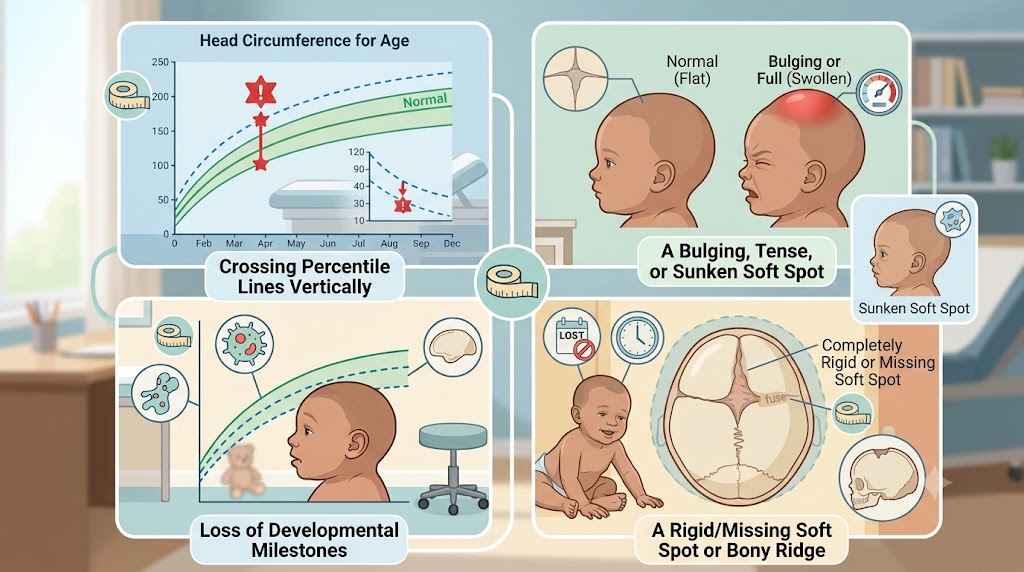
- Crossing Percentile Lines Vertically: if the child’s head you measured last time was 40th percentile, but it changes to the 90th percentile or plunges down to the 10th percentile in a single month, then go to the doctor; they will investigate further.
- A Bulging or Full Soft Spot (Fontanelle): When the baby is upright, their soft spot feels flat or curved inward; however, if that soft spot looks swollen, tense, or bulges upward like a dome, it indicates pressure inside the skull, which needs urgent medical care.
- A Sunken Soft Spot: If the fontanelle is deeply sunken into the skull, it can be because of severe dehydration.
- Loss of Developmental Milestones: If the child’s head size is tracking fast or slow, they stop rolling over; you notice they are losing the ability to support their head; they stop smiling; and they also face difficulty tracking objects visually, so go to the doctor.
- A Completely Rigid or Missing Soft Spot: If you don’t feel any soft spaces in the baby’s head by month two or three and feel a hard, raised, bony ridge along the top or sides of the skull, then there is a possibility of bone fusion.
Frequently asked Questions by Parents
1. What is the average head circumference for a newborn baby?
A full-term newborn head circumference is about 34 to 35 cm (around 13.5 inches). Boys’ measurements can be larger as compared to the girls’. Any size between the 5th and 95th percentile is completely normal and healthy.
2. Why does the doctor measure my baby’s head circumference at every visit?
Well, doctors measure the head size to track rapid brain development. The brain grows to about 80% of its adult size by age 2. Instead of sticking to a single number, the doctor looks at the growth curve with time to make sure the skull and brain are expanding constantly.
3. When should I worry about my baby’s head circumference?
A single unusual measurement isn’t a sign of worry; it shows generics play a huge role. However, if a baby’s growth suddenly jumps or drops drastically across percentiles, then it can be a sign of fluid buildup or slow brain development.
4. How much should a baby’s head grow in the first few months?
A baby’s head grows faster right after birth; for the first three months, the head size increases to 2 cm per month. In 3 to 6 months this growth can slow down to 1 cm per month, and the pattern continues until the first birthday.
5. How do you correctly measure a baby’s head circumference at home?
To get an accurate measurement, all you need is a flexible and non-stretchable measuring tape. Wrap it at the widest part of the baby’s head. Make sure the tape doesn’t touch the hairline or eyes so the measurement is perfect.
Sources for Further Reading
- WHO Child Growth Standards: Access the standard global datasets used by pediatricians worldwide to track head development. Parents can review specific measurement percentiles for Boys Head Circumference-for-Age and Girls Head Circumference-for-Age directly from the World Health Organization.
- CDC Clinical Growth Reference: Explore standard tools, downloadable templates, and professional training resources via the CDC Growth Chart Hub to see how healthcare systems cross-reference development metrics.
- American Academy of Pediatrics (AAP): Read an in-depth breakdown of how pediatricians calculate percentiles, what a sudden variation in data points means, and how to look at overall trends in the HealthyChildren Growth Charts Guide.
