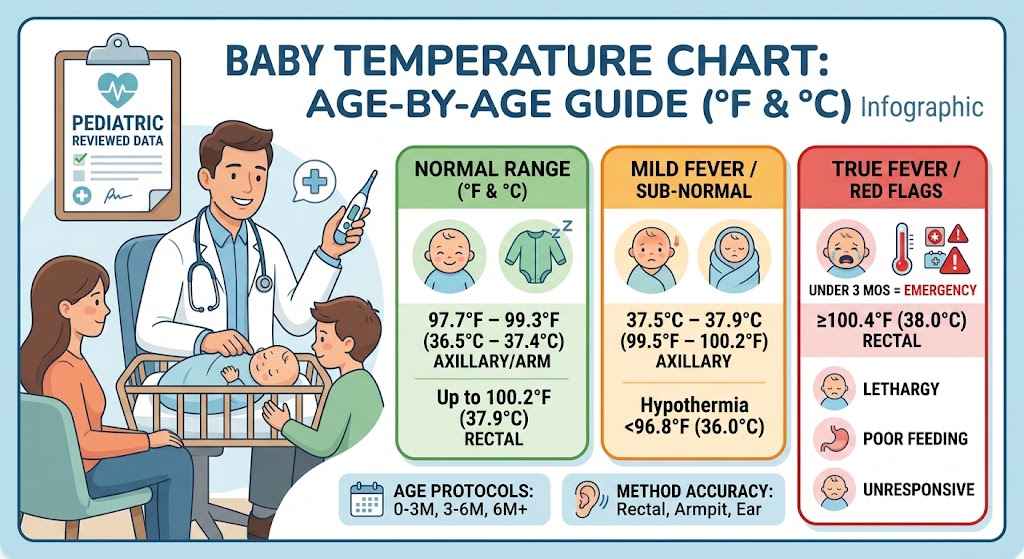
Quick Answer: A normal baby temperature measured under the armpit (axillary) ranges from 97.7°F to 99.3°F (36.5°C to 37.4°C), while a normal core reading taken rectally ranges up to 100.2°F (37.9°C). In pediatric medicine, a true fever is defined as a core rectal or forehead reading of 100.4°F (38.0°C) or higher, or an underarm reading of 99.5°F (37.5°C) or higher. Any temperature meeting or exceeding these fever thresholds in an infant under 3 months of age is considered a medical emergency requiring immediate evaluation by a healthcare provider.
When you find the baby is warm or extremely cold when you touch them, it is completely normal to panic because, as a parent, few things are more unsettling than watching your baby look uncomfortable. In this situation, you just take a thermometer and think, Is this number normal?
The first thing you need to do is not panic; take a deep breath. Temperature is a simple way to communicate about a baby’s body with you. The readings are a sign that the immune system is working properly. Knowing when to interpret those readings correctly and understanding when it is time to go to the doctor is important for every parent.
In this comprehensive guide we will look at everything you need to know about baby temperature chart, age-specific fever cutoffs, step-by-step measurement techniques, and warning signs.
What Is a Normal Temperature for a Baby?
A normal baby temperature reading from the armpit is around 97.7°F and 99.3°F (36.5°C to 37.4°C). Core body readings can be higher than the normal range, like 97.9°F to 100.2°F (36.6°C to 37.9°C). When a baby has a true fever, the core temperature will be 100.4°F (38.0°C) or higher. If an infant is getting a fever under 3 months after being born, then go to medical emergency ASAP.
Master Baby Temperature Chart (By Measurement Method)
Body temperature readings can be different, as it depends fully on where and how you measure them. The core method that is rectal gives better and more accurate readings as compared to surface methods that are armpit or forehead. You can use the following baby temperature chart to understand the normal ranges, fever thresholds, and pediatric guidance on every measurement.
| Measurement Method | Normal Temp (°F) | Normal Temp (°C) | Fever Threshold (°F / °C) | Clinical Accuracy Rank & Guidance |
|---|---|---|---|---|
| Axillary (Armpit) | 97.7°F – 99.3°F | 36.5°C – 37.4°C | ≥ 99.5°F (37.5°C) | Safe Screening (Rank #2): Non-invasive and safe. Reads ~0.5°F–1.0°F lower than core temp. Recommended for routine screening under 4 weeks (NICE). |
| Rectal (Core) | 97.9°F – 100.2°F | 36.6°C – 37.9°C | ≥ 100.4°F (38.0°C) | Gold Standard (Rank #1): Most accurate core reading for infants aged 0–3 years. Standard used for medical decision-making in newborns (AAP). |
| Temporal Artery (Forehead) | 96.4°F – 100.2°F | 35.8°C – 37.9°C | ≥ 100.4°F (38.0°C) | Fast Screening (Rank #3): Quick infrared surface scan. Accurate in infants 3+ months on dry skin. Confirm abnormal readings with an armpit reading. |
| Tympanic (Ear) | 96.4°F – 100.2°F | 35.8°C – 37.9°C | ≥ 100.4°F (38.0°C) | Age-Restricted (Rank #4): Accurate only for infants 6 months and older. Ear canals in younger infants are too narrow for reliable readings. |
| Oral (Mouth) | 95.9°F – 99.3°F | 35.5°C – 37.4°C | ≥ 100.0°F (37.8°C) | Not for Infants: Requires holding the probe under the tongue with a closed mouth for 60+ seconds. Suitable only for children aged 4 to 5 years and up. |
Complete Temperature Reading Lookup Table (°F & °C Action Plan)
To find the exact thermometer reading you can you use the chart below it includes classification, clinical meaning, and required parental response.
| Temp (°F) | Temp (°C) | Classification | Clinical Significance | Immediate Action Plan |
|---|---|---|---|---|
| Below 89.6°F | Below 32.0°C | Severe Hypothermia | Critical emergency. Core body temperature has collapsed. | GO TO HOSPITAL IMMEDIATELY. Wrap baby in dry, warm blankets and hold skin-to-skin while traveling. |
| 89.6°F – 96.6°F | 32.0°C – 35.9°C | Moderate Hypothermia | Danger sign. In newborns, low temperature often indicates serious infection (sepsis) rather than cold room air. | EMERGENCY (ALL AGES). Seek immediate medical evaluation. Do not attempt home re-warming before contacting emergency services. |
| 96.8°F – 97.5°F | 36.0°C – 36.4°C | Mild Cold Stress / Sub-Normal | Slightly below optimal range. Often caused by improper thermometer positioning, cold AC room, or recent bath. | Re-take measurement. Place baby skin-to-skin, cover head with a cap, feed, and re-check in 30 min. If reading stays <96.8°F, or baby is <3 months, call doctor. |
| 97.7°F – 99.3°F | 36.5°C – 37.4°C | NORMAL (Target) | Ideal normal baby temperature armpit target range for healthy infants. | No action required. Baby is normothermic. Continue routine care. |
| 99.5°F – 100.2°F | 37.5°C – 37.9°C | Elevated / Borderline | Low-grade elevation or axillary fever threshold. | Under 3 Months: Treat as emergency; call doctor immediately. 3+ Months: Undress one layer, offer fluids, re-check in 30 minutes. |
| 100.4°F – 101.1°F | 38.0°C – 38.4°C | TRUE FEVER | Standard pediatric fever cutoff across all national clinical guidelines. | Under 3 Months: Immediate ER/doctor visit. 3–6 Months: Call pediatrician same day. 6+ Months: Keep hydrated, monitor behavior, treat if uncomfortable. |
| 101.3°F – 102.0°F | 38.5°C – 38.9°C | Moderate Fever | Active immune response. Common with viral infections and routine vaccinations. | Under 3 Months: Emergency. 3+ Months: Focus on comfort and fluid intake. Administer weight-based acetaminophen if prescribed by pediatrician. |
| 102.2°F – 103.8°F | 39.0°C – 39.9°C | High Fever | Significant fever elevation. Indicates active immune engagement against infection. | Under 3 Months: Emergency. 3+ Months: Contact pediatrician if fever persists over 24 hours, or if accompanied by poor feeding or distress. |
| 104.0°F and Above | 40.0°C and Above | Very High Fever | Severe fever threshold. Higher risk of dehydration and extreme discomfort. | ALL AGES: Contact pediatrician or seek urgent care immediately. Keep child hydrated and cool room environment. |
Temperature Cutoffs and Rules by Age Group
When medical progress evaluating the temperature it depends on baby age to example a reading that is consider safe for 18 months old can be life threatening for a 2 week old infant.
| Age Group | Recommended Route | Normal Temp Range (°F / °C) | Fever Threshold (°F / °C) | Medical Action Trigger |
|---|---|---|---|---|
| Newborns (0 to 4 Weeks) | Axillary (NICE) or Rectal (AAP) | 97.7°F – 99.3°F (36.5°C – 37.4°C) |
≥ 99.5°F (37.5°C) Axillary ≥ 100.4°F (38.0°C) Rectal |
IMMEDIATE EMERGENCY. Any reading at or above fever threshold or below 96.8°F requires same-day emergency evaluation. |
| Infants (1 to 3 Months) | Rectal (Preferred) or Axillary | 97.9°F – 100.2°F (36.6°C – 37.9°C) |
≥ 100.4°F (38.0°C) Rectal | IMMEDIATE EMERGENCY. Young infants lack mature immune barriers. Fever may be the sole sign of serious bacterial infection. |
| Infants (3 to 6 Months) | Rectal, Temporal, or Axillary | 97.7°F – 100.2°F (36.5°C – 37.9°C) |
≥ 100.4°F (38.0°C) | Call pediatrician if temperature reaches 101.0°F (38.3°C) or higher, or if fever persists past 24 hours. |
| Older Infants (6 to 24 Months) | Temporal, Ear, Axillary, or Rectal | 97.5°F – 100.0°F (36.4°C – 37.8°C) |
≥ 100.4°F (38.0°C) | Treat based on comfort and behavior. Seek care if fever exceeds 103.0°F (39.4°C), lasts longer than 3 days, or responds poorly to fluids. |
| Toddlers (2+ Years) | Temporal, Ear, Axillary, or Oral | 97.5°F – 99.5°F (36.4°C – 37.5°C) |
≥ 100.4°F (38.0°C) | Focus on hydration. Seek evaluation if fever persists past 72 hours, or if accompanied by difficulty breathing or stiff neck. |
How to Take a Normal Baby Temperature Armpit Reading Correctly
Since the armpit measurement is a surface reading, a missed measurement can happen. If the thermometer is loose or the skin is sweating, then the temperature will easily change. To get the temperature accurately, you can follow some steps as follows:
Dry the Armpit: First clean the baby’s armpit and remove any sweat with the help of a cloth, then turn on the digital thermometer and place it in the center of the bare armpit. Make sure it is directly on skin, with no hurdle in between them like cloth.
Seal the Arm: Once the thermometer is placed, press your baby’s arm flat against their side, hugging their elbow against their chest. This will close the arm, and air will not enter. Hold Until the Signal: Keep the arm in the same place for 3 to 5 minutes.
Interpret the Number: A normal baby temperature armpit reading will be between 97.7°F and 99.3°F (36.5°C and 37.4°C). If the reading is 99.5°F (37.5°C) or higher, the baby has a fever; go to the doctor.
The Clinical Danger Signs Checklist
If we talk about pedestrian care, how a baby acts or looks is more important than the temperature range of a baby’s body. A baby who has a temperature of 100.8°F is less sick as compared to a baby who has a temperature of 103.0°F. However, there are some red flags you need to look for if your baby has any temperature readings combined with the following signs:
- Difficulty waking or unresponsiveness when spoken to or touched.
- Inconsolable, high-pitched crying or screaming
- Weak, high-pitched, or absent cry.
- Floppiness (hypotonia)
- Seizure activity or eye-rolling
- Rapid breathing
- Audible grunting, squeaking, or stridor on respiration.
- Chest retractions
- Flaring nostrils while taking breaths.
- Pale, grey, ashen, or mottled (blotchy blue/white) skin tone.
- Blue discoloration around the lips, tongue, or nail beds (cyanosis).
- Non-blanching rash (small purple or red spots)
- Total refusal of breast milk or formula
- Absence of wet diapers for 8 hours or longer.
- Sunken soft spot (fontanelle) on top of the infant’s head.
Medical Disclaimer: This content is for informational purposes only and is not a substitute for professional medical advice, diagnosis, or treatment. Always seek the advice of your pediatrician or other qualified health provider with any questions regarding your baby’s health or medical condition.
Understanding Low Body Temperature in Newborns (Sepsis vs. Cold)
As parents, I know we are mostly worried about the fever; however, the most dangerous thing in infants is the low body temperature because the older kid’s immune system can generate heat while fighting with a bacterium, but a newborn can’t, as they have an underdeveloped system that responds by dropping the temperature.
World Health Organization (WHO) Hypothermia Classifications
| WHO Thermal Category | Axillary Temp (°F) | Axillary Temp (°C) | Underlying Physiological Causes | Mandatory Clinical Response |
|---|---|---|---|---|
| Mild Hypothermia (Cold Stress) | 96.8°F – 97.5°F | 36.0°C – 36.4°C | Drafty room, improper clothing, recent bath, or early metabolic strain. | Warm baby immediately via skin-to-skin contact under warm blankets. Put a hat on the baby. Re-check in 30 minutes. |
| Moderate Hypothermia | 89.6°F – 96.6°F | 32.0°C – 35.9°C | Environmental exposure, severe systemic infection (sepsis), or hypoglycemia. | URGENT MEDICAL EVALUATION. Do not delay medical assessment. Keep infant warm during transport. |
| Severe Hypothermia | Below 89.6°F | Below 32.0°C | Critical organ failure, profound cold exposure, or end-stage neonatal sepsis. | CRITICAL MEDICAL EMERGENCY. Transport immediately to emergency department. |
Differentiating Sepsis Hypothermia from Environmental Cold
Use this clinical comparison to evaluate why a baby might be running cold:
| Assessment Factor | Environmental Cold Stress | Neonatal Sepsis / Infection |
|---|---|---|
| Response to Warming | Temperature climbs back above 97.7°F (36.5°C) within 30–60 minutes of skin-to-skin contact. | Temperature remains low or drops further despite active re-warming efforts. |
| Skin Appearance & Feeling | Cold hands and feet, but chest and abdomen remain warm and pink. | Entire body, including core, chest, and belly, feels cold to the touch; skin looks pale, grey, or mottled. |
| Feeding & Energy Level | Baby stays alert, feeds eagerly once warmed, and maintains strong suckle. | Poor feeding, weak suckle, extreme sleepiness, floppiness, or weak crying. |
| Breathing Pattern | Normal respiratory effort without grunting or nasal flaring. | Rapid breathing, grunting, pauses in breathing (apnea), or retractions. |
Pediatric Fever Management Protocol (What to do and what to avoid)
Many people consider fever a disease, but you will be shocked to hear it is a healthy, protective physiological response. The human body responds with heat to slow down the replication of viruses and bacteria while stimulating the white blood cell activity.
As a parent your primary goal is not to reduce the temperature reading back to normal but to provide baby relief while they feel uncomfortable. Keep the baby hydrated by offering breast milk or formula feeds. Re-check with a core rectal reading in 30 minutes if the baby is under 3 months old. Give a 6+ month old child acetaminophen or ibuprofen. If your child has a high fever (>104°F / 40°C) quickly place them in a bath of lukewarm water (85°F–90°F / 29°C–32°C).
Avoid giving aspirin to infants or children. Don’t cover them up with multiple blankets. Avoid giving ibuprofen to infants under 6 months of age. DON’T use cold water, ice baths, or rubbing alcohol on infants.
Frequently Asked Questions (FAQ) by Parents
What is a normal baby temperature armpit reading?
Normal Baby Temperature Under Armpit (Axillary) 97.7° to 99.3°F (36.5° to 37.4°C) Readings will vary depending on the time of day or night, the temperature in the room and the amount of clothes you are wearing.
Is 99.5°F (37.5°C) considered a fever on a baby’s temperature chart?
99.5°F (37.5°C) is what marks the fever cutoff according to WHO and NICE guidelines. If your infant has this temperature, they need urgent medical attention. If your baby is above 3 months of age, then the fever is mild. Keep them hydrated and recheck the temperature again in 30 minutes.
Why does my baby’s reading on the baby temperature chart keep changing?
The main reason behind the change is infant body temperature naturally fluctuates by 1.0°F to 1.5°F (0.5°C to 0.8°C) over a 24-hour cycle.
Should I wake my baby to give fever medicine at night?
No sleeping is very important for immune system recovery, so if your baby is over 3 months and breathing normally while they sleep, then don’t wake them up. Treat the baby’s comfort level, not the thermometer reading.
Does teething cause high fevers in babies?
No, according to the research published by the American Academy of Paediatrics, teething may raise the temperature of the body to 99.5°F / 37.5°C, but it doesn’t cause a true fever that comes with a temperature of 100.4°F / 38.0°C or higher. If your baby is currently teething and has a high temperature, then there are also some other health issues, like viral infection or ear infection.
How long can a normal viral fever last in infants?
A normal viral fever can last for 2 to 3 days. If your baby’s fever stays the same after 72 hours and goes and comes back again, then it means they have a worsening cough, ear pulling, or rash. Take them to the doctor.
Authoritative Health Resources & Government References
For further medical reading and guidelines established by national and global public health organizations, consult these direct official resources:
