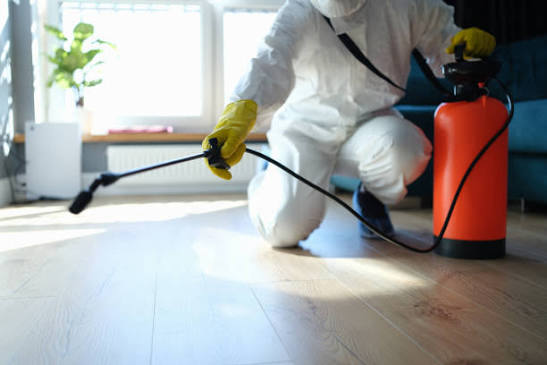
The calculation changes the day your baby starts crawling. Ants in the kitchen were an annoyance when the floor was just a floor. Now the floor is where your child spends her day, putting her hands on it and then in her mouth, and the aerosol can under the sink suddenly looks like a worse idea than the ants.
The good news is that the most effective way to deal with household pests and the lowest-exposure way are usually the same thing. The methods that actually solve an infestation are mostly not the ones that involve spraying chemicals across surfaces your child touches.
Pests are a health question once there is a baby on the floor.
Cockroaches in particular are a recognized asthma trigger. Their droppings, shed skins, and body fragments break down into household dust, and that dust is a well-documented contributor to asthma symptoms in children. The EPA lists pests among the common asthma triggers worth controlling in the home.
Rodents carry a similar allergen problem along with a contamination one, since mouse and rat allergens are documented the same way. So the goal isn’t only to stop seeing bugs. It’s to reduce what’s accumulating in the dust of a room where a child spends ten hours a day at floor level.
Skip the fogger
Total release foggers, the bug bombs sold in supermarket aisles, are the first thing most people reach for and the least appropriate product in a home with an infant. Two reasons.
First, they don’t work well on the pests people buy them for. A fogger disperses insecticide into open air, where it settles on exposed horizontal surfaces. Cockroaches live in wall voids, under appliances, and inside cabinet cavities, which is exactly where the fog doesn’t reach. There’s decent evidence that foggers actually scatter roaches deeper into a structure rather than killing the population.
Second, they leave residue on every open surface in the treated area, which in a home with a crawling baby means the floor, the coffee table, and anything left out. They also carry a genuine fire risk from the propellant near a pilot light. The EPA’s safety guidance for foggers spells out exactly why.
Three more to leave on the shelf
Mothballs are used anywhere but in a sealed container. Mothballs are a pesticide, and using them in an attic, a crawlspace, or an open closet to repel rodents or insects is a misuse of the product. They work by releasing vapor, which means that vapor ends up in your air. If you smell mothballs, you’re breathing them.
Ultrasonic plug-in repellents. These are marketed heavily to parents specifically because they promise pest control without chemicals. There’s no reliable evidence they drive out roaches, mice, or ants, and regulators have taken action against marketers for unsupported claims. They’re not dangerous. They’re just an expensive way to not solve the problem while it gets worse.
Broadcast spraying baseboards. Running a general-purpose spray along every baseboard in the house treats an enormous surface area, most of which no pest will ever walk across, while putting residue exactly at crawling height. It’s the highest-exposure, lowest-precision option available.
What actually works: take away the food, the water, and the way in
Nearly every household pest problem is a supply problem. Remove the supply, and the population can’t hold.
- Water first, because it matters more than food for roaches. Fix the dripping trap under the sink, dry the shower floor, don’t leave the pet bowl full overnight, and check behind the refrigerator where condensation collects.
- Food in sealed hard containers rather than the boxes it came in. Cereal, flour, rice, and pet food. Especially pet food, which is a common and overlooked ant and rodent supply.
- Crumbs at the level a baby generates them. Under the high chair, in the seams of the couch, under the toe kick of the cabinets where the vacuum doesn’t reach.
- Entry points sealed. Gaps around pipes under the sink, gaps at the dishwasher, a door sweep that no longer touches the threshold, and torn window screens. A mouse fits through a gap the width of a pencil.
This is unglamorous, and it’s most of the actual work. A kitchen with no standing water, sealed food, and closed gaps is a kitchen that can’t sustain a population regardless of what else you do.
Bait, placed where small hands don’t go
When you do need a product, bait is the format that fits a home with children, and the reason is placement rather than the chemistry. A gel bait or a bait station is applied as small dots or discrete units in the tight, dark places pests travel, inside a cabinet hinge recess, in the gap behind the refrigerator, under the toe kick. Those are locations your child cannot reach, which is exactly the point.
Bait also works on the biology. The insect carries it back into the harborage, which reaches the population you can’t see. That’s why bait resolves a roach problem that spraying only appears to resolve.
Two rules if you’re placing it yourself. Read the label and follow it exactly, because the label is the legally binding instruction, and it specifies where the product may and may not be used. And write down where you put every placement so you can retrieve them all later and so you know a station hasn’t gone missing behind an appliance.
The crawling-baby rule
A simple filter for any treatment decision in a home with a small child. Treatment belongs in the places a child cannot reach and nowhere else.
That means inside wall voids, in cabinet cavities, behind and beneath appliances, in the gaps where plumbing enters, and along the exterior foundation. It does not mean open floor, the fronts of cabinets, windowsills at toddler height, or any surface where toys land. If a treatment can only work by being applied where your child plays, that’s the wrong treatment for your house.
Keep children and pets out of any treated area for the full period the label specifies, and ventilate afterward. Then vacuum and damp-mop the open floor once the interval has passed, which removes anything that drifted where it shouldn’t have.
When to bring in a professional
Some situations don’t respond to sealing and sanitation, and continuing to work at them yourself mostly extends the exposure.
- Roaches sighted in daylight, which usually indicates the harborage is crowded and the population is well established.
- An apartment or attached home where the source is a neighboring unit, since treating your unit alone won’t hold.
- Any rodent activity, because sealing the structure correctly is the part homeowners consistently get wrong and the part that determines whether they come back.
- Bed bugs, where consumer sprays are at best moderately effective and rarely reach the eggs and the voids where the population actually survives.
- Any problem still present after four to six weeks of consistent effort.
A technician isn’t applying a stronger product. The value is in reaching wall voids and cavities you can’t open, identifying the species so the treatment actually matches it, and placing material precisely instead of broadly, which is what keeps it off the floor your child uses. If you’re arranging professional cockroach control or any other service with a baby at home, say so when you book, ask what’s being applied and where, and ask how long to keep the family out of the treated rooms.
The bottom line
Skip the fogger, the mothballs, the ultrasonic gadget, and the whole-house baseboard spray. Fix the water, seal the food, close the gaps, and place any product deep in the places a child can’t reach. The approach that keeps chemicals away from a crawling baby is also the approach that actually clears an infestation, which is a rare case where the cautious option and the effective option are the same option.
