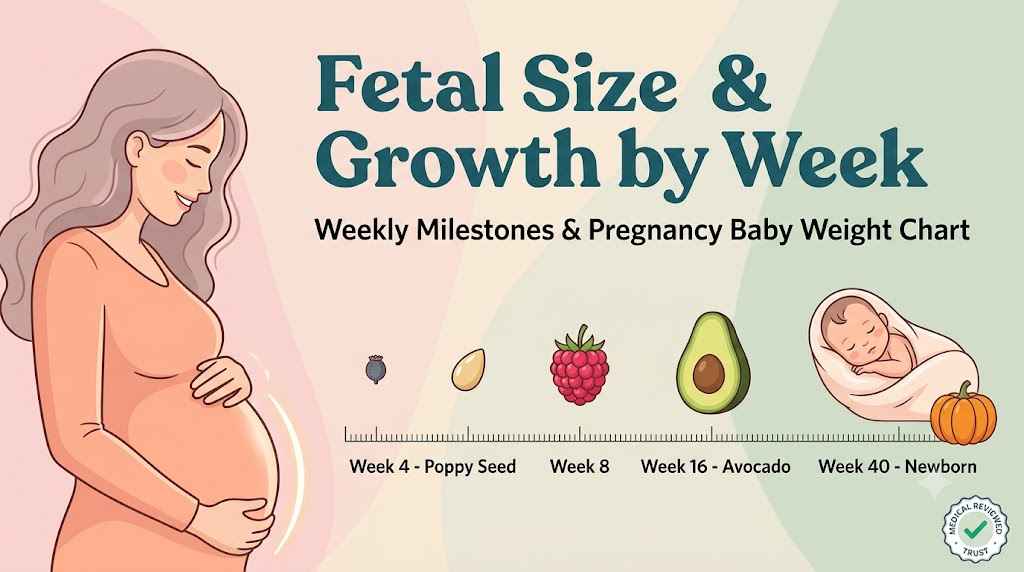
Quick Answer: A pregnancy baby weight chart tracks estimated fetal growth from Week 4 to Week 41 using clinical Hadlock standards. Fetal weight increases from under 0.04 ounces (1 gram) in the first trimester to nearly 2 pounds at Week 27, ultimately reaching an average full-term weight of 7.6 pounds (3.5 kg) at Week 40. Any growth within the 10th to 90th percentile is considered healthy.
Pregnancy is an exciting journey, and the most important part of it is to picture how big your baby is growing week after week. Whether you are tracking the size of a fetus on a weekly basis or looking for a quick guide that has a baby weight chart, a pregnancy reference understanding the measurements provides you knowledge about baby development. In 40 weeks a fertile egg, which is smaller than a salt grain, changes into a fully formed newborn who is on average 20 inches in length and around 7.5 to 8 pounds.
While every baby develops at their own time period, medical professionals depend on standardized fetal growth curves to find healthy development during prenatal checkups.
Parents often ask if the ultrasound weight of their baby is ‘exact.’ Keep in mind, ultrasound measurements give estimated fetal weight based on mathematical formulas. These are averages from the clinic, not hard and fast rules. If your baby is growing steadily on their own percentile curve, it is perfectly normal to be above or below the average.
— Dr. Sarah Jenkins, M.D., Board-Certified OB/GYN & Maternal-Fetal Medicine Specialist
How Is Fetal Size Measured Week by Week?
Measuring a fetus’s size by week inside the uterus changes the progress in pregnancy as the early embryo is still curled into a tight C-shape, so taking a head-to-toe measurement isn’t correct, especially in the first trimester. Here is how the doctors calculate the fetus in each stage of pregnancy.
1. Crown-Rump Length (CRL) | Weeks 8 to 13
In starting prenatal ultrasound scans, the sonographer measures the baby’s head to bottom. Legs aren’t included in early measurements because they are very small.
2. Crown-Heel Length (CHL) | Weeks 14 to 40+
When the second trimester starts, the baby begins to uncurl and start to stretch, so doctors use ultrasound to measure the changes in crown-heel length.
3. Estimated Fetal Weight (EFW) & Ultrasound Acronyms
Doctors don’t measure the weight of a baby by the womb; instead, they go for an ultrasound to estimate fetal weight. The size of the baby’s skull. The overall length of the baby’s head. The circumference of the baby’s belly. Finally, the length of the thighbone. When all 4 measurements are combined:
4. Fundal Height (Mid-to-Late Pregnancy)
When you enter the 20th week of pregnancy, the doctor will measure your abdomen by using a tape. It measures the pubic bone to the top of the uterus. According to a general rule, the fundal height (cm) usually matches your gestational age in weeks (± 2 cm). If the measurements fall out, then the doctor will go for an ultrasound to check the growth of the fetus.
Master Fetal Growth & Pregnancy Baby Weight Chart (Weeks 4 to 41)
This table below is fully detailed based on average length, average weight, the healthy 10th-to-90th percentile weight spectrum, visual size analogies, and primary developmental milestones for every week of pregnancy.
- Weeks 4–13: Length measured from Crown-to-Rump (CRL).
- Weeks 14–41: Length measured from crown to heel (CHL).
First Trimester (Weeks 4–13)
| Gestational Age | Visual Analogy | Average Length (In / Cm) | Average Weight (US / Metric) | Healthy Weight Range (10th–90th) | Major Developmental Milestone |
|---|---|---|---|---|---|
| Week 4 | Poppy Seed | 0.04 in (0.1 cm) | < 0.04 oz (1 g) | < 0.04 oz (< 1 g) | Implantation complete; neural tube begins forming. |
| Week 5 | Sesame Seed | 0.05 in (0.13 cm) | < 0.04 oz (1 g) | < 0.04 oz (< 1 g) | Tiny heart tube begins beating and pumping blood. |
| Week 6 | Lentil | 0.20 in (0.5 cm) | < 0.04 oz (1 g) | < 0.04 oz (< 1 g) | Facial features (eyes, nostrils) begin taking shape. |
| Week 7 | Blueberry | 0.50 in (1.3 cm) | 0.03 oz (0.8 g) | 0.02 oz – 0.05 oz (0.5–1.5 g) | Arm and leg buds emerge; brain hemispheres form. |
| Week 8 | Raspberry | 0.63 in (1.6 cm) | 0.04 oz (1 g) | 0.02 oz – 0.07 oz (0.5–2 g) | Webbed fingers and toes begin to separate. |
| Week 9 | Cherry | 0.90 in (2.3 cm) | 0.07 oz (2 g) | 0.04 oz – 0.11 oz (1–3 g) | Embryonic stage ends; fetal stage officially begins. |
| Week 10 | Strawberry | 1.22 in (3.1 cm) | 0.14 oz (4 g) | 0.10 oz – 0.20 oz (3–6 g) | Critical organs (kidneys, brain, heart) are functioning. |
| Week 11 | Lime | 1.61 in (4.1 cm) | 0.25 oz (7 g) | 0.18 oz – 0.35 oz (5–10 g) | Fetus begins active stretching and involuntary movements. |
| Week 12 | Plum | 2.13 in (5.4 cm) | 0.49 oz (14 g) | 0.35 oz – 0.70 oz (10–20 g) | Fingerprints form; thumb-sucking reflexes develop. |
| Week 13 | Lemon | 2.64 in (6.7 cm) | 0.81 oz (23 g) | 0.60 oz – 1.10 oz (17–31 g) | Vocal cords form; baby swallows amniotic fluid. |
Second Trimester (Weeks 14–27)
| Gestational Age | Visual Analogy | Average Length (In / Cm) | Average Weight (US / Metric) | Healthy Weight Range (10th–90th) | Major Developmental Milestone |
|---|---|---|---|---|---|
| Week 14 | Peach | 5.79 in (14.7 cm) | 1.52 oz (43 g) | 1.10 oz – 2.10 oz (31–60 g) | Facial muscles activate; squinting and grimacing occur. |
| Week 15 | Apple | 6.57 in (16.7 cm) | 2.47 oz (70 g) | 1.80 oz – 3.30 oz (51–94 g) | Light sensitivity develops through closed eyelids. |
| Week 16 | Avocado | 7.32 in (18.6 cm) | 3.53 oz (100 g) | 2.60 oz – 4.70 oz (74–133 g) | Skeleton hardens from flexible cartilage into bone. |
| Week 17 | Onion | 8.03 in (20.4 cm) | 4.94 oz (140 g) | 3.70 oz – 6.50 oz (105–184 g) | Subcutaneous fat stores accumulate under skin. |
| Week 18 | Bell Pepper | 8.74 in (22.2 cm) | 6.70 oz (190 g) | 5.00 oz – 8.80 oz (142–250 g) | Inner ear bones harden; baby hears maternal heartbeat. |
| Week 19 | Heirloom Tomato | 9.45 in (24.0 cm) | 8.47 oz (240 g) | 6.30 oz – 11.2 oz (179–317 g) | Vernix caseosa protective coating covers skin. |
| Week 20 | Banana | 10.12 in (25.7 cm) | 10.58 oz (300 g) | 7.90 oz – 14.1 oz (224–400 g) | Halfway point! First movements (“quickening”) felt. |
| Week 21 | Carrot | 10.79 in (27.4 cm) | 12.70 oz (360 g) | 9.50 oz – 16.9 oz (269–479 g) | Bone marrow takes over blood cell production. |
| Week 22 | Cucumber | 11.42 in (29.0 cm) | 15.17 oz (430 g) | 11.3 oz – 1.25 lbs (320–567 g) | Taste buds develop; tactile senses sharpen. |
| Week 23 | Mango | 12.05 in (30.6 cm) | 1.10 lbs (500 g) | 0.82 lbs – 1.45 lbs (372–658 g) | Rapid eye movement (REM) sleep cycles begin. |
| Week 24 | Ear of Corn | 12.68 in (32.2 cm) | 1.32 lbs (600 g) | 0.99 lbs – 1.75 lbs (449–794 g) | Lung surfactant production starts; viability benchmark. |
| Week 25 | Rutabaga | 13.27 in (33.7 cm) | 1.54 lbs (700 g) | 1.15 lbs – 2.05 lbs (522–930 g) | Capillaries form under skin, giving a pinkish glow. |
| Week 26 | Zucchini | 13.82 in (35.1 cm) | 1.76 lbs (800 g) | 1.32 lbs – 2.35 lbs (598–1,066 g) | Eyes crack open; blinks in response to light. |
| Week 27 | Cauliflower | 14.41 in (36.6 cm) | 1.98 lbs (900 g) | 1.48 lbs – 2.65 lbs (671–1,202 g) | Brain activity shows regular sleep-wake cycles. |
Third Trimester (Weeks 28–41)
| Gestational Age | Visual Analogy | Average Length (In / Cm) | Average Weight (US / Metric) | Healthy Weight Range (10th–90th) | Major Developmental Milestone |
|---|---|---|---|---|---|
| Week 28 | Eggplant | 14.80 in (37.6 cm) | 2.20 lbs (1,000 g) | 1.65 lbs – 2.95 lbs (748–1,338 g) | Baby typically settles into head-down presentation. |
| Week 29 | Acorn Squash | 15.47 in (39.3 cm) | 2.53 lbs (1,150 g) | 1.90 lbs – 3.38 lbs (862–1,533 g) | Muscle fibers and bone mass strengthen rapidly. |
| Week 30 | Cabbage | 15.95 in (40.5 cm) | 2.86 lbs (1,300 g) | 2.15 lbs – 3.82 lbs (975–1,733 g) | Bone marrow completely assumes red blood cell creation. |
| Week 31 | Coconut | 16.46 in (41.8 cm) | 3.30 lbs (1,500 g) | 2.48 lbs – 4.40 lbs (1,125–1,995 g) | All five sensory pathways are operational. |
| Week 32 | Jicama | 16.93 in (43.0 cm) | 3.75 lbs (1,700 g) | 2.81 lbs – 5.00 lbs (1,275–2,261 g) | Fingernails reach fingertips; soft lanugo hair sheds. |
| Week 33 | Pineapple | 17.36 in (44.1 cm) | 4.19 lbs (1,900 g) | 3.14 lbs – 5.58 lbs (1,424–2,527 g) | Antibodies pass from maternal blood to build immunity. |
| Week 34 | Cantaloupe | 17.84 in (45.3 cm) | 4.63 lbs (2,100 g) | 3.47 lbs – 6.17 lbs (1,574–2,793 g) | Central nervous system and lungs reach maturity. |
| Week 35 | Honeydew | 18.23 in (46.3 cm) | 5.25 lbs (2,380 g) | 3.94 lbs – 7.00 lbs (1,787–3,173 g) | Rapid fat deposits smooth out skin folds on limbs. |
| Week 36 | Romaine | 18.62 in (47.3 cm) | 5.78 lbs (2,620 g) | 4.33 lbs – 7.70 lbs (1,965–3,493 g) | Fetus drops deeper into pelvis (“lightening”). |
| Week 37 | Swiss Chard | 19.02 in (48.3 cm) | 6.31 lbs (2,860 g) | 4.73 lbs – 8.41 lbs (2,145–3,813 g) | Early Term. Firm grasp reflex present; organs ready. |
| Week 38 | Winter Squash | 19.41 in (49.3 cm) | 6.83 lbs (3,100 g) | 5.12 lbs – 9.11 lbs (2,322–4,133 g) | Eye pigmentation finishes; lung surfactant complete. |
| Week 39 | Watermelon | 19.72 in (50.1 cm) | 7.25 lbs (3,290 g) | 5.44 lbs – 9.67 lbs (2,468–4,387 g) | Full Term. Rapid brain growth continues; fat reserves peak. |
| Week 40 | Small Pumpkin | 20.08 in (51.0 cm) | 7.63 lbs (3,460 g) | 5.72 lbs – 10.18 lbs (2,595–4,617 g) | Due Date! Fetus fully prepared for birth. |
| Week 41 | Large Pumpkin | 20.39 in (51.8 cm) | 7.93 lbs (3,600 g) | 5.95 lbs – 10.58 lbs (2,700–4,800 g) | Late Term. Monitoring increases to check placental efficiency. |
How Fetal Weight Gain Accelerates Throughout Pregnancy
As we’ve seen in the chart of fetus weight week by week. The fetal weight gain is nonlinear; the baby starts like a tiny seed, then gains weight on a daily basis, changing into rapid skeletal growth when the pregnancy reaches the second trimester.
First Trimester (Weeks 1–13): Growth in this timeline focuses on organogenesis, making the formation of tissues, limbs, and vital organs. The weight gain in this starting trimester is minimal, meaning the fetus has less than 1 ounce total by Week 13.
Second Trimester (Weeks 14–27): In this phase the skeletal structure lengthens rapidly. In weeks 16 and 24 the baby’s weight doubled many times and was 3 to 4 ounces per week.
Peak Growth Window (Weeks 28–35): At the start of this trimester, the fetal weight gain became fast. In weeks 30 and 35, the fetus gains 6 to 7.5 ounces (170–215 grams) per week, which takes place in the lower body, muscles, and near bones.
Late Term Slowdown (Weeks 36 to 40+): Growth rate tapers naturally in the final month. The space inside the uterus is fully occupied by the baby. You can expect a 5- to 6-ounce weight gain in the last month.
When to Discuss Fetal Growth with Your Healthcare Provider?
Your obstetrician or midwife tracks the baby’s growth measurements to standard percentiles at every visit. A single measurement that is below or above is not a concern. However, the obstetrician will pay attention if the growth drops below the 10th percentile, as it indicates Intrauterine Growth Restriction or small for Gestational Age (SGA) and needs an ultrasound to check the blood flow in the placenta.
When the growth exceeds the 90th percentile, it indicates large for gestational age, which needs glucose testing to screen for gestational diabetes.
If the doctor notices the fundal height or estimated fetal weight stops gaining in appointments, then the doctor will schedule a detailed biophysical profile.
Also Read: How to Choose a Baby Stroller: Ultimate Buyer’s Guide (2026)
What are the factors affecting fetal weight?
A variety of factors can affect fetal growth, including genetics, maternal health, placental function, and environment. Clinically averages can be a baseline, but a baby’s weight in the womb can change based on a variety of factors that can speed up or slow down growth.
| Category | Key Variable | Typical Effect on Fetal Weight | Mechanism / Clinical Note |
|---|---|---|---|
| Genetics & Biology | Parental Height & Weight | Increases or Decreases | Taller, larger parents naturally tend to have higher-percentile babies. |
| Biological Sex | Males weigh ~150g more | Male fetuses generally grow slightly faster and accumulate more mass in the late 3rd trimester. | |
| Fetal Anomalies | Decreases (SGA / IUGR) | Chromosomal conditions (e.g., Trisomy 18, 21) can restrict cellular division and growth potential. | |
| Maternal Health | Gestational Diabetes / High Blood Sugar | Increases (Macrosomia) | Excess maternal glucose crosses the placenta, causing the fetus to produce extra insulin and store excess fat. |
| Pre-pregnancy BMI & Weight Gain | Increases or Decreases | Underweight mothers risk lower birth weight; higher weight or rapid gestational gain increases fetal weight. | |
| Chronic Hypertension / Preeclampsia | Decreases | Constricts uterine blood vessels, reducing blood flow and nutrient delivery to the placenta. | |
| Parity (Number of Pregnancies) | Firstborns weigh slightly less | First pregnancies often have tighter uterine space and less compliant vascular pathways than subsequent ones. | |
| Placental & Uterine | Placental Insufficiency | Decreases | A smaller or poorly attached placenta restricts oxygen and essential nutrient transfer. |
| Plurality (Twins / Multiples) | Decreases | Multiple fetuses share placental surface area and uterine space; growth typically slows after Week 28. | |
| Lifestyle & Environment | Smoking & Nicotine | Decreases (by ~150g–250g) | Carbon monoxide and nicotine restrict oxygen delivery and narrow placental blood vessels. |
| Maternal Nutrition & Hydration | Increases or Decreases | Balanced protein and micro-nutrient intake support steady tissue build-up; severe malnutrition slows growth. | |
| High Altitude (>1,500m / 5,000ft) | Decreases | Lower ambient oxygen pressure reduces oxygen saturation reaching the fetal circulation. |
Tips for Ensuring Healthy Fetal Weight Development
Aim for 75 to 100 grams of protein daily from foods such as lean meats, eggs, Greek yogurt, lentils, tofu, or nuts, as this will promote muscle growth and tissue. Concentrate on nutrient-dense calories, such as adding an extra 300 to 450 good calories per day during the second and third trimesters. Keep yourself hydrated. Drink 8 to 10 glasses of water every day. Aim for 7-9 hours of quality sleep daily. Sleep on your left side to keep weight off the main vein, which returns blood from your lower body and provides full oxygen to the baby. Do body movement by following light exercises like walking or prenatal swimming. Avoid nicotine, alcohol, and excess caffeine. You can take less than 200 mg/day of caffeine in a day.
Medical Disclaimer: The information in this article is for educational purposes only and is not a substitute for professional medical advice, diagnosis, or treatment. Always consult your doctor or a qualified healthcare provider with any questions regarding your pregnancy or fetal growth.
Frequently Asked Questions by Mom to be
1. What is the margin of error on an ultrasound weight estimate?
Ultrasound weight calculations have an inherent margin of error of 10% to 15% in either direction. EFW formulas use mathematical models based on structural measurements (BPD, HC, AC, FL). Elements like low amniotic fluid levels, maternal body habitus, or fetal position during a scan indicate the number.
2. What is the difference between SGA, LGA, and IUGR?
- SGA stands for “Small for Gestational Age” when a newborn fetus’s measurement is below the 10th percentile for their gestational age. However, this is not an issue; these babies are completely healthy.
- LGA stands for “Large for Gestational Age” when a fetus measurement is above the 90th percentile, often caused by genetics or maternal gestational diabetes.
- IUGR stands for Intrauterine Growth Restriction; it is a clinical condition when a fetus doesn’t achieve its structural growth potential due to underlying medical factors.
3. Do fetal growth charts differ for twins and multiples?
Yes, it is different for twins’ growth; it can track closely with singletons until approximately weeks 26 to 28. After the mentioned week, uterus space got completely full, and placental capacity slowed down.
4. Why did my baby’s length jump significantly between Week 13 and Week 14?
This happens because maybe there is a change in clinical measurement technique, not a sudden growth surge. From starting week 1 to week 13, the ultrasound technicians record Crown-Rump Length (CRL) from head to bottom. From week 14 they measure Crown-Heel Length (CHL) from head to toe.
