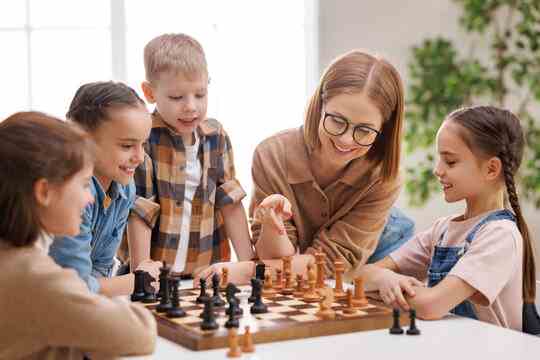
Parents often ask me what children can gain from chess besides learning the game itself. Concentration and logical thinking usually come to mind first, but I would add two less obvious qualities: patience and self-control.
My name is Valery Filippov. I am a chess grandmaster and professional chess coach, and I have spent most of my life in professional chess. Over the years, I have worked with many children and watched how they react to pressure, mistakes, victories, and defeats.
Chess does not automatically make a child patient. But it repeatedly puts children in situations where they need to slow down, check their ideas, accept mistakes, and try again. For me, this is one of its less obvious benefits.
Chess Teaches a Child Not to Rush
One of the most common problems among young beginners is simple: a child sees a move and plays it almost immediately. They notice an opportunity to give a check, attack the queen, or capture a piece, and their hand reaches for the board.
The problem is often not their ability to find a stronger move. After the game, I sometimes return to the same position and ask, “What else could you have done here?” A minute later, the child finds a much better solution.
The knowledge was there. The child simply did not spend enough time on the decision.
Before making a move, it is useful to stop, look at the opponent’s possible replies, and compare several options. The chessboard itself demonstrates why patience matters. Rush, and you may get a bad position. Spend another thirty seconds checking, and you may avoid a mistake.
A Pause Appears Between Desire and Action
A child wants to capture a pawn but first needs to check whether it is a trap. They want to attack the king, but perhaps their own king is in danger. They want to play a beautiful move, but a quieter continuation may be stronger.
A small sequence begins to develop: “I want to do this. But first, I will check.”
In my opinion, this is one of the most useful habits a child can develop at the chessboard. Sometimes, after a rushed mistake, it is enough for a coach to ask, “What would have happened if you had thought for one more minute?”
Eventually, some children begin asking themselves that question.
The Chess Clock Changes a Child’s Relationship With Time
The process becomes especially interesting when a child starts playing tournament games with a chess clock.
Many children initially use their time inefficiently. One plays almost instantly and finishes with most of the time still on the clock. Another spends too long on a simple move and then has to rush in a genuinely difficult position.
Gradually, they understand that time is a resource. Sometimes a decision really is obvious. Sometimes it is worth stopping for several minutes. And sometimes a position is important enough to continue calculating even when you desperately want to make a move.
For me, learning when to slow down is much more valuable than simply learning to sit at a chessboard for a long time.
Chess Makes Children Wait for Results
Chess improvement can be slow. A child may train for weeks without seeing an obvious change in tournament results. Then a tactical idea that used to be difficult becomes familiar, or a complicated position becomes easier to understand.
I consider the expectation of quick results one of the major problems in chess training. Adults struggle with it too. A person studies for several weeks and already expects a significant increase in rating. Chess improvement rarely happens in such a straight line.
A child gradually becomes accustomed to the idea that effort today does not necessarily produce a reward today. Perhaps the result will appear in a month or in six months. I think accepting this is itself a useful exercise in patience.
Losing Is a Serious Test of Self-Control
I consider losses one of the most valuable and difficult parts of children’s chess.
Strong emotions after a loss do not surprise me. A tournament game can be very important to a child, particularly when they have prepared for it seriously.
What interests me as a coach is what happens afterward. Can the child return to the board and look at the game? Can they find where the position went wrong? Can they listen to an explanation even while disappointed?
The goal is not to teach a child not to care about winning or losing. I would find that strange in a competitive player. The more useful skill is learning what to do with those emotions.
A Winning Position Also Requires Patience
Patience is not required only after things go wrong. Sometimes playing a winning position correctly is
just as difficult.
A child wins an extra piece and wants to finish the game as quickly as possible. Then come unnecessary attacks, sacrifices, and attempts to deliver a beautiful checkmate. A few moves later, the advantage may have disappeared.
I have seen games like this countless times. An advantage still has to be converted. Sometimes that means exchanging pieces and making several quiet moves instead of looking for something spectacular.
Children often find this difficult, which is exactly why I find these positions useful for training.
A Child Learns to Make Decisions Independently
There is another feature of chess that I particularly value. During a game, a child is on their own.
The coach cannot suggest a move. Once the game starts, the decisions belong to the player. The position is in front of the child, the clock is running, and the opponent is waiting.
Sometimes the decision is correct and sometimes it is not. Either way, the child eventually has to look back at their choice and understand what happened. I think this creates a good environment for developing internal discipline.
A Lot Depends on the Coach and the Parents
If a child is constantly rushed, criticized for losses, and judged exclusively by tournament results, chess may create additional stress. If the coach only demands correct answers and gives little time for independent thought, an important part of chess training is lost.
I prefer a different approach. A child should have the right to sit in a position for a while. A wrong answer is not always a bad outcome during training. If a student has genuinely worked on a position, discussing the mistake can be more useful than simply giving them the correct move.
I also advise parents not to focus only on the tournament result. There is nothing wrong with asking. whether a child won, but questions about the game itself can tell you much more. What was difficult? Where did the child feel uncertain? Was there a position they particularly liked?
This keeps the tournament from becoming only about the final score.
We Should Not Expect Miracles
Scientific research on chess and executive functions provides interesting but far from conclusive results. I think this is worth remembering when discussing the educational benefits of chess.
My own view is simpler. Chess creates many small situations in which patience and self-control become useful. Should I make the move now or check once more? Should I become frustrated after a mistake or continue fighting? Should I try to win quickly or calmly convert my advantage?
A single game can contain many decisions like these. For that reason, I prefer to see chess as an environment where these qualities can be practiced rather than as a guarantee that they will develop automatically.
The Most Important Changes Happen Gradually
I rarely see a particular moment when you can say, “Today this child learned patience.” Usually, the changes are much less obvious.
At first, a child makes a move after three seconds. A few months later, they stop and check a variation. A child who used to become frustrated with a difficult exercise very quickly may eventually spend much longer searching for the answer.
These small changes are what I find most valuable.
Chess does not have to turn a child into a perfectly calm and disciplined person. But it can regularly give a child the opportunity to practice something that is difficult to teach with a simple instruction: wait, think a little longer, deal with disappointment, resist the first impulse, and make an independent decision.
If these habits gradually begin to appear outside the chessboard as well, then, in my opinion, that is a more important result than winning another children’s tournament.
Also Read: 101+ Fun & Clever Riddles for Students of All Ages
