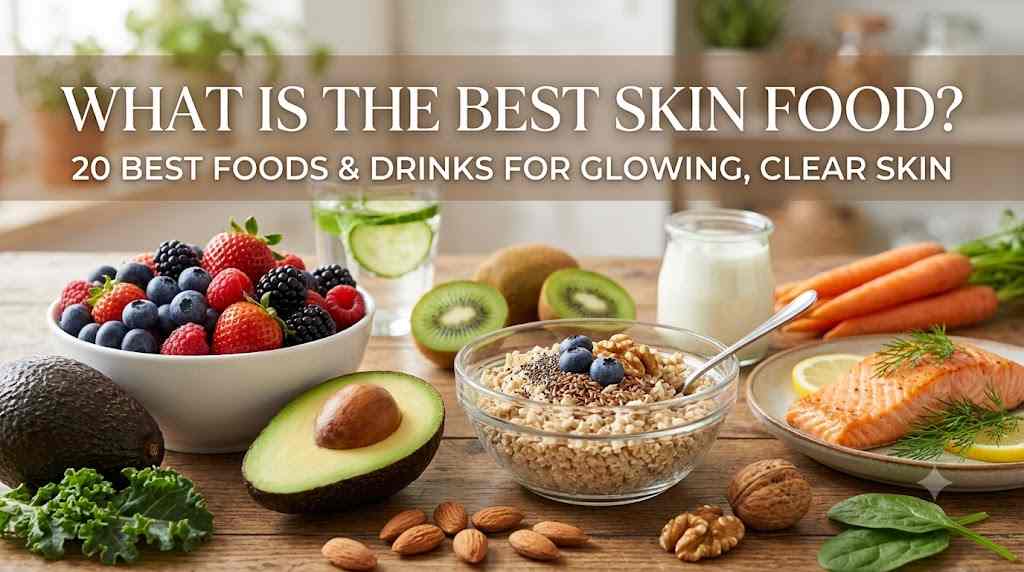
Nowadays every girl wants glowy skin. There are several products in the market to give a glow; however, they come with chemicals, not naturally. However, some people also search for “What is the best skin food?” So they get the glow naturally because they want long-term results, which won’t come from a quick fix or an expensive topical cream.
The best skin food is a whole food diet that is full of healthy fats, essential minerals, antioxidants, and hydrating nutrients that nourish the skin cells from both inside and outside.
The luxury serum only works outside the means of the surface of the skin. Eating the food items helps in locking the moisture, minimizing inflammation, and protecting skin against premature aging.

How Your Diet Actually Affects Your Skin
To understand how nutrition plays an important role in the complexion, you need to look at how it helps the skin to build itself.
The 28-Day Cell Turnover: Our skin is made from cells that are created deep within the dermis. When new cells are made, they are pushed upward to the surface. This process will take 28 to 40 days because of the long time limit; the dietary changes don’t transform the face overnight. However, you will see good results after constant intake of such food items.
Building From the Bloodstream: Moisturizers and topicals help to protect the skin’s outer barrier, but they aren’t able to make new tissues. The elements like amino acids, fatty acids, vitamins, and minerals needed to form new skin cells can be delivered through your bloodstream.
The Lipid Moisture Barrier: Essential fatty acids like omega-3s form the lipid seal in the cell membranes. When your diet doesn’t have any healthy fats, it weakens the barrier, leading to transepidermal water loss, dryness, and sensitivity.
The Gut-Skin Axis: Digestive tract and skin communicate constantly. An imbalance in gut bacteria and systemic inflammation take place. A poor diet also reacts with the skin and results in acne breakouts, eczema, redness, or premature dullness.
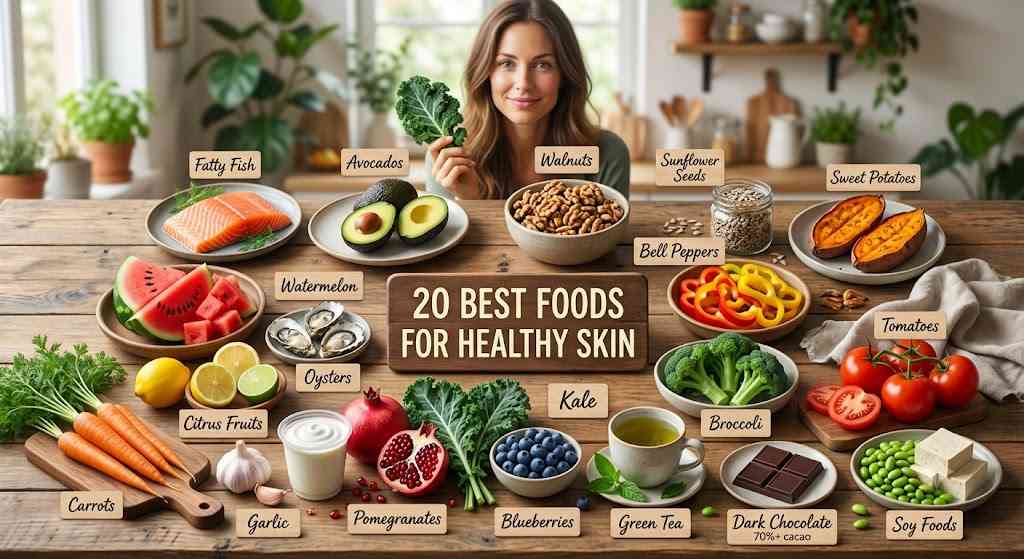
20 Best Foods for Healthy Skin
Here is a list of 20 Best Foods for Healthy Skin focused on active nutrients, biological mechanisms, skin impact, and how much you need to eat.
1. Beta-Carotene & Lutein (Sun & UV Shield)
To get beta-carotene & lutein, you need to eat carrots, sweet potatoes, pumpkins, kale, and spinach. The body converts beta-carotene into active vitamin A (retinol) that helps to speed up cellular turnover. Lutein is collected in the dermal layer and absorbed UV rays.
- Daily Quantity: You can eat 1 medium carrot, 1/2 sweet potato, or 1 cup of leafy greens (cooked).
- Best Time to Take: Lunch or Dinner. All the mentioned items have fat-soluble nutrients that need to pair up with healthy dietary fats like olive oil or avocado to absorb smoothly.
2. Vitamin C Powerhouses (Collagen Builders)
To get full vitamin C, you need to eat Kiwis, oranges, bell peppers, strawberries, and papaya. Vitamin C plays an important role in skin health, as it helps the enzymes to cross-link collagen molecules into a tight and firm matrix. It also neutralizes free radicals that are caused by pollution.
- Daily Quantity: You need everything in a minimum quantity, like 1 medium bell pepper, 2 kiwis, and 1 cup of berries.
- Best Time to Take: You can eat them in the morning for breakfast. The body can’t store vitamins, so start your day with vitamin C so the skin stays fresh and you feel stress-free.
3. Vitamin E Sources (Oxidative Shield)
To get vitamin E, all you need to eat is avocados, almonds, hazelnuts, and sunflower seeds. Vitamin E is inserted into cell membranes directly. It plays an important role by absorbing the oxidative stress that comes from UV light when it hits the skin. It also prevent lipid breakdown, which is the main cause of dry and prematurely aged skin.
- Daily Quantity: Take half an avocado and 1 small handful of almonds or seeds.
- Best Time to Take: You can eat it as a midday snack or with meals. The best combination you can do is add vitamin C foods as well.
4. Selenium Boosters (Cell Protectors)
To get selenium boosters, you need to eat Brazil nuts, eggs, cooked tomatoes, and sardines. Selenium creates an enzyme called the catalytic center of glutathione peroxidase; it helps in neutralizing tissue-damaging peroxides. It also protects the cellular DNA from photodamage.
- Daily Quantity: Eat 2 to 3 Brazil nuts daily.
- Best Time to Take: Anytime with meals. These nuts are a highly packed mineral snack. To get the best results, eat 2 nuts at breakfast with a meal or at lunch.
5. Zinc-Rich Foods (Healing & Oil Control)
To get zinc from food items, you need to eat pumpkin seeds, oysters, lean poultry, and whole grains. Zinc helps in regulating hormone enzymes that cause excess sebum (oil) in skin pores. It also guides cell division and protein synthesis when the skin barrier is repairing.
- Daily Quantity: You can eat 2 tablespoons of pumkin seeds and 3–4 oz of lean protein or shellfish.
- Best Time to Take: You can eat it at dinner.
6. Omega-3 Fatty Acids (Lipid Barrier Support)
To get omega-3 fatty acids, all you need to eat is wild salmon, trout, walnuts, chia seeds and flaxseeds. Omega-3s help in replacing stiff fats in the cell membranes by making them permeable. It also seals moisture in the skin while dampening inflammatory pathways, which is the main reason for breakouts and redness.
- Daily Quantity: You can have 3.5 oz of wild oily fish but only 2 to 3 times in a week or 1 to 2 tablespoons of ground chia or flax seeds.
- Best Time to Take: You can take them at dinner or with healthy fats. These food items also help in improving the digestive system and prevent stomach upset.
7. High-Fiber Whole Foods (Gut Cleaners)
To get high fiber from whole foods, all you need to eat is black beans, lentils, steel-cut oats, and chia seeds. These soluble fibers bind the digestive and hormonal waste in the intestinal tract and help to remove them before they recirculate in the bloodstream and cause inflammatory acne.
- Daily Quantity: Take half a cup of cooked legumes and 1 bowl of oats.
- Best Time to Take: You can eat them at breakfast or at lunch.
8. Fermented Foods (Microbiome Balance)
The best choices include plain kefir, kimchi, sauerkraut, and live organic yogurt. These fermented foods provide probiotic cultures that reinforce the gut lining, which keeps the bacterial endotoxins from leaking into the bloodstream.
- Daily Quantity: Take half a cup of kefir or yogurt and 2 tablespoons of unpasteurized kimchi/sauerkraut.
- Best Time to Take: You can have it in the morning on a lighter stomach.
9. Phyto-estrogens (Hormonal Support)
To get phytoestrogen food items, you need to eat edamame, tofu, tempeh, and ground flaxseeds. These plant compounds help the collagen production, skin thickness, and hydration levels.
- Daily Quantity: Take half a cup of edamame or tofu and 1 tbsp of ground flaxseeds.
- Best Time to Take: Eat them at lunch or dinner.
10. High-Water Hydrating Foods (Cellular Plumping)
The top food choices include cucumber, watermelon, courgettes (zucchini), and celery. These foods deliver electrolyte-bound water, which is full of potassium and magnesium that enters cells and hydrates the intercellular spaces.
- Daily Quantity: Take 1 to 2 cups of fresh and raw high-water produce.
- Best Time to Take: You can eat them in mid-morning or mid-afternoon.
11. Low-GI Carbohydrates (Collagen Protection)
To get low-GI carbohydrates, you need to eat porridge oats, pulses, quinoa, or brown rice. These carbohydrates prevent sharp insulin spikes.
- Daily Quantity: Take half or one cup of cooked complex grains per main meal.
- Best Time to Take: You can eat them at breakfast or lunch.
12. Polyphenols & Flavanols (Microcirculation Boosters)
To get polyphenols & flavanols, all you need to eat is dark chocolate (70%+ cocoa), matcha, green tea, and blueberries. Flavanols stimulate the production of nitric oxide in tiny blood vessels so the tiny facial capillaries provide oxygen, hydration, and nutrient-rich blood to the epidermis directly.
- Daily Quantity: All you need is 20g of dark chocolate and 1 to 2 cups of freshly brewed matcha or green tea.
- Best Time to Take: You can have these in mid-morning.
13. Lycopene-Rich Foods (Internal Sun Protection)
To get lycopene, all you need to eat is lycopene-rich foods like cooked tomato sauce/paste, pink grapefruit, and watermelon. Lycopene is a red pigment that deposits into outer skin layers, which works as a natural filter to save skin from free radicals created by UV light.
- Daily Quantity: You need 2 tbsp of tomato paste or half a cup of cooked tomato sauce.
- Best Time to Take: You can have it at dinner. If you cook tomatoes in oil, it increases lycopene bioavailability, making it an ideal part of evening-cooked dishes.
14. Bioavailable Collagen & Peptides (Structural Matrix)
To get bioavailable collagen & peptides, you need food items like bone broth, chicken with skin, fish with skin, or collagen powder. It provides concentrated glycine, proline, and hydroxyproline. These amino acid peptides go into the bloodstream and trigger fibroblasts in the dermis to synthesize new collagen and hyaluronic acid.
- Daily Quantity: You need 1 cup of bone broth and 15g of hydrolyzed collagen peptides.
- Best Time to Take: You can have it in the morning as the first thing or right before bed. Consuming it on an empty stomach can lead to high amino acid uptake in tissues.
15. Silica-Rich Foods (Tissue Elasticity)
To get silica, all you need to eat is cucumbers (with skin intact), oats, bell peppers, and green beans. Silica is important for skin as it strengthens the glycosaminoglycan, which helps the connective tissues to retain elasticity and moisture.
- Daily Quantity: Take 1 cucumber (make sure it is unpeeled) and 1 cup of green beans or oats (cooked).
- Best Time to Take: You can have them at lunch.
16. Chlorophyll Sources (Detox & Oxygenation)
To get chlorophyll, all you need to eat is spirulina, chlorella, wheatgrass, fresh parsley, and spinach. The molecular structure of chlorophyll resembles that of human hemoglobin. It helps regenerate deep tissues, which is important for glowy skin.
- Daily Quantity: You need 1 teaspoon of green superfood powder or 1 handful of fresh greens and herbs.
- Best Time to Take: You can have it in the early morning. Mix it with water or in a smoothie to get smooth digestion and cellular detox.
17. Anthocyanin Berries (MMP Enzyme Inhibitors)
Top choices for this include blueberries, blackberries, acai berries, and elderberries. These purple anthocyanins block matrix metalloproteinase enzymes that break down the healthy collagen.
- Daily Quantity: All you need is half a cup of fresh and frozen dark berries.
- Best Time to Take: You can eat them at breakfast. Add them in morning oats or yogurt to shield skin cells before going out in sunlight.
18. Sulfur-Rich Foods (Glutathione Production)
To get sulfur, you have to eat sulfur-rich foods like garlic, onions, broccoli, Brussels sprouts, and cabbage. These sulfur compounds help provide the building blocks for liver and skin cells to make glutathione, an important antioxidant for tissue repair and tone clarity.
- Daily Quantity: Take 1 or 2 cloves of garlic and 1 cup of cruciferous vegetables.
- Best Time to Take: You can have them at dinner. Cruciferous veggies help in liver detoxification when you sleep.
19. Healthy Monounsaturated Fats (Suppleness & Fluidity)
To get healthy monounsaturated fats, all you need to eat are food items like extra virgin olive oil (EVOO), olives, and macadamia nuts. These food items contain oleic acid, which replenishes the intercellular lipid matrix on the outer skin layer; it also smooths the rough patches and reinforces the barrier.
- Daily Quantity: Take 1 to 3 tablespoons of extra virgin oil as you prefer for a dressing or drizzle.
- Best Time to Take: You can use it to drizzle over dishes or salad at lunchtime or dinnertime.
20. Copper & Trace Mineral Sources (Elastin Cross-Linking)
To get copper & trace minerals, you need to add food items like shiitake mushrooms, dark leafy greens, sesame seeds, and cashews to your diet. Copper activates an enzyme known as lysyl oxidase, which works with zinc to weave collagen and elastic strands, which are needed for strong skin.
- Daily Quantity: All you need is half a cup of mushrooms or 1 small handful of raw cashews and sesame seeds.
- Best Time to Take: You can have them at dinner or as evening snacks.
Daily Glowing Skin Drink Schedule
If you are looking for the top 10 drinks for glowing skin, then you need the following chart: it has the ingredients, time to drink it, benefits, and how to make the drink.
| Time & Drink | Key Skin Benefit | Ingredients & How to Make |
|---|---|---|
| 7:00 AM (Empty Stomach) Warm Lemon & Raw Honey Water | Flush overnight toxins, stimulate digestion, and boost Vitamin C synthesis. |
Ingredients: 1 cup warm water, 1/2 lemon juice, 1 tsp raw honey. How: Stir lemon & honey into warm water. Drink immediately. |
| 8:00 AM (With Breakfast) Matcha Green Tea | High EGCG antioxidants prevent UV collagen damage and reduce inflammation. |
Ingredients: 1 tsp matcha, 2 tbsp warm water, 1 cup warm milk. How: Whisk matcha with warm water until frothy; top with warm milk. |
| 10:00 AM (Mid-Morning) Cucumber, Mint & Lime Water | High silica and electrolytes plump epidermal cells and reduce puffiness. |
Ingredients: 1/2 cucumber, 5 mint leaves, 1/2 lime, 1L water. How: Infuse in cold water for 1 hr in fridge; sip through morning. |
| 11:30 AM (Pre-Lunch) Fresh Aloe Vera Juice | Hydrates deep tissue layers and polysaccharides speed up skin repair. |
Ingredients: 2 tbsp aloe gel, 1 cup water/coconut water. How: Blend fresh clear aloe gel with water until smooth. |
| 1:30 PM (Post-Lunch) Probiotic Kefir / Buttermilk | Balances gut-skin axis to calm active breakouts, eczema, and redness. |
Ingredients: 1 cup plain unsweetened kefir or buttermilk. How: Drink cold plain or blend with roasted cumin & mint. |
| 3:30 PM (Mid-Afternoon) Beetroot, Carrot & Ginger Juice | Rich in nitrates & beta-carotene to boost blood flow for a natural flush. |
Ingredients: 1 small beet, 2 carrots, 1/2″ ginger, 1/2 apple. How: Juice all ingredients or blend with water and strain well. |
| 5:00 PM (Late Afternoon) Iced Hibiscus Tea | Packed with Vitamin C & anthocyanins that protect skin collagen. |
Ingredients: 1 tbsp hibiscus flowers, 1 cup hot water, ice, lime. How: Steep in hot water 5 mins, strain, cool, pour over ice with lime. |
| 6:30 PM (Pre-Dinner) Spinach & Coconut Smoothie | Delivers chlorophyll & potassium to oxygenate tissues & flush sodium. |
Ingredients: 1 cup spinach, 1/2 cup coconut water, 1/2 apple, 1 tbsp chia. How: Blend at high speed until smooth. Drink right away. |
| 8:30 PM (After Dinner) Warm Bone / Mushroom Broth | Delivers collagen peptides (glycine & proline) to repair skin overnight. |
Ingredients: 1 cup organic bone/mushroom broth, pinch sea salt. How: Heat on stove until warm. Season lightly and sip like tea. |
| 9:30 PM (30m Before Bed) Golden Turmeric Milk | Curcumin reduces inflammation, calms redness, and aids regeneration. |
Ingredients: 1 cup warm milk, 1/2 tsp turmeric, 1/4 tsp cinnamon, pinch pepper. How: Simmer together for 3 minutes. |
3 Golden Rules for Drink Absorption
- Don’t drink everything at once because it will be flushed out easily through the kidneys. Take one drink at a time so the cells absorb hydration and micronutrients.
- For drinks that have fat-soluble antioxidants like beta-carotene in the carrot/beet juice or curcumin in the turmeric milk, make sure you also have a small amount of healthy fat items, such as milk fat, chia seeds, or coconut oil, so the gut absorbs it.
- Don’t add refined sugars or artificial syrups to these drinks, as high sugar levels can cause stiffening of collagen fibers.
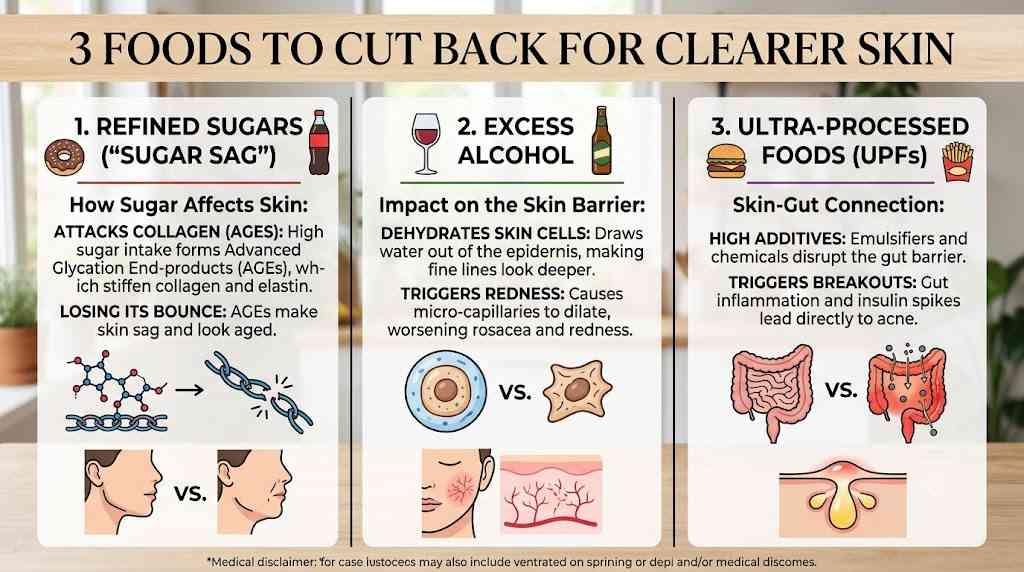
3 Foods to Cut Back for Clearer Skin
Now we know what food items and drinks are needed for glowing and clear skin; it’s time to look at 3 main foods to cut so you won’t face any skin concerns.
1. Refined Sugars & High-GI Carbs (Sugar Sag)
Foods that are high in carbs and refined sugar include white bread, bagels, croissants, donuts, cakes, cookies, pastries, milk chocolate, candy bars, gummies, sugary breakfast cereals, ice cream, high-fructose corn syrup, ketchup, barbecue sauces, and sweetened salad dressings.
Avoid drinks that include sodas, sweetened iced teas, energy drinks, flavored coffee syrups, and packaged fruit juices.
All the mentioned items damage skin because they are high in sugar when excessive glucose molecules enter the bloodstream, which are attached to collagen and elastin fibers. This will produce toxic compounds called AGEs, which cause collagen to weaken or become stiff and brittle.
Visible Skin Symptoms: These food items also cause insulin spikes & sebum. Overproduction, which leads to acne. It also causes a dull skin tone, loss of elasticity, premature sagging, and fine lines.
2. Excess Alcohol
Avoid high-sugar cocktails and wines like margaritas, piña coladas, daiquiris, rum & cola, flavored vodka mixers, sweet white wines, dessert wines, prosecco, and heavy red wines. Also avoid beers and ciders like commercial lagers, craft beers, sweet hard ciders, whiskey, rum, tequila, gin, and vodka.
Alcohol acts as a potent diuretic by suppressing anti-diuretic hormones, which forces the commercial flush water out faster than it absorbs whiskey, sture from the epididymis, and cells. It also
Dilates peripheral blood close to the skin surface; the large consumption of alcohol can weaken these micro-capillaries with time, leading to spider veins and rosacea build-up. Alcohol also raises the stress hormone levels, leading to slow cellular tissue repair.
3. Ultra-Processed Foods (UPFs)
Avoid food items like hamburgers, deep-fried chicken, French fries, onion rings, potato chips, flavored crackers, instant noodles, pre-packaged pastries, cheese curls, hot dogs, sausages, bacon, deli cold cuts, chicken nuggets, frozen pizzas, instant microwave dinners, and canned soups high in sodium and synthetic preservatives.
All these food items contain industrial additives and emulsifiers like carboxymethylcellulose and polysorbate-80, which wear down the mucus layer in the digestive tract and lead to leaky guts.
Ultra-processed food items are cooked in refined seed oils like corn, soy, and sunflower and are disproportionately high in pro-inflammatory omega-6 fatty acids. High intake of these acids can overwhelm omega-3, causing breakouts to be redder and swollen.
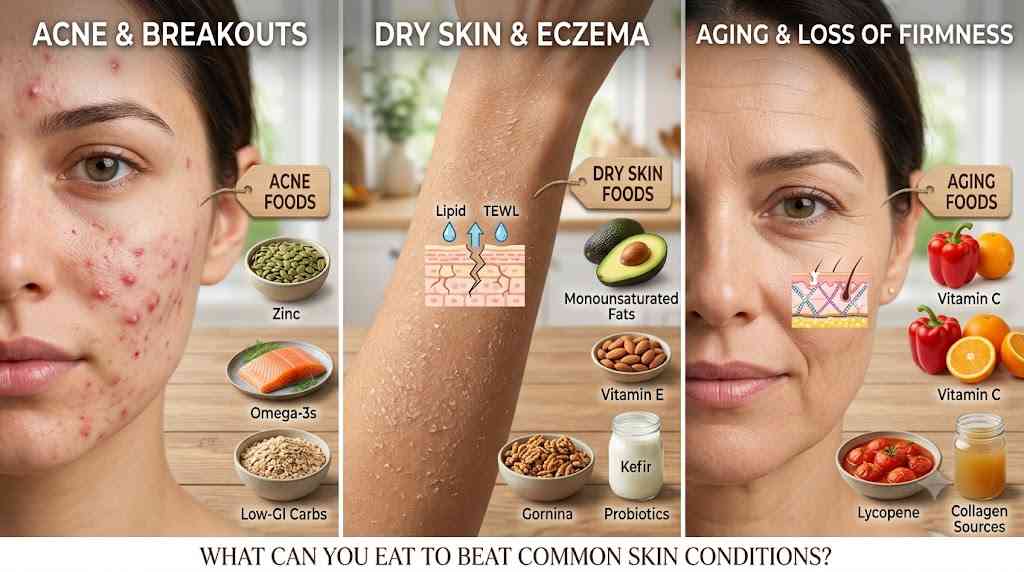
What can you eat to beat common Skin conditions?
What to Eat for Acne: To get rid of acne and breakouts, focus on eating food items like pumpkin seeds, oysters, lean poultry, wild salmon, trout, walnuts, chia seeds, steel-cut oats, lentils, and quinoa, as they are rich in zinc, omega-3 fatty acids, and low-glycemic carbohydrates.
Zinc helps in regulating the main enzyme that converts the testosterone into dihydrotestosterone (DHT) within skin tissue. Lowering DHT helps in preventing the production of sticky and thick oils aggressively. Omega-3s help in the production of leukotriene B4, which reduces swelling and redness. Lastly, low-GI carbs prevent sharp blood sugar and insulin spikes.
What to Eat for Dry Skin & Eczema: To save skin from dry skin & eczema, you need to add food items to your diet like avocados, extra virgin olive oil, macadamia nuts, kimchi, sauerkraut, live organic yogurt, almonds, and sunflower seeds. All these items have monounsaturated fats, vitamin E, and probiotics.
Both monounsaturated fats & vitamin E in the outer layer of skin prevent transepidermal water loss (TEWL) and restore softness to dry or flaky skin. Probiotic fermented foods provide bacteria like Lactobacillus and Bifidobacterium that reinforce the intestinal epithelial lining.
What to Eat for Aging & Loss of Firmness: You can include items like bell peppers, strawberries, kiwis, oranges, cooked tomatoes, tomato paste, bone broth, fish with skin, and collagen peptides. All these items are rich in vitamin C, lycopene, and collagen.
Vitamin C & bioavailable amino acids act as primary building blocks for young skin. Whereas lycopene is a fat-soluble carotenoid that deposits in the dermal matrix.
Skin Lycopene Nutrient Focus Chart
| Condition & Core Goal | Primary Active Nutrients | Key Mechanism in Skin |
|---|---|---|
| Acne & Breakouts Goal: Reduce oil synthesis & calm inflammation |
|
Inhibits androgen-driven oil surges, regulates sebum production, and reduces swelling in cystic breakouts. |
| Dry Skin & Eczema Goal: Rebuild lipid seal & balance gut immune system |
|
Locks in moisture at the cell surface, prevents water loss (TEWL), and reduces gut-driven systemic skin irritation. |
| Aging & Loss of Firmness Goal: Stimulate structural proteins & block UV damage |
|
Cross-links new collagen fibers to restore firmness while shielding existing elastin from solar breakdown. |
The 1-Day Glowing Skin Meal Plan
For glowy skin, you need to follow the meal plan as mentioned.
Breakfast
All you need is steel-cut oatmeal; use fresh blueberries, 1 tbsp of chia seeds, and walnuts at the top of it. A splash of unsweetened almond milk and 1 cup of ceremonial matcha green tea.
- Skin Benefits: Low-GI oats help to reduce morning insulin spikes, and walnuts and chia seeds deliver skin-plumping benefits. Omega-3s and blueberries give anthocyanins, which help in protecting collagen. Matcha supplies EGCG polyphenols, which help in reducing sebum production and calming redness.
Lunch
All you need is a large spinach and kale salad; use grilled wild salmon, half a diced avocado, and pumpkin seeds as toppings. For dressing, use extra virgin olive oil and fresh lemon juice.
- Skin Benefits: Wild salmon provides EPA/DHA, which helps to reduce inflammation. Avocado and olive oil help in rebuilding the lipid moisture barrier. Pumpkin seeds have zinc, which regulates oil production, and fresh lemon juice offers vitamin C to boost collagen synthesis.
Afternoon Snack
All you need is 1 cup of probiotic-rich plain kefir, 2 Brazil nuts, and unsweetened Greek yogurt.
- Skin Benefits: Kefir has probiotics, which help to strengthen the gut lining. 2 Brazil nuts provide the selenium needed to protect cell membranes.
Dinner
All you need is roasted sweet potato wedges, steamed broccoli, baked trout, extra virgin olive oil, and fermented kimchi.
- Skin Benefits: Sweet potatoes have beta-carotene that encourages healthy cell turnover; broccoli has sulfur that helps in glutathione production. Trout has lean, collagen-building protein, and kimchi has live enzymes to balance skin and gut.

Role of Water in Skin Health
Water plays an important role in skin health but not like as many people think. Drinking water won’t magically tone the skin cells like filling up with water. Instead, it works from both inside and outside, leading to plump, clear, and glowy skin.
1. Cellular Plumping (Turgor Pressure)
The outer layer of skin, known as the stratum corneum, needs adequate water content to keep its elasticity and density. When you stay hydrated, the skin cells swell, which leads to smoothing out fine lines, reducing texture, and providing a bouncy appearance. However, when you are dehydrated, the skin looks dull and even exaggerates fine lines.
2. Flushing Micro-Toxins & Waste
The kidneys and liver completely depend on water to flush out the toxins and waste. If you don’t drink enough water, this leads to dehydration and waste buildup in circulation. All these result in making skin look sallow, grey, or prone to breakouts.
3. Preserving the Moisture Barrier
When you drink enough water, the skin can make enough natural oils and natural moisturizing factors (NMFs). However, without water, the skin barrier can crack, leading to epidermal water loss, which causes dry, flaky, and irritated skin.
Water Alone Isn’t Enough: The Hydration Trap
Many people think only drinking a lot of water can give a glow; however, it ends up giving dry and dull skin. The main reason is plain water passes quickly, as kidneys need to flush out waste. If you want water to stay long, then it needs to have electrolytes and healthy fats.
| Plain Water Alone | Cellular Hydration (Water + Electrolytes + Fats) |
|---|---|
|
|
3 Ways to Upgrade Your Hydration for Maximum Glow
You can eat fruits and vegetables that are naturally rich in water, like cucumber, watermelon, berries, and celery. The water found in the following items is rich in natural potassium, magnesium, and silica. This water is more effective than a plain one.
You can add electrolytes to water, like adding a pinch of unrefined sea salt or a squeeze of fresh lemon juice. These Additives are rich in sodium and potassium, needed to pull hydration into skin cells.
Pair the liquid intake with monounsaturated fats and omega-3s, like avocados, extra virgin olive oil, almonds, salmon, and chia seeds. These fats form the oil seal at the top of the skin, which stops water from evaporating in the air.
Is food enough for glowy skin, or do you need anything more?
The short answer is yes if you get the majority of food items that are rich in skin nutrients by following a well-planned and whole-food diet.
The most essential skin nutrients include Vitamin C, Vitamin E, Zinc, Beta-Carotene, and Collagen amino acids. The food derived nutrients have more bioavailable because they are pack with natural co-factors and enzymes that helps in absorption.
The following are the three specific nutrients often requiring supplementation or special attention:
1. Vitamin D3 (The “Sunlight Mineral”)
The food falls short because only a few food items contain vitamin D3, such as wild fatty fish, egg yolks, and fortified foods. The majority of vitamin D is synthesized in the skin when you go in the sunlight. You need to implement sun protection like SPF.
To find how much vitamin D your body has, you can also do a simple blood test; it will reveal how much you need daily, like 1,000–4,000 IU/day. To get vitamin D, people use supplements.
2. Bioavailable Omega-3s (EPA & DHA)
While plant foods such as seeds, flaxseeds, and walnuts contain alpha-linolenic acid (ALA). Our body converts it into an active skin-soothing EPA and DHA; however, the rate is less than 5–10%.
To get omega-3, you need to eat cold-water fish like wild salmon, mackerel, or sardines 2 to 3 times in a week.
If you don’t eat fish weekly, then use fish oil or a microalgae-based vegan EPA/DHA supplement; they will give you 500–1,000 mg combined EPA/DHA daily.
3. Bioavailable Collagen Peptides
Natural dietary collagen comes from connective tissue from animal bone, tendon, and fish skin, so if you don’t eat bone broth or whole fish with the skin, then the intake will be low.
While the body can take collagen from protein intake, aging reduces this internal production by 1% per year after age 20. For this you can take 10–15 g of hydrolyzed collagen powder daily.
Disclaimer: This article is for informational purposes only and does not constitute medical, nutritional, or dermatological advice. Speak with your doctor or registered dietitian before making significant changes to your diet or skincare routine.
What Else Is Needed for Healthy Skin?
The diet can provide building blocks internally, but there are four additional lifestyle pillars that are also needed as follows:
Pillar 1: Topical Skincare (External Protection & Barrier Support)
Diet fuels the dermis (deep layer), but topical products treat the epidermis (outer layer). UV rays can destroy collagen, so it is important to use a sunscreen that has an SPF of 30 to 50.
Avoid washing your face with harsh sulfates, as they strip natural lipids. Always use a pH-balanced cleanser that has ceramides, hyaluronic acid, or fatty acids. Use topical retinoids and vitamin C products.
Pillar 2: Deep Sleep & Circadian Rhythm
When you sleep, the blood flow in the skin increases, human growth hormone repairs the UV damage, and cell division peaks. Lack of sleep can cause stress hormones to elevate, leading to acne, eczema, and psoriasis. Take 7 to 9 hours of sleep daily.
Pillar 3: Gut Health & Digestion
It’s not about what you eat only; it’s also about what you absorb. If your gut is inflamed or digestive enzymes are low the body won’t break down the foods to extract the nutrients needed for skin.
Make sure you eat fermented foods and prioritize dietary fiber and chew food properly to address these issues.
Pillar 4: Stress Management & Micro-Circulation
Psychological stress releases cortisol and neuro-inflammatory chemicals, which leads to increased skin oil and impaired barrier function. To reduce this stress, all you need to do is brisk walking, strength training, yoga, deep breathing, and time outdoors daily.
