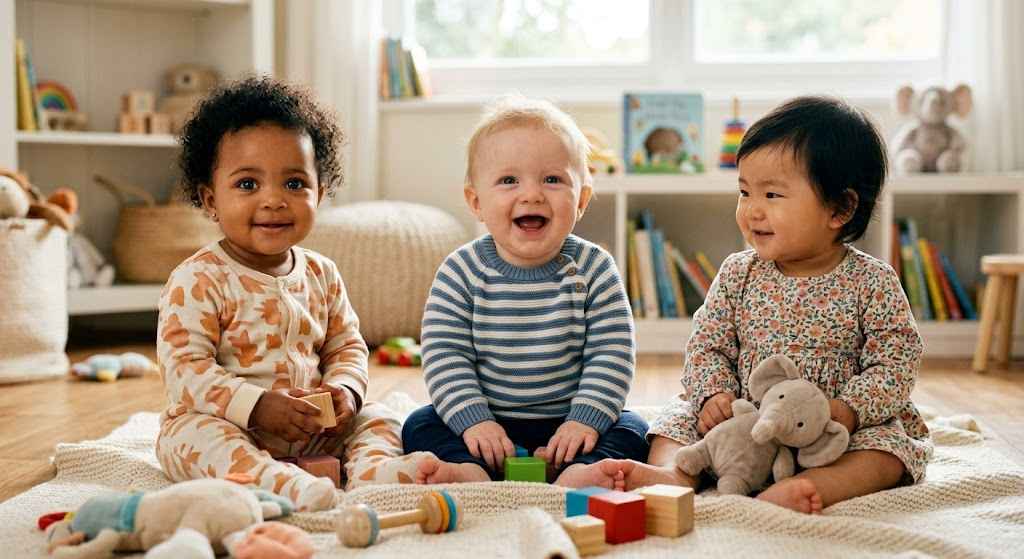
If you are a parent-to-be, you may wonder about the baby’s adopted features, hair, eyes, etc. of which parent. Genetics is a mix of chance, biology, and history. While the parent features depend on complex interactions between multiple pairs of DNA, using an interactive tool like a baby genetics calculator can give you an accurate glimpse into the statistical probabilities of your child’s physical traits.
Dominant Prediction Profile
Statistical Probability Metrics
| Mom \ Dad | – | – |
| – | – | – |
| – | – | – |
Think of this grid like a genetic matchup: The capital B stands for a dominant trait (like brown eyes), and the lowercase b stands for a hidden, recessive trait (like blue eyes). Each of the four boxes represents a 25% chance for your baby. As long as a box has at least one capital B, that combination results in brown eyes!
How Genetic Dominance Works: The Quick Cheat Sheet
A baby receives two copies of every gene; one comes from the mother and the other comes from the father. These copies are called alleles. When one allele is stronger than the other, the child will adopt that parent’s feature. When you input these traits into a baby genetics calculator, the algorithm weighs them and will use this for prediction.
| Trait Category | Dominant Expression (High Probability) |
Recessive Expression (Low Probability) |
|---|---|---|
| Eye Color | Brown, Hazel | Blue, Green |
| Hair Color | Black, Dark Brown | Blonde, Red |
| Dimples | Present (Cheek or chin) |
Absent |
| Earlobes | Free / Detached | Attached directly to the neck |
| Hairline | Widow’s Peak (V-shape) |
Straight Hairline |
Eye Color Genetics: Can Two Blue-Eyed Parents Have a Brown-Eyed Baby?
Over years we learn eye color is a simple genetic trait. Today we know it can be controlled by multiple genes that are working in unison. The two main genes that are important for eye color are OCA2 and HERC2; they both are located on chromosome 15. The work of these genes is to control the amount of dark pigment known as melanin deposit into the iris.
High Melanin (Brown Eyes): If one person passes a strong brown allele, then the child will likely have brown eyes.
Low Melanin (Blue Eyes): The blue eyes take place where there is a little melanin in the iris because the blue allele is recessive, meaning it needs two copies, one from each parent.
The Genotype Twist: Many parents ask, “If both parents have brown eyes, is it possible that the baby can have blue eyes?” Well, you may be shocked to hear yes, if both parents have a hidden recessive blue allele from their parents, then there is a 25% chance the baby can have blue eyes. This is why parents are using genetic calculators nowadays.
As a parent, you also have a question in mind: When do a baby’s eyes stop changing color? Those babies who are born with light blue or gray eyes have pigment-producing cells that aren’t fully activated by light, so it takes 9 to 12 months of age to develop permanent eye color.
Medical Disclaimer: This tool is for informational and entertainment purposes only and is based on simplified genetic probabilities. It does not constitute medical advice, a formal diagnosis, or genetic counseling. Human inheritance is complex, and actual traits can vary from statistical models. For any health or genetic concerns, always consult a qualified healthcare professional or a licensed genetic counselor.
Hair Color and Texture Probabilities
Hair color genetics works on a spectrum that is based on two pigments: eumelanin (responsible for brown and black shades) and pheomelanin (responsible for red or blonde shades).
Dark vs. Light Shades
Dark hair alleles are very sharp, meaning if one parent passes a gene for black or brown eumelanin, it will create lighter blonde alleles. If a child has true blond hair, it means both parents passed recessive light-hair alleles.
The Red Hair Gene
Red hair is unique and can take place because of a mutation in the MC1R gene. A baby can only have red hair if both parents have red hair or carry the mutated MC1R gene. If neither parent has red hair, then there is just a 1 in 4 chance a baby will have red hair.
Understanding Facial Features: Dimples, Earlobes, and Hairlines
Most of the kids have their parents’ faces. Parents think it is common, but it is a unique characteristic that shows family resemblance.
Cheek and Chin Dimples
Dimples are considered a beautiful feature that every person doesn’t have. If one parent has dimples, there is a high chance a baby will have them too; however, the expression may vary, like if a parent has two large dimples, a child can have just a small one.
Free vs. Attached Earlobes
Look closely at where the earlobe meets the side of the head. Free earlobes (which hang down slightly below the attachment point) are dominant. Attached earlobes (which blend smoothly straight into the side of the head) are recessive.
Frequently Asked Questions: Baby genetics calculator
Why doesn’t my baby look exactly like the calculator results?
The reason behind this is every online baby genetics calculator uses statistical mathematical models that rely on Mendelian rules and factors like spontaneous genetic mutations; environmental factors alter how a tool displays them. There is a possibility of 75% accuracy, but these features are completely natural; there is a 25% possibility that the tool can also be just for fun.
Can a child inherit a trait neither parent shows?
Yes, if the trait is recessive, such as blue eyes, red hair, or attached earlobes. Both parents can carry the gene, which is not inherited by the child.
Is baby skin color predictable?
The skin color is very polygenic because it includes 100 distinct genes. A child’s skin tone also falls between both parents’ colors.