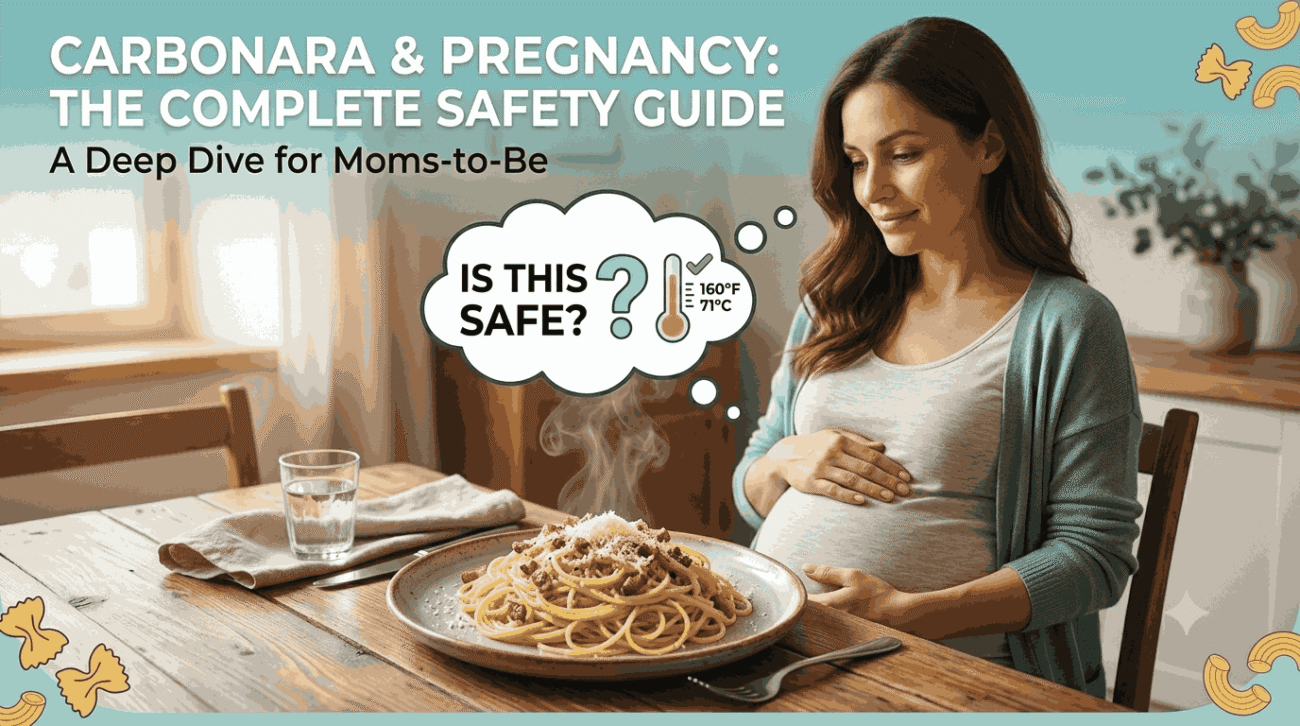
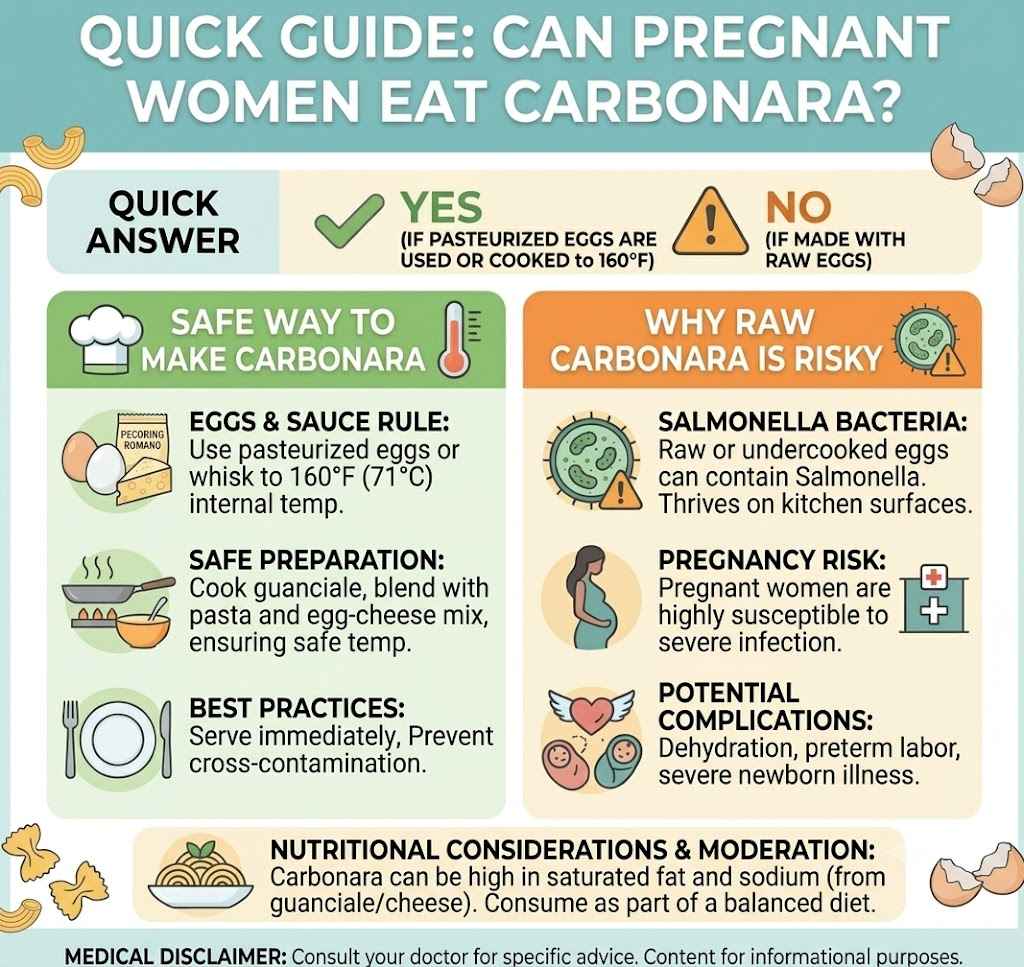
Quick answer: Yes, pregnant women can safely eat carbonara if it is prepared correctly. The risk of Salmonella from raw eggs is eliminated by ensuring the sauce is heated to an internal temperature of 70°C (160°F) or by using pasteurized eggs. When dining out, always confirm with the restaurant how it is prepared.
If you are someone who loves creamy Italian pasta and you become pregnant, you may have many questions in mind, like: can pregnant women eat carbonara? You think before you eat any food item during pregnancy, as there are many food restrictions for safety. The good news is you don’t need to cut your pasta dish from the list for the next nine months.
While the traditional carbonara recipes are based on raw or soft-cooked eggs, which carry a risk of Salmonella, it is possible to enjoy a safe, delicious version. Whether you are making one at home or ordering at the restaurant. Knowing how to make it and requesting it at a restaurant to get a safe dish makes a difference.
In this guide, we will break down the safety facts of carbonara, how to handle the ingredients, and how to savor carbonara with a relaxed mind.
Understanding the Risk: Why Ingredients Matter
To enjoy carbonara safely, it is important to understand why many health organizations consider it to be a high-risk dish. The pasta and the cured meat aren’t the real villains in the dish. The sauce is hot.
The Primary Concern: Raw or Under-Cooked Eggs
Traditional recipes of carbonara don’t use heavy cream; the dish is completely dependent on the emulsion created by whisking raw egg yolks (or whites too) with some grated Parmesan cheese. When this mixture is tossed with hot pasta, the heat is supposed to cook the eggs too; however, in many traditional recipes, the eggs aren’t fully cooked and remain runny or soft to give a signature silky texture.
The Salmonella Risk: Raw and uncooked eggs carry a risk of salmonella bacteria. While Salmonella isn’t harmful for a fetus, as it can’t cross the placental barrier like listeria, it can cause severe food poisoning that includes high fever, vomiting, diarrhea, and dehydration. In pregnancy this food poisoning can make you physically exhausted, and even in severe cases it leads to complications or premature labor due to extreme dehydration.
The Threshold of Safety: To reduce the risk of salmonella, the egg components need to be heated at an internal temperature of at least 70°C (160°F). However many home cooks and restaurant chefs don’t reach this temperature because they fear the eggs will turn into a scrambled form, which ruins the sauce’s structure.
The Secondary Factor: The Quality of Eggs
Well, not all the eggs carry salmonella risk; you can go for pasteurized eggs, as they are heat-treated in their shells to kill bacteria while remaining in a liquid state, completely safe during pregnancy.
Another option is vaccinated eggs. In many countries, like the UK, the eggs have a specific safety stamp (like the British Lion Mark). These eggs are marked so people know they come from hens vaccinated against salmonella.
However, in regions where this certification is not standard, the risk remains higher.
The Meat: Cured Pork
The traditional recipe of carbonara uses guanciale (cured pork jowl) and pancetta (cured pork belly). The cured meat isn’t raw, but it is not cooked like the chicken breast or steak. Cured meat can only be safe in pregnancy if it is cooked until steaming hot.
When you are making carbonara pasta at home, make sure the cutting board, utensils, and hands used for raw meat are properly washed before using them with other ingredients.
Why Store-Bought is Different
You may have a question in mind: can you buy carbonara sauce found in a jar or not? Well, commercially produced carbonara sauces are processed and pasteurized at high heat during manufacturing. This makes for a stable shelf life and is free from bacteria like salmonella, making it completely safe to eat in pregnancy.
How to Make Pregnancy-Safe Carbonara at Home
You don’t need to completely avoid the carbonara sauce and eat dry pasta to stay safe; instead, follow some techniques to get the same classic, luxurious, velvety carbonara texture while the egg base is fully cooked and safe in pregnancy. Here are the three best methods to get a safe carbonara pasta.
1. The Pasteurised Advantage Method (Recommended)
The easiest way to remove the risk of salmonella in the dish is to substitute the fresh, shell-cracked eggs with pasteurized liquid eggs. These eggs are heat treated during the bottling process, so the bacteria are killed without changing the liquid in the egg.
Once you swap the fresh eggs for pasteurized liquid eggs for the recipe. You can now follow the standard preparing method.
2. The “Double-Boiler” Emulsion Technique
If you like the taste of fresh eggs, then you can use a double-boiler technique in which a bowl is set over a pot of simmering water. This creates a custard base to ensure that the eggs reach the safe temperature.
- First whisk the eggs with cheese and black pepper in a heatproof bowl.
- Now place the same bowl on a saucepan of gently simmering water; ensure the bottom of the bowl doesn’t touch the water.
- Continue whisking the mixture in the bowl until you find the perfect creamy, pourable sauce structure. Use a digital kitchen thermometer to ensure the temperature reaches 70°C (160°F).
- Once you find the required temperature, remove it from heat and toss quickly with the fresh, drained, piping-hot pasta. The heat of pasta will help to mix the sauce completely.
3. The Residual Heat & Pasta Water Method
It is the traditional method, but in pregnancy you must be more alert with timing to make sure the eggs are fully cooked.
- The Hot Bowl Trick: First warm the serving bowl with the help of boiling water. This helps the sauce from cooling down quickly when it hits the dish.
- The Pasta Water Secret: When you are draining pasta, save a cup of its boiling-hot water.
- The Emulsion: Toss the hot pasta with the egg and cheese mixture quickly and add the saved pasta water. The water has to be hot, so do this process quickly once the pasta is done.
- The Finishing Touch: If you aren’t sure about the eggs reaching the 70°C (160°F) temperature or not, then add your prepared pasta bowl to the oven and let it cook for 60 seconds. This step will help you to make sure the dish is completely safe while the egg is fully set without being scrambled.
Pro-Tips for the Perfect Safe Carbonara
The “Clear Sauce” Test: If you are worried or on the cautious side, then look at the texture of the sauce. A safe carbonara will have a thick, opaque, and creamy sauce, while an unsafe one looks too translucent or watery, indicating the eggs are still raw.
Grate Your Own Cheese: Avoid pre-grated cheese, as it contains anti-caking agents that can create problems in the way the sauce emulsifies. Buy Pecorino Romano or Parmesan and grate at home.
Dining Out? How to Stay Safe While Enjoying Carbonara
When you are ordering carbonara at a restaurant during pregnancy, you have to be more careful because at home you have full control over the ingredients but not outside. Look at whether the restaurant prioritizes food safety or if they use traditional raw-egg techniques.
If you are going to a high-end or authentic Italian restaurant, mostly these types of restaurants use raw yolks stirred into hot pasta. Look at the menu too. If the dish is marked ‘traditional,’ then completely avoid it, as the chances of raw eggs are high.
If you are going to chain restaurants or family-style eateries, then it can be safe because they use standardized, pre-prepared sauces or pasteurized ingredients, which make the dish safe, especially for pregnant women.
The Ask Protocol (What to Say to the Waiter)
Don’t be shy to ask about anything that can affect your or the baby’s health in pregnancy. Simply ask the waiter: I’m pregnant, and I need to avoid raw eggs, so let me know. Do you guys prepare the carbonara sauce using pasteurized eggs, or is it cooked through to be fully safe?
- If the waiter says yes, we use pasteurized eggs, or the sauce is cooked until the eggs are fully set, and then the dish is safe.
- If the waiter says we stir in fresh raw egg yolks with the pasta, the sauce is lightly tossed with heat. It’s unsafe to avoid ordering it.
Red Flags to Watch For
- If the waiter only answers, we made it in a traditional way, so assume the dish has raw or uncooked eggs.
- If the sauce looks very thin, glossy, or translucent, then it means the eggs are not heated at a safe temperature.
- If the server ends up with the dish by cracking a raw egg directly into your bowl at the table, avoid the dish and order something else.
10 Pregnancy-Safe Pasta Alternatives
Carbonara isn’t only the last dish; you can use other pregnancy-safe options as follows.
- Fettuccine Alfredo: It is completely based on heavy cream, butter, and Parmesan cheese free from eggs. It is cooked properly, and no ingredient is raw.
- Pasta Amatriciana: If you love carbonara, then go for this alternative, as this dish uses guanciale or bacon, tomato sauce, and Pecorino cheese. It is fully cooked and just needs a pinch of salt.
- Pasta alla Vodka: A restaurant staple that provides a luxurious, creamy texture. The sauce is made from tomatoes, cream, and a splash of vodka.
- Cacio e Pepe (Verified): It is known as the parent of carbonara, made with cheese and black pepper only.
- Creamy Mushroom Risotto: If you crave something creamy, then this dish is perfect for you. It is slow-cooked, and the rice in it gives natural starch to provide creaminess.
- Pesto Genovese: It is made from basil, pine nuts, garlic, olive oil, and Parmesan. No raw eggs needed.
- Pasta Primavera: If you want something lighter, then this dish is perfect for you. It includes seasonal vegetables in a light cream or olive oil sauce completely safe during pregnancy.
- Gnocchi in Gorgonzola or Four-Cheese Sauce: It provides a comforting texture that holds up well to rich sauces. Cheese-based sauces are generally safe if they are heated properly.
- Spaghetti Aglio e Olio: Another one for a simple, flavorful dish. It includes garlic, olive oil, chili flakes, and parsley; no eggs needed.
- Baked Ziti or Lasagna: They are baked at a high temperature and take a high amount of time so all the ingredients get cooked.
The Nutritional Benefit: Why Carbonara Can Be a Power Meal
While it is labeled as comfort food, it does have many advantages for your baby if it is prepared safely.
The Choline Boost: Eggs are considered a best source of choline; this nutrient helps in the development of a baby’s brain and memory functions. Many prenatal vitamins don’t have enough choline, so getting it from your diet is a huge win.
High-Quality Protein: The combination of eggs and cured pork offers a significant hit of protein, which is important for building new tissues and providing you energy the whole day.
Smart Tweaks: To make the meal more pregnancy-friendly, add a side green like a fresh baby spinach into a hot pasta before tossing it. You can also add steamed broccoli on the side. This combination will give iron, folate, and fiber that help in better digestion during pregnancy.
| Ingredient | Nutritional Profile | Pregnancy Benefit |
|---|---|---|
| Egg Yolks | Rich in choline, vitamin D, B-vitamins, lutein, and healthy lipids. |
Choline directly supports fetal brain development and neural tube formation, matching early development demands.
|
| Hard Cheeses Pecorino / Parmesan |
Concentrated source of bioavailable calcium, high-quality protein, and zinc. |
Provides the essential calcium required to build the fetal skeletal system while protecting maternal bone density.
|
| Durum Pasta | Complex carbohydrates, iron, and crucial enrichment nutrients like folic acid. |
Supplies stable, long-lasting energy to combat pregnancy fatigue, while folate prevents congenital complications.
|
I Ate Carbonara and Now I’m Worried: A Note of Reassurance
If you are reading this just after finishing a plate of carbonara that has raw eggs and are now looking for the risk, then take a deep breath.
- Don’t panic; while the risk of salmonella exists, interaction with it is low from a single meal.
- Monitor how your body reacts for the next 24 to 48 hours. Look for the symptoms like stomach cramps, diarrhea, fever, or vomiting.
- If you experience any of the mentioned symptoms, then contact your healthcare provider.
Decoding the Carbonara vs. Creamy Pasta Confusion
There is massive confusion in people about what real carbonara is. Well, the traditional Italian carbonara contains zero cream and is fully based on a raw egg-and-cheese emulsion.
Many restaurants use heavy cream in carbonara recipes, which makes it a safe option because the cream is boiled or simmered with the sauce.
But always ask the restaurant server if they use eggs in cream to make the texture more smooth or not, because some restaurants do this too.
| Sauce Type | Traditional Authentic Carbonara | Cream-Based “Carbonara” / Alfredo |
|---|---|---|
| Core Ingredients | Egg yolks (or whole eggs), Pecorino Romano or Parmesan, crispy guanciale or pancetta, and black pepper. | Heavy cream, butter, garlic, Parmesan cheese, and often American bacon or ham. |
| How It’s Thickened | Emulsified naturally using raw eggs cooked gently by the residual heat of the hot pasta water. | Simmered and reduced on the stovetop, creating a thick, stable dairy structure without relying on raw eggs. |
| Pregnancy Risk | Higher risk due to potential undercooked eggs, which can harbor Salmonella bacteria if not fully pasteurized. | Virtually zero bacterial risk, provided the cream and cheeses used are standard pasteurized commercial dairy products. |
| Safety Verdict |
USE CAUTION: Eat only if eggs are confirmed pasteurized and the sauce is cooked completely through.
|
100% SAFE: Highly secure choice for pregnancy since the cream is boiled and inherently stable.
|
Your Safe Home Cooking Shopping List
The checklist helps you to make sure that you satisfy the cravings with safety.
- Always go for pasteurized eggs that are available in cartons and stay in the refrigerated aisle. These eggs make the dish completely safe because they have been heat-treated.
- Always buy a fresh Pecorino Romano or Parmesan piece and grate it at home.
- Make sure the guanciale or pancetta is fresh and sealed.
- Use the digital thermometer to ensure the sauce temperature is 70°C (160°F).
First Trimester vs. Third Trimester: Adjusting Your Cravings
Pregnancy is full of experiences, and when you love a food item like carbonara, it completely changes the way you eat it before pregnancy. Understanding these shifts helps to enjoy food while managing the specific physical challenges of each trimester.
The First Trimester: Managing Morning Sickness
During the first trimester, expected moms often experience smell sensitivity and nausea because the body undergoes extreme hormonal changes.
The scent of rendered guanciale or salty pork can be appetizing to a normal person, but a pregnant woman can immediately feel nausea. If you are experiencing the same thing, then avoid eating or making carbonara. Digestion is already slow in the first trimester, and carbonara is high in fats; it’s better to avoid it in the first trimester.
If you are craving carbonara and can’t avoid it in the first trimester, then you can go for a smaller portion along with a palate cleanser like a slice of lemon, a fresh salad with a light vinaigrette, or some ginger tea. It will help to cut the fat and make the digestion easy.
The Second Trimester: The “Sweet Spot”
Many pregnant women consider the second trimester the honeymoon phase because the morning sickness reduces and your appetite is back in full force.
The second trimester is the perfect time to enjoy nutrient-dense meals. Since the baby is in a major growth phase, the need for choline and protein automatically increases. Food items that contain the cooked or heated egg and cheese base are actually very beneficial.
You can eat carbonara, but make sure to follow safe cooking techniques. Never leave the eggs raw or eat them.
The Third Trimester: The Heartburn Challenge
As the babies grow, they put pressure on your stomach and diaphragm, which is a primary cause of late-pregnancy heartburn and acid reflux.
Carbonara can be a classic trigger food for heartburn because the dish contains cheese and heavy pasta that can cause acid to push back up into your esophagus. Especially when your bedtime is close.
So it’s better to eat carbonara at lunch if you crave it; this will give your digestive system hours to properly digest it before your dinner meal.
| Trimester | The Carbonara Experience | Comfort & Safety Strategy |
|---|---|---|
| First Trimester | Nausea and smell aversions might make rich sauces unappealing, though complex carbohydrates can sometimes help settle empty stomachs. |
Ensure eggs are fully cooked and pasteurized to eliminate Salmonella risks. Cook meat options thoroughly.
|
| Second Trimester | Appetite returns during the “honeymoon phase,” making savory, hearty pasta dishes highly satisfying for increased caloric needs. |
Monitor sodium intake from cheeses and cured meats to manage baseline blood pressure and pregnancy swelling.
|
| Third Trimester | A growing baby leaves less room for the stomach, making heavy fats and large portions difficult to digest comfortably. |
Eat smaller, fragmented portions and limit heavy spices to prevent late-pregnancy heartburn or acid reflux.
|
Medical Disclaimer: This information is for educational purposes and is based on general food safety guidelines from organizations like the FDA, CDC, and NHS. It is not a substitute for professional medical advice, diagnosis, or treatment. Always consult with your healthcare team regarding your specific medical needs and dietary restrictions.
What Food Authorities Say: The Core Rules
According to the U.S. health authorities FDA & CDC, it is best to avoid all raw or undercooked eggs and foods that have them, like homemade Caesar dressing, traditional hollandaise, or raw cookie dough.
For egg dishes, they need to be completely cooked and have to reach the internal temperature of 160°F (71°C).
According to the United Kingdom, the eggs that are produced under the British Lion Code of Practice are safe to consume in pregnancy, as they are vaccinated against Salmonella. Always look for the red lion logo stamped on the shell.
According to Australia & Other Regions: FSANZ / State Authorities, eggs should be cooked properly until the white is set and the yolk begins to thicken.
Frequently Asked Questions (FAQ): Can pregnant women eat carbonara?
Can I eat carbonara in all trimesters of pregnancy?
Yes, safety requirements need to be the same in all trimesters. The eggs need to be pasteurized or the sauce cooked to an internal temperature of 160°F (71°C).
Is store-bought jarred carbonara sauce safe?
Yes, because they undergo industrial pasteurization and are heated to temperatures that kill salmonella.
What if the restaurant’s carbonara is silky but not hot?
If the sauce is room temperature, or if you look at the sauce and it’s very thin or runny, it is made with raw yolks that are not cooked properly. It’s better to avoid it.
Is it safe to eat carbonara if I live in the UK?
Yes, you can eat carbonara safely in the UK because the eggs carry the British Lion mark, which means they are free from salmonella; however, it is important to always check the packaging or ask the restaurant staff about the eggs.
Does the alcohol used in some carbonara recipes hurt the baby?
Most carbonara recipes use a small amount of white wine, which usually evaporates during the cooking process. However, if you are strictly avoiding alcohol, then go for chicken or vegetable broth as a substitute.
Can I eat leftover carbonara the next day?
Yes, only if you reheat it properly at a temperature of 160°F or 71°C. If you can’t reheat it properly, then avoid eating the leftover.
Why do some doctors say no to carbonara?
Because doctors have to be more careful while suggesting or saying this item is safe in pregnancy. They prioritize the no raw egg rule for simplicity.
Is it safe to eat carbonara made with hard-boiled yolks instead?
Yes, it is a popular snack hack too. All you need is to mix crumbled, fully cooked hard-boiled yolks with cheese and cream. You get a perfect texture of carbonara with no risk.
Are there specific signs of Salmonella to look out for?
You may experience sudden fever, diarrhea, abdominal cramps, and vomiting in 6 to 48 hours after consuming any food item that contains raw eggs or eggs that are not cooked properly.
