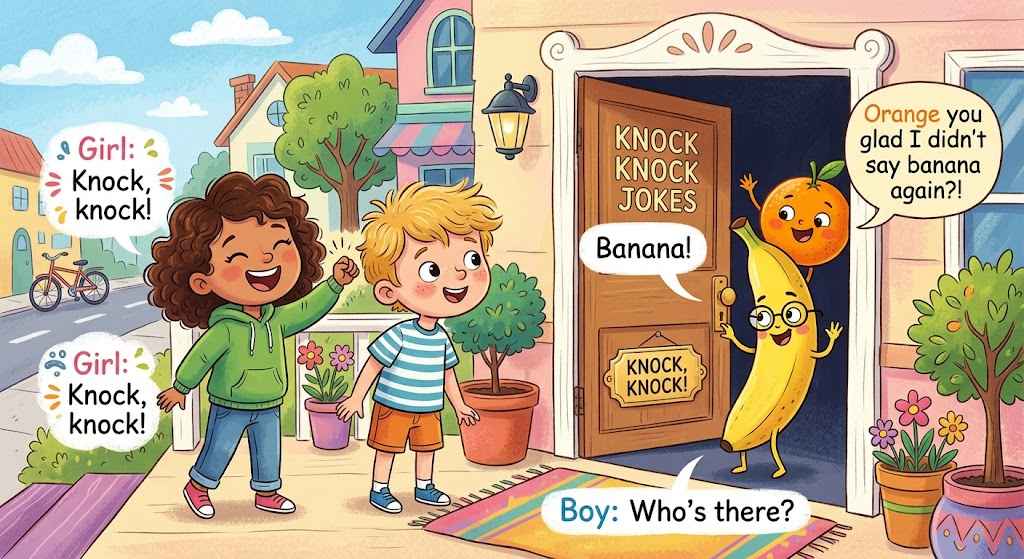
Quick Answer: Children understand knock knock jokes starting around ages 3 to 4, drawn to the predictable rhythm and turn-taking interaction. By ages 5 to 7, kids grasp the double meanings, homophones, and sound-alike puns. Telling knock knock jokes for kids helps build early literacy, phonological awareness, and social confidence through shared humor.
Knock-knock jokes are in a few things that bring a classroom full of children joy and expectant call-and-response. Whether the jokes are passed down on long family road trips, shared across noisy school cafeteria tables, or at bedtime, these jokes have maintained an amazing place in your childhood around all the generations. The main question is what makes this specific style of humor such a universal rite of passage?
The “knock knock” joke for kids may look simple and a part of silly child play; however, in reality, it represents a foundational milestone in things like speech, cognitive development, and social bonding. In small kids, learning such jokes is considered a first experience of storytelling and performance. The rigid and conversational rhythm “Knock, knock! / Who’s there? / …l” works like a training wheel and gives children a safe, predictable space to practice communication, inflection, and timing in all ways.
Additionally, telling funny knock-knock jokes also unlocks the mechanism of the English language. From these jokes children start to discover homophones, double meanings, and phonetic overlap, which means a small joke can turn into a playful, hands-on puzzle. In this article we will look at the top 100 knock-knock jokes for kids according to age and other activities too, so let’s start.
Why Are Knock Knock Jokes Funny for Kids?
To an adult joke like “lettuce in or banana,” who? can be affectionate eye rolls, but for young children these jokes promote a major intellectual breakthrough. Following are the reasons why children find kids’ knock-knock jokes so irresistible:
Predictable Structure: A child’s life is mostly based on routine, the rigid five steps: Knock, knock. Who’s there? [Name] / [Name] who? / [Punchline] provides a clear and safe framework for children where they know when it is their turn to speak up.
Mastery of Language (Puns & Homophones): Young brains actively learn vocabulary when a word such as “olive” sounds like “I live it” and breaks the linguistic rules in a silly and funny way.
Interactive Control: The traditional jokes are different from knock-knock jokes because the knock-knock jokes are based on conversation. This way kids get to see the interaction, prompt an adult, and know the ending.
Shared Social Joy: Knock-knock jokes are full of humor; they build bonds. When kids say a punchline, the teacher, parent, and classmates start laughing, which results in confidence and emotional support.
At What Age Do Children Understand These Jokes?
Understanding humor develops in distinct cognitive stages:
Ages 3–5 (Toddlers & Preschoolers): At this phase the young children love the rhythm and repetition instead of actual wordplay. They love to say “knock, knock” over and over again and also invent random punchlines such as “Banana, who?” and “Big red car!” just for fun and laughter.
Ages 6–7 (Early Elementary): When children enter 1st grade, they begin to understand basic phonological awareness, which is the ability to recognize words that are made of individual sounds. They begin to pick up on double meanings and words that sound like other words, e.g., “lettuce” / “let us.” The ages of 6 and 7 are considered a golden age for saying repetitive funny knock-knock jokes.
Ages 8–9 (Mid-Elementary): When kids go to 2 or 3 grades, their cognitive development develops to process complex puns, idioms, and double entendres. They know why the jokes are fun and how to make a good memory at the same time when shared with friends.
Ages 10+ (Older Kids & Tweens): Older kids love the humor, sarcasm, word manipulation, and cultural references, which means they enjoy all types of jokes, like modern and traditional.
100 Knock Knock Jokes for Kids (Categorized by Age & Theme)
Toddlers & Preschoolers (Ages 3–5)
Simple, repetitive sound-alikes, basic animal sounds, and gentle silliness.
| # | Setup | Response | Punchline |
|---|---|---|---|
| 1 | Knock, knock. | Who’s there? / Boo. / Boo who? | Don’t cry, it’s only a joke! |
| 2 | Knock, knock. | Who’s there? / Lettuce. / Lettuce who? | Lettuce in, it’s freezing out here! |
| 3 | Knock, knock. | Who’s there? / Cow says. / Cow says who? | No silly, a cow says MOO! |
| 4 | Knock, knock. | Who’s there? / Olive. / Olive who? | Olive you and I miss you! |
| 5 | Knock, knock. | Who’s there? / Interrupting cow. / Interrupting c— | MOO! |
| 6 | Knock, knock. | Who’s there? / Atch. / Atch who? | Bless you! Have a tissue! |
| 7 | Knock, knock. | Who’s there? / Donut. / Donut who? | Donut open until Christmas! |
| 8 | Knock, knock. | Who’s there? / Tank. / Tank who? | You’re welcome! |
| 9 | Knock, knock. | Who’s there? / Owls. / Owls who? | That’s right, owls hoo! |
| 10 | Knock, knock. | Who’s there? / Peanut. / Peanut who? | Peanut butter and jelly time! |
| 11 | Knock, knock. | Who’s there? / Teddy. / Teddy who? | Teddy bear is ready for bed! |
| 12 | Knock, knock. | Who’s there? / Ketchup. / Ketchup who? | Ketchup with me and I’ll tell you! |
| 13 | Knock, knock. | Who’s there? / Bee. / Bee who? | Bee happy today! |
| 14 | Knock, knock. | Who’s there? / Meow. / Meow who? | Meow is your chance to answer! |
| 15 | Knock, knock. | Who’s there? / Wood. / Wood who? | Wood you like to play with me? |
| 16 | Knock, knock. | Who’s there? / A duck. / A duck who? | Quack quack, open the door! |
| 17 | Knock, knock. | Who’s there? / Banana. / Banana who? | Knock knock! (Repeat… then: Orange you glad I didn’t say banana again?) |
| 18 | Knock, knock. | Who’s there? / Cereal. / Cereal who? | Cereal pleasure to meet you! |
| 19 | Knock, knock. | Who’s there? / Dino. / Dino who? | Dinosaur is coming, run! |
| 20 | Knock, knock. | Who’s there? / Ice cream. / Ice cream who? | Ice cream if you don’t let me in! |
| 21 | Knock, knock. | Who’s there? / A sheep. / A sheep who? | Baaaa-ck again! |
| 22 | Knock, knock. | Who’s there? / Bacon. / Bacon who? | Bacon a cake for your birthday! |
| 23 | Knock, knock. | Who’s there? / Silly. / Silly who? | Silly goose, it’s me! |
| 24 | Knock, knock. | Who’s there? / Gorilla. / Gorilla who? | Gorilla me a cheese sandwich, please! |
| 25 | Knock, knock. | Who’s there? / Pencil. / Pencil who? | Your pants are falling down! |
Section 2: Early Elementary (Ages 6–7)
Clear phonics puns, school-themed humor, name play, and familiar foods.
| # | Setup | Response | Punchline |
|---|---|---|---|
| 26 | Knock, knock. | Who’s there? / Anita. / Anita who? | Anita borrow a pencil for class! |
| 27 | Knock, knock. | Who’s there? / Justin. / Justin who? | Justin time for dinner! |
| 28 | Knock, knock. | Who’s there? / Harry. / Harry who? | Harry up and answer the door! |
| 29 | Knock, knock. | Who’s there? / Butter. / Butter who? | Butter let me in, it’s raining outside! |
| 30 | Knock, knock. | Who’s there? / Howard. / Howard who? | Howard you like to be my friend? |
| 31 | Knock, knock. | Who’s there? / Turnip. / Turnip who? | Turnip the volume, I love this song! |
| 32 | Knock, knock. | Who’s there? / Luke. / Luke who? | Luke through the keyhole and see! |
| 33 | Knock, knock. | Who’s there? / Mustard. / Mustard who? | Mustard-n’t forget to do your homework! |
| 34 | Knock, knock. | Who’s there? / Robin. / Robin who? | Robin you! Now hand over the cookies! |
| 35 | Knock, knock. | Who’s there? / Noah. / Noah who? | Noah good place to get pizza? |
| 36 | Knock, knock. | Who’s there? / Dwayne. / Dwayne who? | Dwayne the bathtub, I’m drowning! |
| 37 | Knock, knock. | Who’s there? / Art. / Art who? | Art you going to open the door? |
| 38 | Knock, knock. | Who’s there? / Annie. / Annie who? | Annie-body home in there? |
| 39 | Knock, knock. | Who’s there? / Candice. / Candice who? | Candice door open any faster? |
| 40 | Knock, knock. | Who’s there? / Disguise. / Disguise who? | Disguise is falling from the sky! |
| 41 | Knock, knock. | Who’s there? / Who. / Who who? | Are you sure you aren’t an owl? |
| 42 | Knock, knock. | Who’s there? / Broccoli. / Broccoli who? | Broccoli doesn’t have a last name! |
| 43 | Knock, knock. | Who’s there? / Canoe. / Canoe who? | Canoe come out and play with me? |
| 44 | Knock, knock. | Who’s there? / Interrupting sloth. / Interrupting slo— | (Wait 10 seconds silently) … squeeak! |
| 45 | Knock, knock. | Who’s there? / Ears. / Ears who? | Ears another funny joke for you! |
| 46 | Knock, knock. | Who’s there? / Wanda. / Wanda who? | Wanda go buy some ice cream? |
| 47 | Knock, knock. | Who’s there? / Adolf. / Adolf who? | A dolf-in swam right past me! |
| 48 | Knock, knock. | Who’s there? / A herd. / A herd who? | A herd you were coming, so I baked a pie! |
| 49 | Knock, knock. | Who’s there? / Geno. / Geno who? | Geno the secret passcode to get in? |
| 50 | Knock, knock. | Who’s there? / Alma. / Alma who? | Alma chocolate is gone! |
Section 3: Mid-Elementary (Ages 8–9)
Smart vocabulary, clever homophones, word inversion, and double meanings.
| # | Setup | Response | Punchline |
|---|---|---|---|
| 51 | Knock, knock. | Who’s there? / Europe. / Europe who? | No, YOU’RE a poo! |
| 52 | Knock, knock. | Who’s there? / Control Freak. / Control Fr— | Now you say, “Control Freak who?” |
| 53 | Knock, knock. | Who’s there? / Cash. / Cash who? | No thanks, I prefer peanuts! |
| 54 | Knock, knock. | Who’s there? / Spell. / Spell who? | W-H-O! |
| 55 | Knock, knock. | Who’s there? / Pecan. / Pecan who? | Pecan somebody your own size! |
| 56 | Knock, knock. | Who’s there? / Sherlock. / Sherlock who? | Sherlock the door tight at night! |
| 57 | Knock, knock. | Who’s there? / Isabel. / Isabel who? | Isabel working, or should I knock again? |
| 58 | Knock, knock. | Who’s there? / Police. / Police who? | Police hurry, it’s freezing out here! |
| 59 | Knock, knock. | Who’s there? / Doris. / Doris who? | Doris locked, that’s why I knocked! |
| 60 | Knock, knock. | Who’s there? / Hugo. / Hugo who? | Hugo your way and I’ll go mine. |
| 61 | Knock, knock. | Who’s there? / Ivana. / Ivana who? | Ivana hold your hand! |
| 62 | Knock, knock. | Who’s there? / Al. / Al who? | Al give you a clue if you let me in! |
| 63 | Knock, knock. | Who’s there? / Ben. / Ben who? | Ben knocking for 10 minutes straight! |
| 64 | Knock, knock. | Who’s there? / Irma. / Irma who? | Irma glad to see you today! |
| 65 | Knock, knock. | Who’s there? / Nacho. / Nacho who? | Nacho cheese, it’s mine! |
| 66 | Knock, knock. | Who’s there? / Claire. / Claire who? | Claire the way, I’m coming through! |
| 67 | Knock, knock. | Who’s there? / Alex. / Alex who? | Alex-plain everything when you open up! |
| 68 | Knock, knock. | Who’s there? / Abby. / Abby who? | Abby birthday to you! |
| 69 | Knock, knock. | Who’s there? / Gladys. / Gladys who? | Gladys weekend is finally here! |
| 70 | Knock, knock. | Who’s there? / Oman. / Oman who? | Oman, these jokes are getting silly! |
| 71 | Knock, knock. | Who’s there? / Wendy. / Wendy who? | Wendy wind blows, the trees dance. |
| 72 | Knock, knock. | Who’s there? / Otto. / Otto who? | Otto know better than to ask that! |
| 73 | Knock, knock. | Who’s there? / Xavier. / Xavier who? | Xavier money for a rainy day! |
| 74 | Knock, knock. | Who’s there? / Paige. / Paige who? | Paige 99 of your favorite book! |
| 75 | Knock, knock. | Who’s there? / Yael. / Yael who? | Yael at me if I don’t clean my room! |
Section 4: Older Kids & Tweens (Ages 10+)
Witty grammar puns, meta-humor, technology references, and clever twists.
| # | Setup | Response | Punchline |
|---|---|---|---|
| 76 | Knock, knock. | Who’s there? / To. / To who? | It’s “To WHOM,” actually. |
| 77 | Knock, knock. | Who’s there? / WiFi. / WiFi who? | WiFi not open the door and talk? |
| 78 | Knock, knock. | Who’s there? / I am. / I am who? | You don’t know who you are? |
| 79 | Knock, knock. | Who’s there? / Deja. / Deja who? | Knock, knock. (Repeat) |
| 80 | Knock, knock. | Who’s there? / Little old lady. / Little old lady who? | I didn’t know you could yodel! |
| 81 | Knock, knock. | Who’s there? / Howie. / Howie who? | Howie gonna clean this huge mess up? |
| 82 | Knock, knock. | Who’s there? / Justin Bieber. / Justin Bieber who? | See, I knew you weren’t a real fan! |
| 83 | Knock, knock. | Who’s there? / You. / You who? | Yoo-hoo! Over here! |
| 84 | Knock, knock. | Who’s there? / Water. / Water who? | Water you doing standing there? Open up! |
| 85 | Knock, knock. | Who’s there? / Kanga. / Kanga who? | No, it’s kangaroo! |
| 86 | Knock, knock. | Who’s there? / Don. / Don who? | Don get mad, it’s just a harmless joke! |
| 87 | Knock, knock. | Who’s there? / Manuel. / Manuel who? | Manuel be tired after reading all these! |
| 88 | Knock, knock. | Who’s there? / Albert. / Albert who? | Albert you can’t guess this punchline! |
| 89 | Knock, knock. | Who’s there? / Norma Lee. / Norma Lee who? | Normally I don’t knock on random doors! |
| 90 | Knock, knock. | Who’s there? / Barbara. / Barbara who? | Barbara shop needs a haircut! |
| 91 | Knock, knock. | Who’s there? / Phillip. / Phillip who? | Phillip my glass with lemonade, please! |
| 92 | Knock, knock. | Who’s there? / Thermos. / Thermos who? | Thermos be a better joke than this one! |
| 93 | Knock, knock. | Who’s there? / Les. / Les who? | Les go to the park and play! |
| 94 | Knock, knock. | Who’s there? / Hoby. / Hoby who? | Hoby see each other again real soon! |
| 95 | Knock, knock. | Who’s there? / A door. / A door who? | A-door-able, that’s what you are! |
| 96 | Knock, knock. | Who’s there? / Anita. / Anita who? | Anita nap after telling all 100 jokes. |
| 97 | Knock, knock. | Who’s there? / Clover. / Clover who? | Clover your eyes, I have a big surprise! |
| 98 | Knock, knock. | Who’s there? / Gator. / Gator who? | Gator coat on, it’s time to leave! |
| 99 | Knock, knock. | Who’s there? / Wire. / Wire who? | Wire you asking so many questions? |
| 100 | Knock, knock. | Who’s there? / Opportunity. / Opportunity who? | Opportunity only knocks once! |
Other Suitable Games and Activities for Kids
Knock knock jokes are funny and a great part of childhood play, but when paired with other activities, they can help build social skills, cognitive strength, and active play habits even more.
1. Verbal & Wordplay Games
Games like riddles and brain teasers work perfectly for kids who are 6 years or older; they help in lateral thinking and problem-solving. The name game where you pick a category like animal or fruit and go around in a circle naming items without repeating. Twenty Questions is a classic reasoning game that is perfect for long rides.
2. Physical & Group Play
Freeze dance is where the music is playing and kids are dancing, then suddenly you pause the music, and all kids freeze. It helps in self-regulation and gross motor skills. Charades for kids where they have to act like animals, sports, or movie characters without saying a single word, and everyone has to guess. Simon Says is also a perfect game because it focuses on listening skills, movement, and body awareness.
3. Creative & Quiet Activities
DIY joke book crafting, where mids write their favorite knock-knock jokes in a handmade booklet and illustrate each punchline. Puppet threats are also a good choice where kids use sock puppets or stuffed animals to make comedy performances with the help of jokes.
Conclusion
Laughter is the best tool for childhood development. Knock-knock jokes provide kids a playful, structured point to enter into the world of humor, language development, and social bonding. Whether you share a few funny knock-knock jokes on breakfast or practice the best knock-knock jokes in a long commute, these classic wordplays help in creating long-lasting memories and brighten any child’s day.
Frequently Asked Questions (FAQs) on Knock Knock Jokes for Kids
1. What are the benefits of knock-knock jokes for children?
Knock-knock jokes help kids in developing language skills, phonological awareness, and social confidence. The known rhythms will provide kids a framework to practice conversation, timing, and wordplay while creating bonds with friends and family.
2. At what age can kids start learning knock-knock jokes?
Children that are 3 years old can take part in knock-knock jokes. The main reason is toddlers love to enjoy something that they can repeat easily. The kids that are 5 to 7 years old start to understand the actual puns, sound-alikes, and double meanings.
3. How do knock-knock jokes improve reading and speech skills?
Knock-knock jokes are based on words that sound the same but have different meanings. When kids understand what lettuce is and let us know they sound the same, the vocabulary increases.
Child Development & Early Literacy (Official / Government Resources)
- U.S. Department of Education Literacy Guide
- National Institute of Child Health and Human Development (NICHD) Reading Panel Report
- American Speech-Language-Hearing Association (ASHA) Speech Milestones
- National Association for the Education of Young Children (NAEYC) Early Learning Resources
- CDC Child Development Milestones Guide
