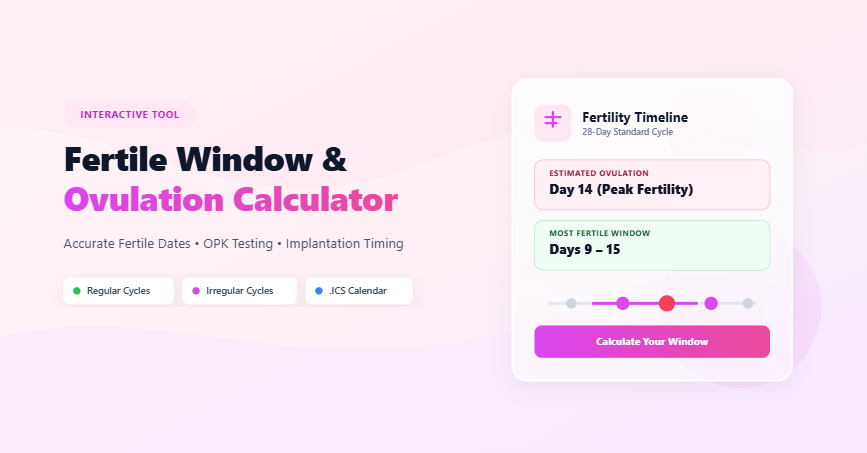
A fertile window calculator estimates the 6-day period during a menstrual cycle when pregnancy is possible, specifically the five days leading up to ovulation and the day of ovulation itself. Sperm can survive up to 5 days inside the female reproductive tract, making this 6-day timeframe peak fertility.
Calculate fertile dates, OPK testing milestones, and pregnancy test timing.
- Start LH/OPK Test Strips: –
- Expected Implantation Window: –
- Earliest Pregnancy Test (10 DPO): –
- Expected Next Period: –
How to Calculate Your Fertile Window
Nowadays people are using fertile window calculators, as they are the simplest way to pinpoint the date in your cycle when intercourse turns into pregnancy. To understand how the calculation works, look at two biological factors: sperm lifespan and egg viability.
While an egg can only last for 12 to 24 hours after getting out from the ovary, the sperm can live inside the female reproductive tract for 4 to 5 days. Because of this overlap, the fertility window can span 6 days each month, the 5 days leading up to ovulation plus ovulation day itself.
The Math Behind the Calculation
The standard fertile window calculator finds the fertility date by just calculating the average cycle length (e.g., 28 days) from the first day of your last menstrual period (LMP). To calculate your fertile window, count backward from the date of your next period by the length of your luteal phase. The fertile window takes place 5 days before your estimated ovulation day and ends 1 day after ovulation.
When are the peak fertility days?
While the fertile window only lasts for 6 days, not all the days carry the same likelihood of conception. According to clinical research, the peak fertile days are the two days that occur before ovulation and the day of ovulation itself. If you did intercourse during this time, the chances of conceiving are high.
| Tracking Method | Accuracy Level | When It Detects Ovulation | Best Used For |
|---|---|---|---|
| Calendar / Calculator |
Moderate Rough Estimate |
Predicts upcoming cycle based on historical averages. |
Baseline Schedule Getting a rough starting estimate for cycle timing. |
| OPK Urine Strips |
High Hormonal Surge |
24–36 hours before ovulation occurs. |
Pinpointing Surge Identifying the exact LH hormone peak in advance. |
| Cervical Mucus |
High Biomarker |
Days leading up to and including ovulation. |
Real-Time Window Identifying fertile days in real-time as they open. |
| Basal Body Temp (BBT) |
High Thermal Shift |
1–2 days after ovulation has taken place. |
Confirmation Confirming that ovulation officially occurred. |
How to Calculate Your Fertile Window with Irregular Cycles
If your menstrual cycles change from month to month, then the standard fixed-day fertile window calculator might miss your actual fertility dates. Cycles that take place in 21 or 35 days are considered normal, but when they fluctuate, for example, 26 days in one month and then 32 days the next month, then your ovulation date shifts along with it.
To find the estimated fertile window correctly with an irregular cycle, you need to depend on the shortest and longest cycle lengths over the last 6 to 3 months.
The Range-Based Calculation Method
Don't calculate a single day; you can establish a safe range by using the formula.
- Earliest Fertile Day: Take the shortest cycle length and subtract 18 days. Count this number of days forward from the first day of your last menstrual period.
- Latest Fertile Day: Your longest cycle length minus 11 days. Add this number of days to the first day of your last period.
Medical Review & Fact-Checking Standard This fertile window calculator and accompanying content are clinically reviewed by Dr. Sarah Jenkins, MD, FACOG, a board-certified obstetrician and gynecologist. Our fertility tools utilize standard clinical algorithms defined by the American College of Obstetricians and Gynecologists (ACOG) to estimate ovulation based on user-entered cycle parameters. Medical insights: Peer-reviewed research in reproductive endocrinology backs the medical insights. by peer-reviewed research in reproductive endocrinology.