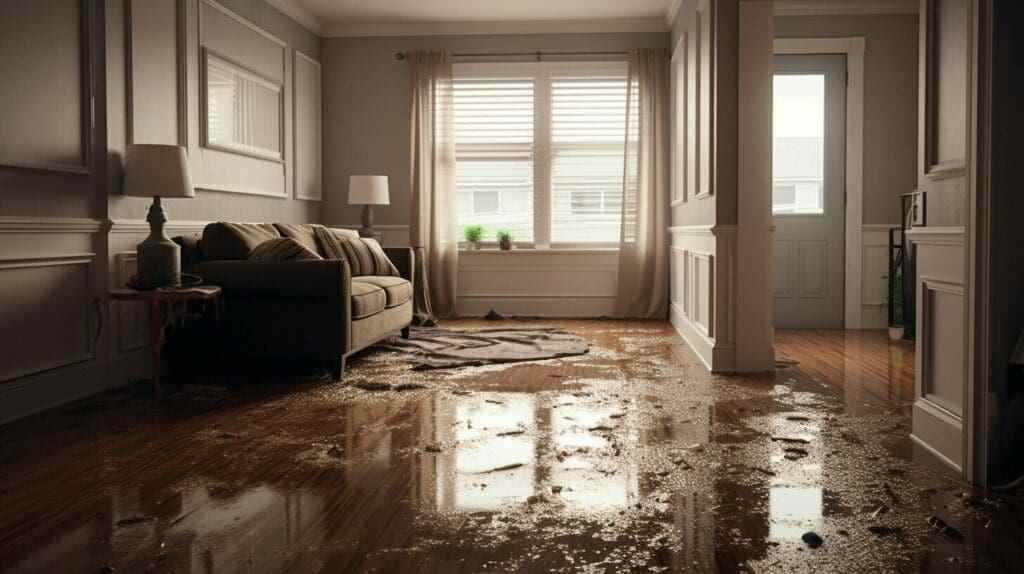
You find the water at nine at night. A supply line under the bathroom sink, a washing machine hose, and a slow roof leak that finally showed itself as a stain on the ceiling. The baby is asleep down the hall, and you’re standing in a wet hallway trying to work out what actually needs to happen right now versus what can wait until morning.
Most of what you’ll read about water damage is written for a homeowner with unlimited time and no one small in the house. Here’s the version organized by the clock, with the part that decides everything else handled first.
Hour one: kill the source, then kill the power
Shut off the water. If it’s a fixture, the local valve under the sink or behind the toilet is enough. If you can’t find it or it won’t turn, use the main shutoff for the house, which is usually near where the supply enters, in a basement, garage, or utility closet. Find that valve now if you don’t know where it is, because two in the morning is a bad time to learn.
Then deal with electricity before you deal with anything else. If water has reached outlets, is running down a wall with wiring in it, or has pooled anywhere near a panel or an extension cord, cut power to that area at the breaker. If reaching the panel means walking through standing water, stop and call an electrician or your utility. Nothing in the house is worth that.
Only then start moving things. Get anything absorbent up off the wet floor, because a rug that sits overnight in half an inch of water is usually finished.
Not all water is the same, and this decides everything else
This is the distinction almost no parent has heard, and it’s the single most useful thing in this article. The restoration industry sorts water into three categories, and which one you’re dealing with determines whether cleanup is a reasonable weekend project or something you shouldn’t be doing with a baby in the house.
Category 1 is clean water. A broken supply line, an overflowing tub, and rain through a window. It came from a sanitary source. Caught quickly, this is the one you can often handle.
Category 2 is grey water. Washing machine or dishwasher discharge, a toilet overflow with no solids, water from an aquarium. It carries contamination that can make people sick. Handle it with gloves, and don’t let a crawling child anywhere near the area until it’s been cleaned and dried.
Category 3 is black water. Sewage backups, a toilet overflow that came from beyond the trap, groundwater flooding, or any water that’s been sitting long enough to grow its own biology. This is not a DIY situation. With an infant in the home, that goes double.
Here’s the part that catches people. Category 1 water degrades. Clean water sitting in warm drywall and carpet for as little as a day or two can become category 2 on its own. The clock isn’t just about mold. It’s about the water itself getting worse.
Where the baby sleeps tonight
Move the crib out of any room that’s wet, shares a wall with wet drywall, or sits directly above or below the affected area. Water travels sideways through wall cavities and down through floors, so the visibly wet room isn’t always the whole story.
If the nursery is the wet room, relocate for the night rather than running a fan in there and hoping. Air movers are loud; they aerosolize whatever is in the material they’re drying, and a sleeping infant is the wrong audience for both. Set the baby up in the driest room in the house, keep the door closed, and deal with the wet area separately.
The 24- to 48-hour window
The EPA’s guide to mold and moisture is direct about the timeline: act within 24 to 48 hours of water damage to prevent mold growth. That window is the entire reason speed matters here. Mold doesn’t need a flood. It needs moisture, an organic surface like paper-faced drywall, and time, and a warm house supplies the rest.
This matters more with young children than it does for the adults in the house. Damp indoor environments are associated with respiratory symptoms, coughing, wheezing, and worsening asthma. Children breathe a larger volume of air relative to their body weight than adults do, so they take in a proportionally bigger dose of whatever is in that air. Their smaller airways also mean the same amount of irritation narrows them more.
So the goal for the first 24 hours isn’t cosmetic. Get the standing water out, get air moving, and get the materials dry before the window closes. Dehumidifiers do more useful work than fans alone, because pushing air across a wet surface without removing moisture from the room just relocates it.
Photograph it before you touch anything
Two minutes of documentation now saves an argument with an adjuster later. Get wide shots of each affected room, close shots of the source, the water line on the wall or baseboard, and anything damaged. Photograph the failed part itself, the burst hose or the cracked fitting, before you throw it away. Keep it in a bag if you can.
Write down the time you found it and the time you shut the water off. Save receipts for anything you buy, including a rented dehumidifier or a box of fans. Most policies cover sudden and accidental discharge but not long-term seepage, and your timeline is what separates the two.
What you can dry yourself with, and where the line is
Clean water, caught on the first day, on a hard surface or a small area of carpet you can pull up and dry from both sides, is usually within reach. Extract the water, run a dehumidifier, and keep checking the material for the next few days.
The EPA’s cleanup guidance puts a practical boundary on the other end: if the mold covers more than about 10 square feet, bring in someone who does this professionally. A few other lines are worth drawing for a household with a baby in it.
- Any category 2 or 3 water, regardless of the area involved.
- Water that got into wall cavities, under cabinets, or beneath a subfloor, where you can’t verify it’s dry.
- Anything still damp after three days of active drying, which means the moisture is coming from somewhere you haven’t found.
- A musty smell that persists after the visible water is gone.
- Any situation where you’d be sanding, scraping, or cutting mold-affected material in an occupied home, since that’s the step that puts spores into the air.
That last one is where professional mold remediation earns its cost. The point isn’t just removing the material. It’s containing the area, controlling airflow so spores don’t travel to the rest of the house, and verifying the cavity behind the wall is actually dry rather than looking dry.
The bottom line
Water off, power off, then find out what kind of water you’re dealing with, because that answer determines everything after it. Move the baby out of the wet room for the night instead of trying to dry around a sleeping infant. Photograph it before you clean it. And treat 24 to 48 hours as a real deadline rather than a guideline, because after that you’re no longer managing water, you’re managing what grew in it.
