
Quick answer: Does black hair exist? Yes, black hair is a distinct, natural hair color found in the majority of the global population. It is defined by high concentrations of eumelanin pigment within the hair shaft. While often confused with “very dark brown,” black hair is genetically and scientifically recognized as the world’s most common hair color.
If you ever look at someone’s hair that is black, you may be curious and think, Is it true black or just an incredibly deep shade of brown? You aren’t alone. The question of hair color that exists has become a persistent point of curiosity; sometimes it is also a topic of debate online.
It’s easy to argue about hair color, but the reality is based on biological processes, like the role of dense eumelanin pigments and how hairs look in light There is more to your natural hair color than meets the eye.
In this article we will remove the confusion by explaining why black hair is the global standard, not an exception. We will look at the genetics of hair pigmentation, answer the myth on rarity, and even help you calculate the hair color probabilities in your own family tree.
The Science of Black Hair: Beyond the Surface
To fully understand the philosophy of Black hair, we need to look past superficial color and how hair follicles look in a microscope. Black hair isn’t merely an absence of light, but it is biologically defined by pigment density.
Defining True Black: Eumelanin vs. Pheomelanin Concentrations
Hair color is defined by the ratio of two primary types of melanin, eumelanin and pheomelanin, produced by melanocytes in the hair follicle. Eumelanin is a pigment that is responsible for both brown and black hues. It has two forms: brown and black. Pheomelanin is responsible for red and yellow pigments.
True black only takes place when there is a high density of black eumelanin and there is no pheomelanin. Brown hairs also depend on eumelanin. It has a lower concentration of the pigment, and there is also an existence of pheomelanin, resulting in warm, lighter undertones.
In black hairs the pigment particles are so packed together tightly that they absorb all the visible light spectrum, leading to a deep, dark appearance.
| Feature | True Black Hair | Dark Brown Hair |
|---|---|---|
| Eumelanin Density | Maximum concentration | High, but not maximum |
| Appearance | Black in all lighting | Shows brown in bright light |
| Light Reflection | Cool (Blue/Violet) | Warm (Chocolate/Coffee) |
Optical Physics: Why black hair looks different under sunlight
When light hits the strand of hair, three things can happen: it may be absorbed, reflected, and refracted.
The physics of black hair is very unique because of its high pigment density. Because black hair has the highest volume of eumelanin, which has an ability to absorb incoming light. When you check the black hairs in low-light conditions, you may find they appear extremely black because all the light is trapped in the pigment-rich cortex.
However, if you look at the hairs in sunlight, they behave differently. Unlike lighter hair, which looks light in sunlight, black hair works as a sponge; it absorbs all the light spectrum and just reflects a small, intense amount off the cuticle, which makes that signature, healthy shine related to dark hair. If your hair is truly black, this sheen is neutral or cool.
If the hair is very dark brown in color, then you will see reddish-brown highlights when the hairs get the sunlight, which proves the light is penetrating deeply and reflects the undertones of lower-density pigments.
The Anatomy of a Strand: How the cuticle structure in black hair differs
The outermost layer of the hair shaft, known as the cuticle, acts like a protective scale-based covering. In black hair, the structure of the cuticle is more robust as compared to light hair colors. As we discussed earlier, the black hairs are highly packed with eumelanin, so a single hair tends to be thicker in diameter. To make room for this thickness, the cuticle features more overlapping layers, which leads to a higher level of protection against the UV rays, high heat, and environmental damage.
However, there is also a structure density turn-off, which means the hair is less porous. These tightly sealed cuticles make the black hair highly resistant against moisture loss and chemical attacks, so when a person tries to apply professional hair color that has a bleaching and dyeing process, it takes more time and effort to open the tightly sealed cuticles as compared to lighter hair. Understanding this structural integrity is important to maintain the health and shine of black hair.
Can You Be Born with Black Hair? (Infant Hair Science)
Many parents get surprised when they see the newborn arrives with full, thick, and jet-black hair, which changes significantly in the first year of life. To understand this phenomenon, we need to look at the delicate balance of infant biology and the change from prenatal development to the outside environment.
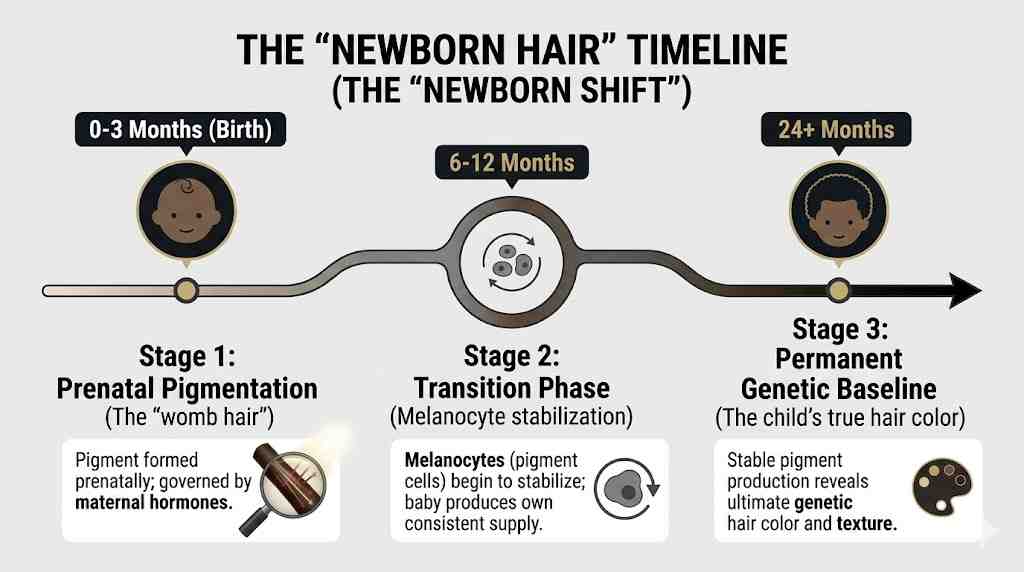
The Newborn Shift: Why some babies have black hair that lightens or changes texture
It is very common in infants to be born with dark hairs that later change into lighter shades. The main reason behind it is the stabilization of melanocytes.
During pregnancy, the fetus is in the hormonal environment of the mother, so the baby’s hair is shaped by the mother’s hormones; however, once the baby is born, their body switches from mother-hormone dependency to their own hormones. It tells the hair follicles to grow up. When the baby starts making its own pigment, the hairs that the baby was born with start falling out. The new hair growth is completely based on the baby’s own unique genetics. This is the reason why the color and texture of baby hair change after the first hair shed as compared to the hairs they were born with.
Genetic Markers: Understanding the MC1R and ASIP genes at birth
While the MC1R (Melanocortin 1 Receptor) gene is quite famous for its major role in red hair, it also works as the primary switch for all human pigmentation. When a baby is born, their hair color is guided by two main instruction manuals in the DNA. One is the MC1R gene, and the second is the ASIP gene. They work together to decide how much eumelanin the hair will have. To understand more about it, let’s look at both genes in detail.
MC1R (The Switch): This gene acts as an alert switch that tells the hair follicle it needs to make dark pigment (eumelanin) or light/red pigment (pheomelanin). If this switch gets turned on strongly at birth, the follicle will produce more dark pigment, resulting in overall black hairs.
ASIP (The Timer): This gene acts as a timer; it tells the body when to produce these pigments and when they need to stop. If the ASIP tells the hair to start the production style early, then you may see the hairs start with one dark color and then shift to a lighter shade when the baby grows up.
Why Does Hair Color Change?
The main reason behind this is the baby adopts a mix of these genetic instructions from both parents; the hair color they are born with is temporary.
The hair many parents see is just the starting point in infants. The follicles need 12 to 24 months to finish their transition and settle down; the production routine leads to a permanent hair color in a baby.
Ethnicity and Baseline Pigmentation: Why black hair is the default for the majority
If we speak according to biology, black hair isn’t just a style; it is the human standard. High levels of dark pigment known as eumelanin are found in many species’ hairs from generation to generation; it serves an important evolutionary job.
In the areas that are located near the equator, where the sun’s UV rays are very strong, black hair is universal.
Over time humans migrate from this place to other regions where the sunlight is less intense, so genetic changes take place, and people are born with lighter hair colors like blonde, brown, and red to emerge. However, the black hairs remain the most common yet efficient pigment on earth; you can think of it as a baseline for the majority of human populations.
Is Black Hair Rare? A Global Demographic Analysis
This is a misconception that black hair is rare, often taking place in the Western region, where people see blonde or lighter-brown aesthetics every single day. In reality, black hair is the global standard that represents the successful evolutionary adaptation for human pigmentation.
| Region | Predominant Color | Genetic/Adaptive Factors | Evolutionary Driver |
|---|---|---|---|
| East Asia | Black | High MC1R prevalence | EDAR Gene Adaptation |
| Africa | Black | Maximum UV protection | Sun Radiation Shielding |
| South Asia | Black to Dark Brown | High eumelanin synthesis | High-Density Pigmentation |
| Middle East | Black to Dark Brown | High eumelanin synthesis | Climate Adaptation |
| Southern Europe | Dark Brown to Black | Mediterranean variants | Ancestral Migration |
| Indigenous Americas | Black | Ancient Asian genetics | Migration Patterns |
Population Statistics: Breaking down the 75–85% prevalence
Black hair isn’t just a common color; it is found in every part of the earth, accounting for approximately 75% to 85% of the global human population.
The next most common colour is brown, at 11%, and natural blonde or red hair is even less in the world’s genetic profile. This isn’t something we call a coincidence; in fact, it is the proof of why dark, dense pigment is necessary for survival because it acts as the most effective natural shield against the sun’s harsh UV rays.
Regional Distribution: Jet Black vs. Soft Black
While black hair is broadly common, there are also different types of it based on ancestry and environmental adaptation.
Jet Black (The Raven Spectrum): This type of black hair is very common in East Asia, Southeast Asia, and different parts of the Indian subcontinent. This shade takes place because of the high concentration of eumelanin, and it appears as violet under intense light. These thicker and straight jet-black hairs can be easily found in the EDAR gene, common in East Asian populations.
Soft Black (The Natural Spectrum): This type of black hair is commonly found in Africa, the Middle East, and in Indigenous populations in the Americas. Soft black hair features a more neutral or slightly warm undertone. We can call this shade a human baseline, as it is a result of high-density pigments, which are natural and provide a slightly matte sheen as compared to reflective jet variants.
Debunking the Rarity Myth: Why perception is skewed
In many western countries there is a majority of advertisements and movies where people’s hair is in lighter colors, over 80% of marketing, even when this criterion doesn’t match the actual people who live in the neighborhood. It’s very common when you see lighter hairs in the media around you; it feels like black is rare in the area or even in the world.
Why Dark Brown Gets Misidentified
- The confusion gets worse by how we label hair colors. Many people with dark brown hair have been told by others they have black hairs.
- When people see someone else’s black hair look reddish-brown in the sunlight, they think their hair colour is not black at all; it may be a dark brown.
- Because people see so many individuals don’t have black hair, they assume black is maybe rare, but in reality, true black is common. People just confuse it with lack of pigment density, which is dark brown, with the actual high-density pigment that creates true black hair.
Globally, black hairs are so common; if you ever get a chance to visit Asian countries, you will rarely see any other colour because every next person has black hair naturally.
The Black Hair vs. Dark Brown Hair Diagnostic Table
| Feature | True Black Hair | Dark Brown Hair | Scientific Metric |
|---|---|---|---|
| Eumelanin Density | Maximum | High, but not maximum | 9/10 – 10/10 |
| Undertone | Cool (Blue/Violet) | Warm (Chocolate/Coffee) | Light Refraction |
| Appearance | Black in all lighting | Shows brown in bright light | Absorption Level |
Identifying Your Undertones: Is Your Hair True Black?
To identify whether your hair is black or just an exceptionally dark shade of brown, it is like a microscopic game of light and color. A hair may look solidly dark indoors, but its actual nature hides in the undertones. By seeing how your hair reacts in bright light, you can easily understand the difference between a dark, deep brown and a true black hair color. If you have a warm black spectrum, your hair will shift from black to a warm, dark cocoa color in the sun. If your hair has the cool-black spectrum, then the hair color will shift from black to almost blue, silver, or ink-like.
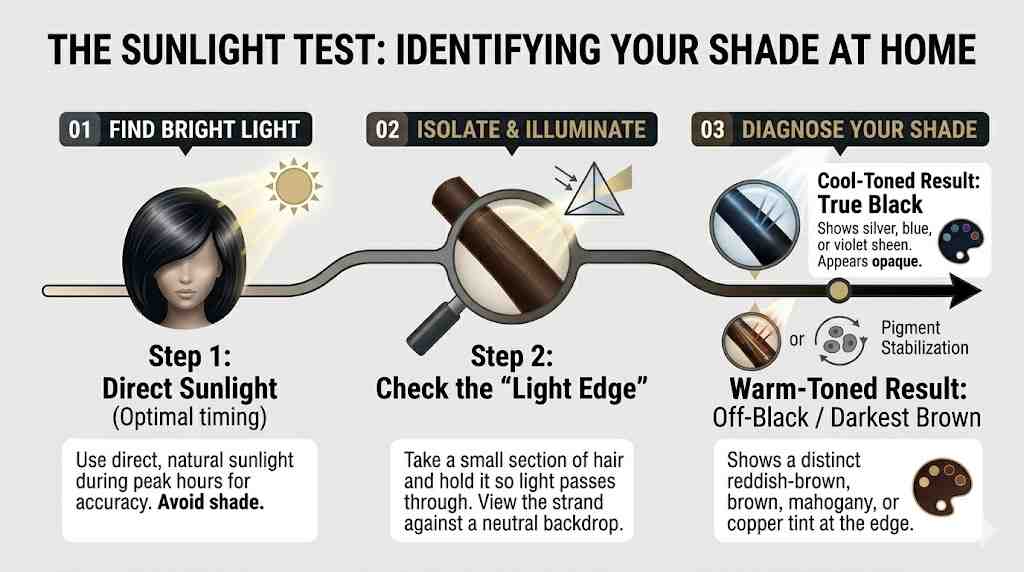
The Sunlight Test: How to correctly identify your shade at home
To clear the confusion of natural hair color, you can easily perform a sunlight test at home.
Step 1: Find Direct Natural Light
Step outside during the peak hours when the daylight is highly intense and the sun is brighter. Avoid early or evening hours because the natural shift of sunlight can distort your results.
Step 2: Isolate a Single Section
Once you go out in sunlight, the next step you need to do is take a small, three-inch section of your hair and let the sunlight touch it completely so the rays can pass through the edges of the strands instead of just showing at the surface.
Step 3: Check the Translucent Edge.
Look closely at the tips and the outer edges of the hair section you hold under sunlight. If you see edges are showing a reddish-brown or dark amber tint, then your hair is classified under the darkest brown or warm black category. If the edges remain dark or show a neutral silver-blue sheen with no brown or red hint, then you have true cool-black hairs.
Practical Care for Black Hair
Since black hairs are thicker in texture and fully packed with more pigment, they are naturally strong but want extra care to stay shiny and healthy. Here is how to manage its unique needs:
1. Mastering Moisture
Due to the high pigment density and flatter shape, it makes it hard for scalps’ natural oil to run from roots to ends. Because the outer layers of hair are so tightly holding the pigment, it is difficult for moisture to get into the strand. For this problem, you need to keep hair deeply hydrated; use oil-based conditioners or leave-in oil or serum treatments. They work as a seal to smooth the outer layer and keep the moisture inside, and hairs won’t be frizzy or dry.
2. Managing Sun Exposure
While we discussed earlier that black hair works as a shield against UV rays, it is also sensitive to them. Melanin is best for absorbing UV rays and protecting the scalp from them, but this same absorption turns your hair into a heat sink.
When your hair absorbs sunlight at an extreme level, it can cause oxidation, meaning it forms a chemical stress where the sun bleaches or even breaks down the pigment with time. This can be a reason hairs that are actually black at the start of extreme heat in summer end up as reddish-brown by the end of the season.
To save your hair, you can use UV-filtering hair sprays or wear hats so the direct heat of the sun won’t affect the hairs.
Product Avoidance Guide for Black Hair
| Product Type | Why to Avoid | Recommended Alternative |
|---|---|---|
| “Golden” or “Warm” Glosses | These deposit red, gold, or copper pigments that clash with black hair’s cool undertones, leading to a “muddy” appearance. | Use “Clear” or “Cool-toned” glossing agents. |
| High-Ammonia Lighteners | These can drastically alter the pigment structure and weaken the cuticle, causing long-term structural damage. | Use non-oxidative, semi-permanent color-depositing conditioners. |
| Harsh Sulfate Shampoos | Sulfates strip the natural sebum that black hair (which is often coarse/thick) relies on for moisture retention. | Use sulfate-free, moisture-focused shampoos. |
| Alcohol-Based Styling Gels | These dry out the hair shaft rapidly, leading to brittleness and breakage in dense hair types. | Use oil-based styling creams or natural aloe-based gels. |
Common Misconceptions in Hair Products: Why dark brown products often fail
Many commercial hair products like color-depositing shampoos or glosses are formulated for dark brown hair because these products have a high level of pigments (red or gold) made to change darker hair to brown hair, which leads to a vibrant look instead of a dull one. When you use such products on black hair, these pigments clash with natural undertones, leading to off-color, giving you a look that doesn’t change the color to brown but a less natural black.
If you have true black hair, you need to use products that are labeled as cool-toned or clear glossing agents; these products will improve the shine without the addition of artificial warmth found in standard dark-brown product lines.
Also Read: The Ultimate 2026 Guide: Middle Aged Woman Low Maintenance Choppy Shaggy Shoulder Length Hair
Personalized Hair Color Match” Quiz
Conclusion: Why Black Is the Most Complex Color
People underestimate black hair and consider it a simple and default color; however, in reality, it is the most complex and biologically significant color in human evolution. It can be a result of genetic engineering and represent the correct balance of maximum photoprotection and structural density. Black comes in two different types, from cool-toned ink shades to soft, warm black. Every color is found among the majority of the population on earth. Whether your hair is jet black or holds subtle mahogany undertones, you are wearing the most robust, protective, and historically resilient hair color on the planet.
Frequently Ask Questions By People on Black hairs
1. Does black hair exist naturally?
Yes, it is a very common hair color found in 75–85% of the human population in the world.
2. Is black hair the same as dark brown?
No, they aren’t the same because black hairs have a higher density of eumelanin and fewer reddish undertones, like dark brown hair.
3. What determines if hair is black?
It is determined by the presence of high eumelanin pigment in the hair cortex.
4. Is black hair rare?
No, it is very common, and you can find many people have it globally.
5. Why do people think black hair is rare?
In Western countries, models in advertisements and in media have different types of hair colors, so people of the country think it’s rare because they don’t see people with black hair daily.
6. Can two non-black-haired parents have a child with black hair?
Yes, if both parents have genetically high-density eumelanin production.
7. Why is my baby’s hair black but turning brown?
This is a shift every newborn faces where the hormones change from maternal to the baby’s own.
8. Does black hair always stay black?
No, the pigment density can change with aging, hormonal changes, or sun exposure. If the hairs always stay black, then how old are people who have white hairs?
9. Which genes control black hair?
Two genes that control black hairs are MC1R and ASIP genes.
10. Why does black hair look blue in the sun?
People who have high-density black hair absorb all the light and reflect the blue/violet color in sunlight.
11. What is the difference between warm-black and cool-black?
Warm black has traces of pheomelanin that are red and gold, whereas cold black is eumelanin, full black.
12. Does black hair absorb more heat?
Yes, they absorb more heat because they protect the scalp from sunlight.
13. How does light interact with black hair?
The light is absorbed by the cortex, and only a small portion reflects the cuticle.
14. Is black hair thicker than other colors?
Yes, due to the existence of high melanin density.
15. Does black hair get damaged easily?
While they’re physically strong because of a thicker cuticle, they can also be damaged if you don’t take care of them properly.
16. Why does black hair turn reddish in the sun?
Extreme heat absorption in hairs can cause deep pigments to fade with time.
17. Should I use dark brown hair products on black hair?
No, because these products are completely designed for dark brown hair.
18. How do I maintain the shine of black hair?
Avoid products that are made for dark brown hair; use clear glossing agents and moisturizing oils.
19. Does black hair turn gray differently?
The contrast between black pigment and the lack of pigment (white) makes greying appear more dramatic.
20. Is jet black hair artificially dyed?
Not always, because many people in the world have jet-black hair naturally.
21. Is black hair boring?
No, they aren’t boring; in fact, they are very attractive.
22. Are all black-haired people from the same region?
Black hair is not found in every part and region of the world.
23. Can black hair be fine or thin?
Yes, black hairs are often coarse; hair diameter is independent of pigment density.
24. Is black hair stronger than blonde hair?
Yes, because the increased melanin provides more resilience to the cuticle.
25. Why do some people with black hair have wavy patterns?
There is no role of hair color in it; the wavy texture is defined by the shape of the follicle (round vs. oval).
26. Does stress affect black hair color?
Yes, extreme stress causes hair fall; however, it never changes the pigment density of new hair growth.
